Quick Answer: Data centre tiers are a standardised classification system developed by the Uptime Institute to rate a facility's reliability, redundancy, and availability. There are four tiers: Tier 1 provides basic capacity with no redundancy, Tier 2 adds some redundant components, Tier 3 supports maintenance without shutting down operations, and Tier 4 is fully fault tolerant with no single points of failure. For most enterprise workloads, Tier 3 is the practical minimum, but the label alone means little without independent certification to back it up.
Key Takeaways
- Data centre tiers range from 1 to 4, with each level adding more redundancy, more uptime, and greater fault tolerance than the one below it.
- Tier 1 facilities can see up to 28.8 hours of downtime per year. At the Tier 4 end of the scale, that ceiling drops to approximately 26 minutes annually.
- A provider claiming to be "Tier III equivalent" is not the same as holding formal Uptime Institute Tier III Certification. There are three distinct certification stages, and buyers should know which ones a provider holds.
- Compliance frameworks like SOC 2, PCI DSS, and HIPAA do not mandate a specific tier directly, but Tier 3 is generally the right fit for enterprise production workloads when paired with appropriate operational controls.
- Qu Data Centres operates four Uptime Institute Tier III certified facilities across Canada, with 17 MW of live, deployable capacity available now. Find the right location for your workload.
Tier labels appear in nearly every data centre sales sheet, RFP template, and procurement conversation in the industry. Providers lead with them. Compliance teams ask about them. But between marketing and actual specs, buyers walk away from those conversations vague on the details more often than not.
The confusion is understandable. Data centre tier classification sits at an awkward intersection of engineering, marketing, and regulatory language, and not everyone using the terminology is using it the same way. A provider saying "Tier III" and a provider saying "Tier III equivalent" are making very different claims and it’s important for businesses to know why.
The four-tier system was designed to give buyers a standardised way to compare facilities on the dimensions that matter most: uptime, redundancy, and the ability to service infrastructure without interrupting operations. Getting this decision right matters, because it has downstream consequences for compliance, cost, and business continuity that can take years to reverse.
What Are Data Centre Tiers?
The tier system gives buyers a shared language for evaluating data centre reliability. Rather than comparing raw uptime SLAs from different providers, which are often phrased inconsistently, tiers describe the underlying infrastructure that makes a certain level of availability possible or impossible in the first place.
Each tier is defined by specific architectural requirements: how many paths exist for power and cooling, whether redundant components are in place, and whether the facility can be serviced without taking systems offline.
The higher the tier, the more resilient the design and the less exposure there is to unplanned downtime. Getting a clear picture of what each tier requires, and who actually verifies those requirements, is where the real buying decision begins.
Who Defines and Certifies the Tier System
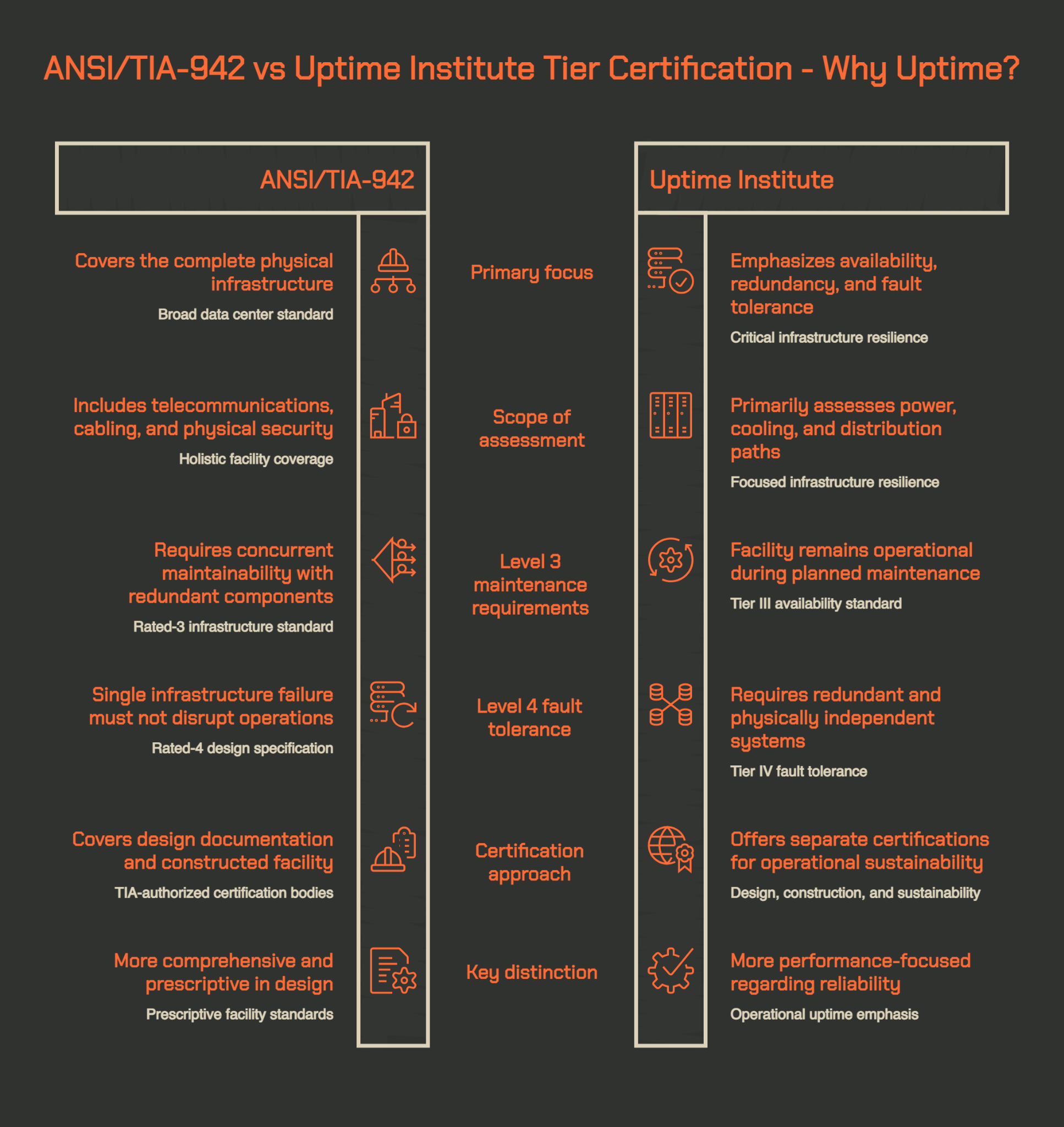
The tier system was developed and is maintained by the Uptime Institute, the only organisation authorised to issue official Tier Certifications. With over 4,300 awards issued across 120 countries, Uptime Institute certification has become the global benchmark for evaluating a facility's design, construction, and ongoing operations.
A parallel standard exists as well. The ANSI/TIA-942 framework uses a similar four-tier structure, described as "Rated" rather than "Certified," and is assessed by third-party auditors rather than a single certifying body.
For Canadian enterprise buyers, Uptime Institute Tier Certification is the more broadly recognised of the two and the standard most likely to appear in compliance documentation, insurance requirements, and procurement reviews.
What a Tier Rating Covers
A tier rating specifically evaluates a facility's power and cooling infrastructure, redundancy architecture, and distribution paths. It does not evaluate cybersecurity practices, network performance, physical access controls beyond basic structural requirements, or the quality of the operations team managing the facility day to day.
This matters when choosing a data centre in Canada. A Tier III certified facility can still have poor incident response procedures or weak monitoring. The tier tells you the infrastructure was built to a specific standard. Certifications like SOC 2 and ISO 27001 fill the operational and security gaps that tier ratings do not cover.
Breaking Down Tier 1, 2, 3, and 4
The four tiers are cumulative. Each level includes everything in the tiers below it, plus additional infrastructure requirements. What changes most meaningfully across the tiers is not just the uptime number, but the architecture behind it. Higher tiers require more physical infrastructure, more capital investment, and more complex operational procedures. Here’s what you need to know.
Tier 1 – Basic Capacity
A Tier 1 data centre provides a single distribution path for power and cooling with no redundant components. If any element along that path fails or if scheduled maintenance requires it to be taken offline, the entire facility goes down with it. Planned outages are a routine operational reality, not an edge case.
Expected uptime for a Tier 1 facility is 99.671%, which translates to up to 28.8 hours of potential downtime per year. For small internal workloads where continuity is not a priority, this may be workable. For anything customer-facing or compliance-sensitive, it is not a viable option.
Tier 2 – Redundant Capacity
A Tier 2 data centre introduces some redundant components, primarily in power and cooling, but still relies on a single distribution path. If a component fails, an operator can switch to the backup manually, but scheduled maintenance still typically requires a site shutdown because there is only one path carrying the load at any given time.
Expected uptime at this level is 99.741%, corresponding to up to 22 hours of annual downtime. A tier 2 data centre fits small and mid-sized businesses that need more reliability than a basic facility offers, but where the cost of higher-tier infrastructure is not yet justified by workload criticality.
Tier 3 – Concurrently Maintainable
This is where the architecture changes significantly. A Tier 3 data centre has multiple independent paths for power and cooling, and all components can be removed or replaced without interrupting operations.
The Uptime Institute calls this "concurrent maintainability." Engineers can service infrastructure during business hours without scheduling a window that takes systems offline.
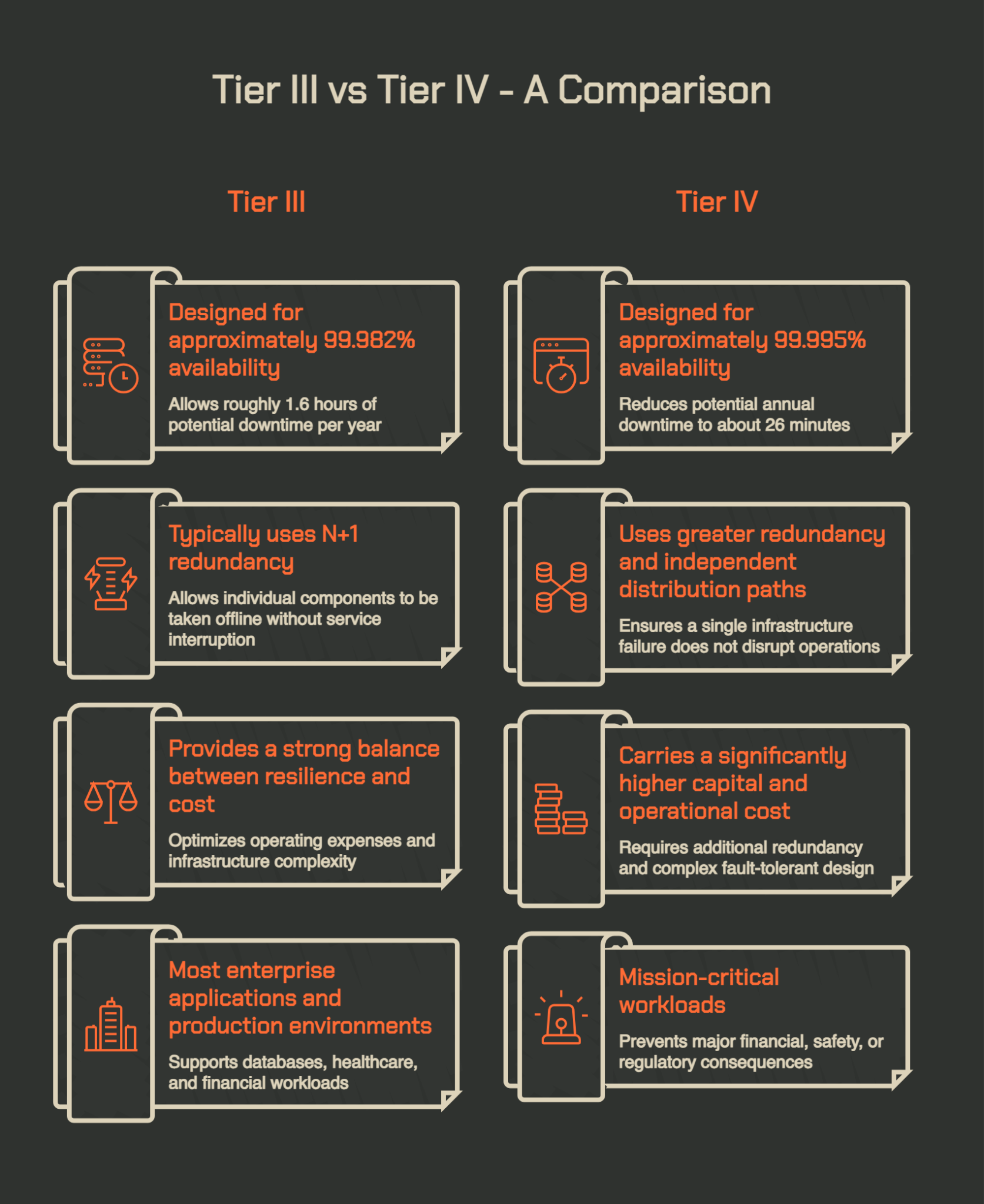
Tier III data centre requirements include N+1 redundancy, meaning at least one additional component exists for every component actively carrying load. Expected uptime is 99.982%, limiting annual downtime to approximately 1.6 hours. Tier 3 is the practical minimum most enterprise IT leaders should require for any production workload, and it is the most common tier found in commercial colocation facilities today.
Tier 4 – Fault Tolerant
A Tier 4 data centre adds a full second, independent system to everything in Tier 3. Rather than N+1 redundancy, the requirement is 2N: two complete, independent power and cooling systems, each capable of carrying the full load on its own. If one entire system fails, operations continue on the second with no interruption.
Expected uptime is 99.995%, capping annual downtime at approximately 26 minutes. This sounds overkill but it really isn’t.
What is a Tier 4 data centre built for? Workloads where any single failure, regardless of duration, creates consequences a business cannot absorb, including financial trading platforms, real-time clinical systems, and national critical infrastructure. Construction costs can exceed $500 million, which is why access to this tier almost always comes through colocation solutions rather than private facility ownership.
|
Tier
|
Classification
|
Uptime
|
Max Annual Downtime
|
Redundancy
|
Concurrent Maintenance
|
|
Tier 1
|
Basic Capacity
|
99.671%
|
28.8 hours
|
None
|
No
|
|
Tier 2
|
Redundant Capacity
|
99.741%
|
22 hours
|
Partial (single path)
|
No
|
|
Tier 3
|
Concurrently Maintainable
|
99.982%
|
1.6 hours
|
N+1 (multiple paths)
|
Yes
|
|
Tier 4
|
Fault Tolerant
|
99.995%
|
~26 minutes
|
2N (fully isolated)
|
Yes
|
Certified Vs. Self-Rated: The Difference in Marketing Lingo
This is the point most buying conversations skip entirely, and it is also where the most risk gets introduced. A provider claiming to be "Tier III" and a provider holding a formal Uptime Institute Tier III Certification are not the same thing. The language used in a sales sheet can signal the difference if you know what to look for.
The Uptime Institute is the only organisation that issues Tier Certification. No other body, internal review, or self-assessment carries the same weight. When a provider lacks formal certification, they will often use softened language in their marketing: "Tier III equivalent," "built to Tier III standards," or "designed to Tier III specifications." Each of those phrases is a self-assessment with no third-party verification behind it.
The Three Stages of Uptime Institute Certification
The Uptime Institute issues certification at three distinct stages, and a buyer asking "are you Tier III certified?" without specifying which stage may be getting an incomplete answer. The three stages are:
- Tier Certification of Design Documents (TCDD): Certifies that the architectural design meets tier requirements before construction begins. This verifies the paperwork, not a physical building.
- Tier Certification of Constructed Facility (TCCF): Certifies that the completed, physical facility was built in accordance with the certified design and meets all tier requirements as built. This stage requires on-site inspection by Uptime Institute engineers.
- Tier Certification of Operational Sustainability (TCOS): Certifies that the facility is managed in a way that sustains the certified tier over time through staffing, procedures, and operational practices.
A facility holding only TCDD has certified its design intent, not its physical infrastructure. TCCF confirms the building itself. TCOS confirms the operation of that building over time. When evaluating a provider, ask specifically which stages they hold, because the answer changes what you are actually buying.
What "Tier III Equivalent" Really Means in a Data Sheet
The phrase "Tier III equivalent" is common in provider marketing, and its meaning is straightforward: the provider believes their facility operates at a level consistent with Tier III requirements based on their own internal assessment. No external body has verified this claim.
That does not mean every self-assessed facility is unreliable. Many well-run facilities operate to high standards without pursuing formal certification. They simply may not want to take on the responsibility of a third-party audit or the costs associated with it. This does mean the burden of verification shifts entirely to the buyer.
For regulated workloads or businesses where disaster recovery commitments carry contractual or regulatory weight, that shift in burden is worth taking seriously before signing a multi-year infrastructure agreement.
How Tier Selection Affects Compliance and Downtime Cost
Tier selection is not purely a technical decision. It has direct implications for regulatory compliance posture and for the financial exposure a business carries when infrastructure falls short. These two angles tend to be treated separately in most conversations, but for an enterprise IT leader they are closely linked.
What SOC 2, PCI DSS, and HIPAA Say About Data Centre Tiers
This is one of the most frequently mischaracterised areas in data centre procurement. Major compliance frameworks, including SOC 2, PCI DSS, and HIPAA, do not directly mandate a specific data centre tier. What they mandate are operational and physical controls that closely align with what Tier 3 infrastructure provides when paired with the right procedures and certifications.
To be specific:
- SOC 2: Evaluates availability, security, processing integrity, confidentiality, and privacy controls. Tier 3 facilities, combined with appropriate operational controls, are sufficient for SOC 2 Type II attestation. The certification is about how the facility is run, not which tier number appears on its datasheet.
- PCI DSS: Requires physical and environmental controls to protect cardholder data. Tier 3 infrastructure meets the physical requirements. The standard does not reference Uptime Institute tier classifications.
- HIPAA: Mandates physical safeguards for Protected Health Information, including access controls and contingency planning. A well-operated Tier 3 facility satisfies HIPAA physical requirements. Healthcare systems with real-time clinical dependencies may prefer Tier 4, but HIPAA does not require it.
For Canadian organisations, OSFI Guideline B-13 places significant weight on resilience, recovery, and third-party risk management for federally regulated financial institutions. B-13 does not reference tier classifications, but selecting a formally certified Tier 3 or Tier 4 facility over a self-rated alternative strengthens the documentation trail that B-13 audits typically require.
The Downtime Math Every IT Leader Should Run
The tier conversation becomes a financial conversation when you apply real numbers to it. According to ITIC's 2024 Hourly Cost of Downtime Survey, 97% of large enterprises report that a single hour of downtime costs their company more than $100,000. A further 41% put that figure between $1 million and $5 million per hour.
Apply those numbers to the tier framework. A Tier 1 facility allows up to 28.8 hours of annual downtime. At even the lower end of the ITIC data, that exposure equals $2.88 million per year in potential losses before factoring in regulatory penalties, remediation costs, or reputational damage. The cost difference between hosting in a Tier 2 facility versus a Tier 3 facility is typically far smaller than the cost of a single unplanned outage at enterprise scale. The tier upgrade tends to pay for itself well before the first serious incident.
Tier 3 Vs. Tier 4: How Enterprise Buyers Should Make the Call
For any enterprise organisation with real production workloads, Tiers 1 and 2 are generally off the table before the conversation even starts. The practical decision for most CIOs and infrastructure leads is whether Tier 3 is sufficient or whether the use case genuinely warrants the additional cost and complexity of Tier 4.
When Tier 3 Is the Right Infrastructure Fit
The large majority of enterprise production workloads belong in a Tier 3 facility. The 99.982% uptime ceiling and approximately 1.6 hours of potential annual downtime satisfy the compliance requirements of SOC 2, PCI DSS, HIPAA, and most government SLAs. Concurrent maintainability means planned maintenance does not require downtime, and N+1 redundancy means a single component failure does not cascade into a service interruption.
Tier 3 is a strong fit for:
- Enterprise applications and databases where SLAs call for 99.9% or better availability
- Healthcare and financial services workloads where compliance frameworks are satisfied with appropriate operational controls in place
- AI and high-density computing deployments that require predictable power and cooling infrastructure without the full fault tolerance premium
- Multi-site disaster recovery architectures where resilience is distributed across facilities rather than concentrated in a single location
When Tier 4 Justifies the Cost Premium
Tier 4 is built for situations where no failure, regardless of how brief, is acceptable. This is not a preference; it is an operational constraint driven by legal, financial, or safety consequences tied directly to any service interruption. The organisations that genuinely need it typically already know before they start evaluating facilities.
Use cases where Tier 4 is genuinely warranted include:
- Financial trading infrastructure where seconds of downtime translate to direct monetary loss and regulatory exposure
- Real-time clinical systems where any service interruption has direct patient safety implications
- Payment processors and exchange operators with contractual uptime guarantees where breach penalties exceed the Tier 4 cost premium
- National critical infrastructure where government regulators require maximum fault tolerance by contract or statute
One important note: many large cloud providers achieve Tier 4-equivalent resilience not by building a single Tier 4 facility, but by distributing workloads across multiple Tier 3 facilities in separate availability zones. For most enterprises, a well-designed multi-site colocation strategy built on Tier 3 infrastructure can achieve comparable resilience at a significantly lower cost point.
Why Qu Data Centres Meets the Enterprise Infrastructure Standard
Selecting a data centre provider is not simply a question of which tier appears on their marketing materials. It is a question of which tier has been independently verified, which certifications back up the compliance claims, and whether the infrastructure will remain Canadian-owned and operated when your data sovereignty obligations are audited.
Qu Data Centres operates four Uptime Institute Tier III certified facilities across its national portfolio of nine Canadian locations, spanning Ottawa, Edmonton, Calgary, Toronto, and London, Ontario. The certification is independently verified by the Uptime Institute, not self-assessed. Alongside Tier III status, Qu's facilities hold SOC 1, SOC 2, ISO 27001, HIPAA, GLBA, and PCI DSS certifications, giving compliance teams the full audit trail they need before a contract is signed.
Qu is 100% Canadian-owned and carrier-neutral, with high-availability connectivity across 15+ carrier networks, so clients control their connectivity without single-provider dependency.
Whether your organisation is placing its first colocation workload or consolidating infrastructure from multiple providers, book a facility tour to see Qu's Tier III infrastructure firsthand.
Frequently Asked Questions About Data Centre Tiers
What Does Tier 3 Certified Mean for a Data Centre?
A Tier 3 certified data centre meets the Uptime Institute's requirements for concurrent maintainability, meaning all infrastructure components can be serviced without taking systems offline. It uses N+1 redundancy across power and cooling and delivers 99.982% expected uptime, capping annual downtime at approximately 1.6 hours. Certification is issued by the Uptime Institute following an independent assessment of the facility's design, construction, or ongoing operations.
Is Tier 3 Good Enough for Enterprise Workloads?
For most enterprise production environments, yes. Tier 3 facilities meet the infrastructure requirements aligned with SOC 2, PCI DSS, HIPAA, and most government SLA thresholds when paired with appropriate operational controls. Tier 4 becomes necessary only when any failure, regardless of duration, creates legal, financial, or patient safety consequences that cannot be managed through multi-site redundancy or application-level failover.
What Is the Difference Between Tier 3 and Tier 4 Redundancy?
Tier 3 uses N+1 redundancy: one backup component exists for every active component, with a single active distribution path at any given time. Tier 4 uses 2N redundancy: two completely independent and physically isolated systems run simultaneously. If one entire system fails, the second takes over with no interruption. At Tier 4, there are no single points of failure anywhere in the facility.
How Can I Verify a Data Centre's Tier Certification?
The Uptime Institute maintains a publicly searchable database of all certified facilities at its Tier Certification List. Search by country, tier level, or facility name. If a provider claims certification but does not appear in this database, they are using the term as a self-description. Always ask which of the three certification stages the provider holds: design documents, constructed facility, or operational sustainability.
Does a Higher Tier Always Mean a Better Choice for My Business?
Not necessarily. A higher tier means more redundancy and a lower downtime ceiling, but it also means significantly higher hosting cost. For workloads where 1.6 hours of annual downtime is acceptable and compliance requirements are met at Tier 3, paying for Tier 4 adds cost without proportionate operational value. The right tier matches the infrastructure to the workload rather than defaulting to the highest number available.
Why Do Some Providers Say "Tier III Equivalent" Instead of Tier III Certified?
Formal Uptime Institute Tier Certification requires an independent audit, site visits, and an ongoing relationship with the certifying body. Providers who have not pursued it often describe their facilities as "equivalent" based on their own internal assessment of the infrastructure. This may be a genuinely accurate self-evaluation, but it has not been independently verified. For regulated workloads, that distinction carries real weight in procurement, audit, and insurance contexts.
Sources Used for This Article
- Uptime Institute: "Data Center Tier Certification Overview" - uptimeinstitute.com/tier-certification
- Uptime Institute: "List of Tier-Certified Data Centers | Issued Awards" - uptimeinstitute.com/tier-certification/tier-certification-list
- ITIC (Information Technology Intelligence Consulting): "ITIC 2024 Hourly Cost of Downtime Part 2" - itic-corp.com/itic-2024-hourly-cost-of-downtime-part-2/




Quick Answer: Data centre tiers are a standardised classification system developed by the Uptime Institute to rate a facility's reliability, redundancy, and availability. There are four tiers: Tier 1 provides basic capacity with no redundancy, Tier 2 adds some redundant components, Tier 3 supports maintenance without shutting down operations, and Tier 4 is fully fault tolerant with no single points of failure. For most enterprise workloads, Tier 3 is the practical minimum, but the label alone means little without independent certification to back it up.
Key Takeaways
Tier labels appear in nearly every data centre sales sheet, RFP template, and procurement conversation in the industry. Providers lead with them. Compliance teams ask about them. But between marketing and actual specs, buyers walk away from those conversations vague on the details more often than not.
The confusion is understandable. Data centre tier classification sits at an awkward intersection of engineering, marketing, and regulatory language, and not everyone using the terminology is using it the same way. A provider saying "Tier III" and a provider saying "Tier III equivalent" are making very different claims and it’s important for businesses to know why.
The four-tier system was designed to give buyers a standardised way to compare facilities on the dimensions that matter most: uptime, redundancy, and the ability to service infrastructure without interrupting operations. Getting this decision right matters, because it has downstream consequences for compliance, cost, and business continuity that can take years to reverse.
What Are Data Centre Tiers?
The tier system gives buyers a shared language for evaluating data centre reliability. Rather than comparing raw uptime SLAs from different providers, which are often phrased inconsistently, tiers describe the underlying infrastructure that makes a certain level of availability possible or impossible in the first place.
Each tier is defined by specific architectural requirements: how many paths exist for power and cooling, whether redundant components are in place, and whether the facility can be serviced without taking systems offline.
The higher the tier, the more resilient the design and the less exposure there is to unplanned downtime. Getting a clear picture of what each tier requires, and who actually verifies those requirements, is where the real buying decision begins.
Who Defines and Certifies the Tier System
The tier system was developed and is maintained by the Uptime Institute, the only organisation authorised to issue official Tier Certifications. With over 4,300 awards issued across 120 countries, Uptime Institute certification has become the global benchmark for evaluating a facility's design, construction, and ongoing operations.
A parallel standard exists as well. The ANSI/TIA-942 framework uses a similar four-tier structure, described as "Rated" rather than "Certified," and is assessed by third-party auditors rather than a single certifying body.
For Canadian enterprise buyers, Uptime Institute Tier Certification is the more broadly recognised of the two and the standard most likely to appear in compliance documentation, insurance requirements, and procurement reviews.
What a Tier Rating Covers
A tier rating specifically evaluates a facility's power and cooling infrastructure, redundancy architecture, and distribution paths. It does not evaluate cybersecurity practices, network performance, physical access controls beyond basic structural requirements, or the quality of the operations team managing the facility day to day.
This matters when choosing a data centre in Canada. A Tier III certified facility can still have poor incident response procedures or weak monitoring. The tier tells you the infrastructure was built to a specific standard. Certifications like SOC 2 and ISO 27001 fill the operational and security gaps that tier ratings do not cover.
Breaking Down Tier 1, 2, 3, and 4
The four tiers are cumulative. Each level includes everything in the tiers below it, plus additional infrastructure requirements. What changes most meaningfully across the tiers is not just the uptime number, but the architecture behind it. Higher tiers require more physical infrastructure, more capital investment, and more complex operational procedures. Here’s what you need to know.
Tier 1 – Basic Capacity
A Tier 1 data centre provides a single distribution path for power and cooling with no redundant components. If any element along that path fails or if scheduled maintenance requires it to be taken offline, the entire facility goes down with it. Planned outages are a routine operational reality, not an edge case.
Expected uptime for a Tier 1 facility is 99.671%, which translates to up to 28.8 hours of potential downtime per year. For small internal workloads where continuity is not a priority, this may be workable. For anything customer-facing or compliance-sensitive, it is not a viable option.
Tier 2 – Redundant Capacity
A Tier 2 data centre introduces some redundant components, primarily in power and cooling, but still relies on a single distribution path. If a component fails, an operator can switch to the backup manually, but scheduled maintenance still typically requires a site shutdown because there is only one path carrying the load at any given time.
Expected uptime at this level is 99.741%, corresponding to up to 22 hours of annual downtime. A tier 2 data centre fits small and mid-sized businesses that need more reliability than a basic facility offers, but where the cost of higher-tier infrastructure is not yet justified by workload criticality.
Tier 3 – Concurrently Maintainable
This is where the architecture changes significantly. A Tier 3 data centre has multiple independent paths for power and cooling, and all components can be removed or replaced without interrupting operations.
The Uptime Institute calls this "concurrent maintainability." Engineers can service infrastructure during business hours without scheduling a window that takes systems offline.
Tier III data centre requirements include N+1 redundancy, meaning at least one additional component exists for every component actively carrying load. Expected uptime is 99.982%, limiting annual downtime to approximately 1.6 hours. Tier 3 is the practical minimum most enterprise IT leaders should require for any production workload, and it is the most common tier found in commercial colocation facilities today.
Tier 4 – Fault Tolerant
A Tier 4 data centre adds a full second, independent system to everything in Tier 3. Rather than N+1 redundancy, the requirement is 2N: two complete, independent power and cooling systems, each capable of carrying the full load on its own. If one entire system fails, operations continue on the second with no interruption.
Expected uptime is 99.995%, capping annual downtime at approximately 26 minutes. This sounds overkill but it really isn’t.
What is a Tier 4 data centre built for? Workloads where any single failure, regardless of duration, creates consequences a business cannot absorb, including financial trading platforms, real-time clinical systems, and national critical infrastructure. Construction costs can exceed $500 million, which is why access to this tier almost always comes through colocation solutions rather than private facility ownership.
Tier
Classification
Uptime
Max Annual Downtime
Redundancy
Concurrent Maintenance
Tier 1
Basic Capacity
99.671%
28.8 hours
None
No
Tier 2
Redundant Capacity
99.741%
22 hours
Partial (single path)
No
Tier 3
Concurrently Maintainable
99.982%
1.6 hours
N+1 (multiple paths)
Yes
Tier 4
Fault Tolerant
99.995%
~26 minutes
2N (fully isolated)
Yes
Certified Vs. Self-Rated: The Difference in Marketing Lingo
This is the point most buying conversations skip entirely, and it is also where the most risk gets introduced. A provider claiming to be "Tier III" and a provider holding a formal Uptime Institute Tier III Certification are not the same thing. The language used in a sales sheet can signal the difference if you know what to look for.
The Uptime Institute is the only organisation that issues Tier Certification. No other body, internal review, or self-assessment carries the same weight. When a provider lacks formal certification, they will often use softened language in their marketing: "Tier III equivalent," "built to Tier III standards," or "designed to Tier III specifications." Each of those phrases is a self-assessment with no third-party verification behind it.
The Three Stages of Uptime Institute Certification
The Uptime Institute issues certification at three distinct stages, and a buyer asking "are you Tier III certified?" without specifying which stage may be getting an incomplete answer. The three stages are:
A facility holding only TCDD has certified its design intent, not its physical infrastructure. TCCF confirms the building itself. TCOS confirms the operation of that building over time. When evaluating a provider, ask specifically which stages they hold, because the answer changes what you are actually buying.
What "Tier III Equivalent" Really Means in a Data Sheet
The phrase "Tier III equivalent" is common in provider marketing, and its meaning is straightforward: the provider believes their facility operates at a level consistent with Tier III requirements based on their own internal assessment. No external body has verified this claim.
That does not mean every self-assessed facility is unreliable. Many well-run facilities operate to high standards without pursuing formal certification. They simply may not want to take on the responsibility of a third-party audit or the costs associated with it. This does mean the burden of verification shifts entirely to the buyer.
For regulated workloads or businesses where disaster recovery commitments carry contractual or regulatory weight, that shift in burden is worth taking seriously before signing a multi-year infrastructure agreement.
How Tier Selection Affects Compliance and Downtime Cost
Tier selection is not purely a technical decision. It has direct implications for regulatory compliance posture and for the financial exposure a business carries when infrastructure falls short. These two angles tend to be treated separately in most conversations, but for an enterprise IT leader they are closely linked.
What SOC 2, PCI DSS, and HIPAA Say About Data Centre Tiers
This is one of the most frequently mischaracterised areas in data centre procurement. Major compliance frameworks, including SOC 2, PCI DSS, and HIPAA, do not directly mandate a specific data centre tier. What they mandate are operational and physical controls that closely align with what Tier 3 infrastructure provides when paired with the right procedures and certifications.
To be specific:
For Canadian organisations, OSFI Guideline B-13 places significant weight on resilience, recovery, and third-party risk management for federally regulated financial institutions. B-13 does not reference tier classifications, but selecting a formally certified Tier 3 or Tier 4 facility over a self-rated alternative strengthens the documentation trail that B-13 audits typically require.
The Downtime Math Every IT Leader Should Run
The tier conversation becomes a financial conversation when you apply real numbers to it. According to ITIC's 2024 Hourly Cost of Downtime Survey, 97% of large enterprises report that a single hour of downtime costs their company more than $100,000. A further 41% put that figure between $1 million and $5 million per hour.
Apply those numbers to the tier framework. A Tier 1 facility allows up to 28.8 hours of annual downtime. At even the lower end of the ITIC data, that exposure equals $2.88 million per year in potential losses before factoring in regulatory penalties, remediation costs, or reputational damage. The cost difference between hosting in a Tier 2 facility versus a Tier 3 facility is typically far smaller than the cost of a single unplanned outage at enterprise scale. The tier upgrade tends to pay for itself well before the first serious incident.
Tier 3 Vs. Tier 4: How Enterprise Buyers Should Make the Call
For any enterprise organisation with real production workloads, Tiers 1 and 2 are generally off the table before the conversation even starts. The practical decision for most CIOs and infrastructure leads is whether Tier 3 is sufficient or whether the use case genuinely warrants the additional cost and complexity of Tier 4.
When Tier 3 Is the Right Infrastructure Fit
The large majority of enterprise production workloads belong in a Tier 3 facility. The 99.982% uptime ceiling and approximately 1.6 hours of potential annual downtime satisfy the compliance requirements of SOC 2, PCI DSS, HIPAA, and most government SLAs. Concurrent maintainability means planned maintenance does not require downtime, and N+1 redundancy means a single component failure does not cascade into a service interruption.
Tier 3 is a strong fit for:
When Tier 4 Justifies the Cost Premium
Tier 4 is built for situations where no failure, regardless of how brief, is acceptable. This is not a preference; it is an operational constraint driven by legal, financial, or safety consequences tied directly to any service interruption. The organisations that genuinely need it typically already know before they start evaluating facilities.
Use cases where Tier 4 is genuinely warranted include:
One important note: many large cloud providers achieve Tier 4-equivalent resilience not by building a single Tier 4 facility, but by distributing workloads across multiple Tier 3 facilities in separate availability zones. For most enterprises, a well-designed multi-site colocation strategy built on Tier 3 infrastructure can achieve comparable resilience at a significantly lower cost point.
Why Qu Data Centres Meets the Enterprise Infrastructure Standard
Selecting a data centre provider is not simply a question of which tier appears on their marketing materials. It is a question of which tier has been independently verified, which certifications back up the compliance claims, and whether the infrastructure will remain Canadian-owned and operated when your data sovereignty obligations are audited.
Qu Data Centres operates four Uptime Institute Tier III certified facilities across its national portfolio of nine Canadian locations, spanning Ottawa, Edmonton, Calgary, Toronto, and London, Ontario. The certification is independently verified by the Uptime Institute, not self-assessed. Alongside Tier III status, Qu's facilities hold SOC 1, SOC 2, ISO 27001, HIPAA, GLBA, and PCI DSS certifications, giving compliance teams the full audit trail they need before a contract is signed.
Qu is 100% Canadian-owned and carrier-neutral, with high-availability connectivity across 15+ carrier networks, so clients control their connectivity without single-provider dependency.
Whether your organisation is placing its first colocation workload or consolidating infrastructure from multiple providers, book a facility tour to see Qu's Tier III infrastructure firsthand.
Frequently Asked Questions About Data Centre Tiers
What Does Tier 3 Certified Mean for a Data Centre?
A Tier 3 certified data centre meets the Uptime Institute's requirements for concurrent maintainability, meaning all infrastructure components can be serviced without taking systems offline. It uses N+1 redundancy across power and cooling and delivers 99.982% expected uptime, capping annual downtime at approximately 1.6 hours. Certification is issued by the Uptime Institute following an independent assessment of the facility's design, construction, or ongoing operations.
Is Tier 3 Good Enough for Enterprise Workloads?
For most enterprise production environments, yes. Tier 3 facilities meet the infrastructure requirements aligned with SOC 2, PCI DSS, HIPAA, and most government SLA thresholds when paired with appropriate operational controls. Tier 4 becomes necessary only when any failure, regardless of duration, creates legal, financial, or patient safety consequences that cannot be managed through multi-site redundancy or application-level failover.
What Is the Difference Between Tier 3 and Tier 4 Redundancy?
Tier 3 uses N+1 redundancy: one backup component exists for every active component, with a single active distribution path at any given time. Tier 4 uses 2N redundancy: two completely independent and physically isolated systems run simultaneously. If one entire system fails, the second takes over with no interruption. At Tier 4, there are no single points of failure anywhere in the facility.
How Can I Verify a Data Centre's Tier Certification?
The Uptime Institute maintains a publicly searchable database of all certified facilities at its Tier Certification List. Search by country, tier level, or facility name. If a provider claims certification but does not appear in this database, they are using the term as a self-description. Always ask which of the three certification stages the provider holds: design documents, constructed facility, or operational sustainability.
Does a Higher Tier Always Mean a Better Choice for My Business?
Not necessarily. A higher tier means more redundancy and a lower downtime ceiling, but it also means significantly higher hosting cost. For workloads where 1.6 hours of annual downtime is acceptable and compliance requirements are met at Tier 3, paying for Tier 4 adds cost without proportionate operational value. The right tier matches the infrastructure to the workload rather than defaulting to the highest number available.
Why Do Some Providers Say "Tier III Equivalent" Instead of Tier III Certified?
Formal Uptime Institute Tier Certification requires an independent audit, site visits, and an ongoing relationship with the certifying body. Providers who have not pursued it often describe their facilities as "equivalent" based on their own internal assessment of the infrastructure. This may be a genuinely accurate self-evaluation, but it has not been independently verified. For regulated workloads, that distinction carries real weight in procurement, audit, and insurance contexts.
Sources Used for This Article
Paul M
Paul Miedzik is Senior Manager of Marketing at Qu Data Centres, with extensive experience in enterprise cloud and digital infrastructure across the Canadian tech sector.