

Solutions · Connectivity
Multi-Homed, High-Availability
Internet Connectivity
Internet connectivity delivered across multiple independent Tier 1 upstream carriers with a fully redundant core network. 100% uptime with no single point of failure - out of the box, without managing BGP, dual carrier contracts, or your own IP space.
Why Multi-Homed High-Availability Connectivity
Single-carrier internet is a single point of failure
Most colocation internet is delivered over one upstream carrier. When that carrier has an outage - a misconfiguration, a fibre cut, a national event - your business goes with it. Qu's connectivity is architected from the ground up to eliminate that failure mode entirely.
The problem with single-carrier dedicated internet
Dedicated internet from a single carrier is fast and simple - until it isn't. Your provider's upstream, their core routing, their maintenance windows, and their major incidents all become your incidents. A business-critical application hosted behind a single carrier has exactly one upstream path to the internet. When that path fails, there is no fallback.
The complexity of building your own multi-homing
Sophisticated organizations try to solve this by contracting two carriers independently, managing their own BGP routing, and maintaining their own IP address space. This works - but it requires network engineering expertise, ongoing management, and a level of complexity most enterprise IT teams don't want to own. Qu delivers the outcome without the overhead.
Qu's approach: built-in, not bolted on
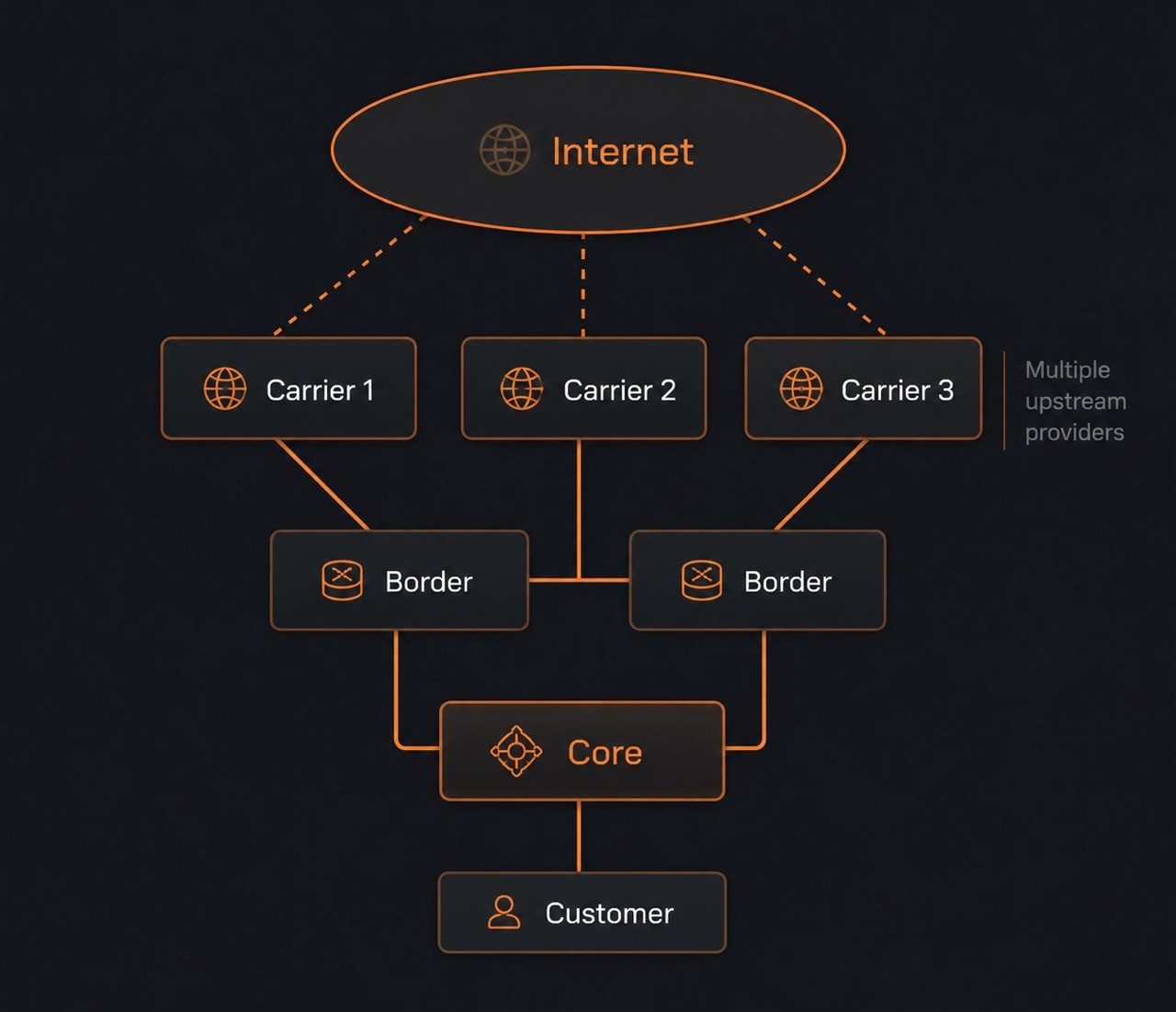
Qu's multi-homed architecture connects to 3-4 independent Tier 1 carriers simultaneously at the network level. Your connectivity inherits that redundancy by default. You do not manage BGP. You do not maintain carrier relationships. You do not need your own IP space. You get 100% uptime as a baseline, not an aspiration.
Multi-Carrier Upstream
3-4 Tier 1 carriers. Simultaneously.
Qu's network connects to multiple independent Tier 1 upstream carriers - providers like Bell, Rogers, and others - simultaneously, not as primary and backup. All carriers carry live traffic. When one has an outage, the others absorb the traffic automatically with no customer action required.
What this means in practice
Redundant Core Network
Designed to sustain two simultaneous failures
Most networks are designed to survive one failure. Qu's core network architecture is designed to sustain two simultaneous component failures and keep customers online. There is no single point of failure anywhere in the path from your equipment to the internet.
Standard single-carrier internet
One upstream provider. One path to the internet. Any failure in that path - carrier outage, fibre cut, routing error - takes you offline. No fallback.
Qu multi-homed high-availability
3-4 upstream carriers. Redundant core with dual-linked routers. Two simultaneous failure tolerance. Automatic failover. No single point of failure anywhere in the path.
Dual Redundant Links to Customer
Two physically separate links to your equipment
Multi-carrier upstream and a redundant core mean nothing if the last link to your equipment is a single connection. Qu extends the redundancy all the way to your colocation environment with two physically separate links delivered to your cabinet or cage.
How dual links work
Why the last link matters
A network with redundant upstream and redundant core but a single connection to the customer environment still has a single point of failure - just closer to the customer. Qu's dual link configuration closes that gap.
For organizations running mission-critical applications - financial services transaction processing, healthcare systems, government services, e-commerce platforms - the combination of multi-carrier upstream, redundant core, and dual customer links provides connectivity resilience equivalent to enterprise carrier-grade infrastructure.
HSRP (Hot Standby Router Protocol) is the failover mechanism used at the customer equipment layer. Core switches monitor both links and invoke HSRP failover automatically when a primary path failure is detected.
Scalable Bandwidth
Start small. Scale when you need to.
High bandwidth is table stakes. The real value is elasticity - the ability to turn bandwidth up or down as your workloads demand, without a new installation, a new contract, or a call to a provisioning team that takes three weeks to respond.
On-demand bandwidth scaling
Bandwidth can be turned up or down on demand. Start at 10 Mbps and scale to 100 Mbps or higher without a new install or contract renegotiation. Your bandwidth adjusts to your business, not the other way around.
100 Mbps to 1 Gbps+ port speeds
High-speed Ethernet ports from 100 Mbps through to 1000 Mbps are available for fast, stable connectivity. Port speed is the ceiling - your committed bandwidth sits beneath it and scales within it.
No provisioning delays
Bandwidth adjustments do not require a new circuit, a new install, or a waiting period. Because Qu manages the network end-to-end within its own facilities, bandwidth changes are operational - not infrastructure projects.
Who It Is For
Mission-critical connectivity for Canada's most demanding organizations
If a connectivity interruption has a consequence - a financial, operational, regulatory, or reputational one - this is the connectivity layer you need.
Organizations that need this
The Canadian sovereignty advantage
Qu's connectivity is delivered from Canadian data centres, operated by Canadians, under Canadian law. For regulated organizations where data residency and sovereign infrastructure are requirements - not preferences - Qu's connectivity offer is the only option that delivers high-availability internet without compromising that posture.
Foreign-owned connectivity providers operating in Canada remain subject to foreign legal authority. Qu is 100% Canadian-owned. That is not a claim that can be replicated by contract.
FAQ
Connectivity questions - answered
The questions network architects, IT managers, and compliance teams ask before committing to a connectivity provider.
Build on Your Connectivity
Connectivity is the foundation. Here is what layers on top.
High-availability internet connectivity is the network layer. Qu's interconnection, colocation, and managed services sit alongside it to complete the infrastructure picture.
Interconnection
Direct connections to cloud providers via Megaport, cross connects between customer environments, carrier-neutral meet-me rooms, and structured cabling. The physical layer beneath your connectivity.
See InterconnectionColocation
Enterprise-grade, carrier-neutral colocation across 9 Canadian data centres. Cabinet, cage, and private suite options. The physical home for the infrastructure your connectivity serves.
See ColocationManaged Network and Security
Managed firewall, switching, and network security for your colocated environment. Qu manages the network layer so your team focuses on your applications.
See Managed ServicesReady for connectivity that doesn't fail?
Our network specialists will assess your current connectivity setup and show you exactly where your single points of failure are. Then we will show you what it takes to eliminate them.