Quick Answer: AI training is the process where a model learns patterns from large datasets by adjusting its internal weights, usually over days or weeks on GPU clusters. AI inference is what happens afterwards, when the finished model answers live requests using those fixed weights. Training is a finite, compute-heavy job, while inference runs continuously and is limited mostly by memory bandwidth and latency. For most production models, inference becomes the larger share of long-term cost, power draw and compliance exposure.
Key Takeaways
- Training builds the model once and rewards parallel compute, while inference serves it continuously and rewards low, predictable latency.
- Token generation is memory-bound, so GPU memory bandwidth and capacity often limit inference speed more than peak compute does.
- Training is a bounded spend, but AI inference costs repeat with every request and tend to dominate budgets over time.
- Where inference runs shapes latency, power density and exposure to foreign legal reach, which makes location a design decision.
- Planning AI infrastructure in Canada? Qu Data Centres offers carrier-neutral colocation in five Canadian markets, so your models stay close to your users and under Canadian jurisdiction. Talk to our team about your workload.
Most explanations of AI training and inference stop at the classroom analogy, where training is studying and inference is sitting the exam. That works as a first pass. It does not help an IT leader who has to size a rack, sign a power contract or explain a GPU invoice to a CFO. The infrastructure behind each phase is different enough that buying for one and running the other is a quick route to overspending.
The pain usually shows up after launch. A model that took six weeks to train now answers thousands of requests an hour, and the meter never stops. Users complain about slow responses, security asks where prompts are stored, and finance asks why GPU spend keeps climbing month after month.
This article covers what each phase does, why inference behaves so differently on the same hardware, and what that means for power, networking, placement and compliance in Canada. It also covers where fine-tuning and retrieval sit between the two, a gap most comparisons skip.
What Are AI Training and AI Inference?
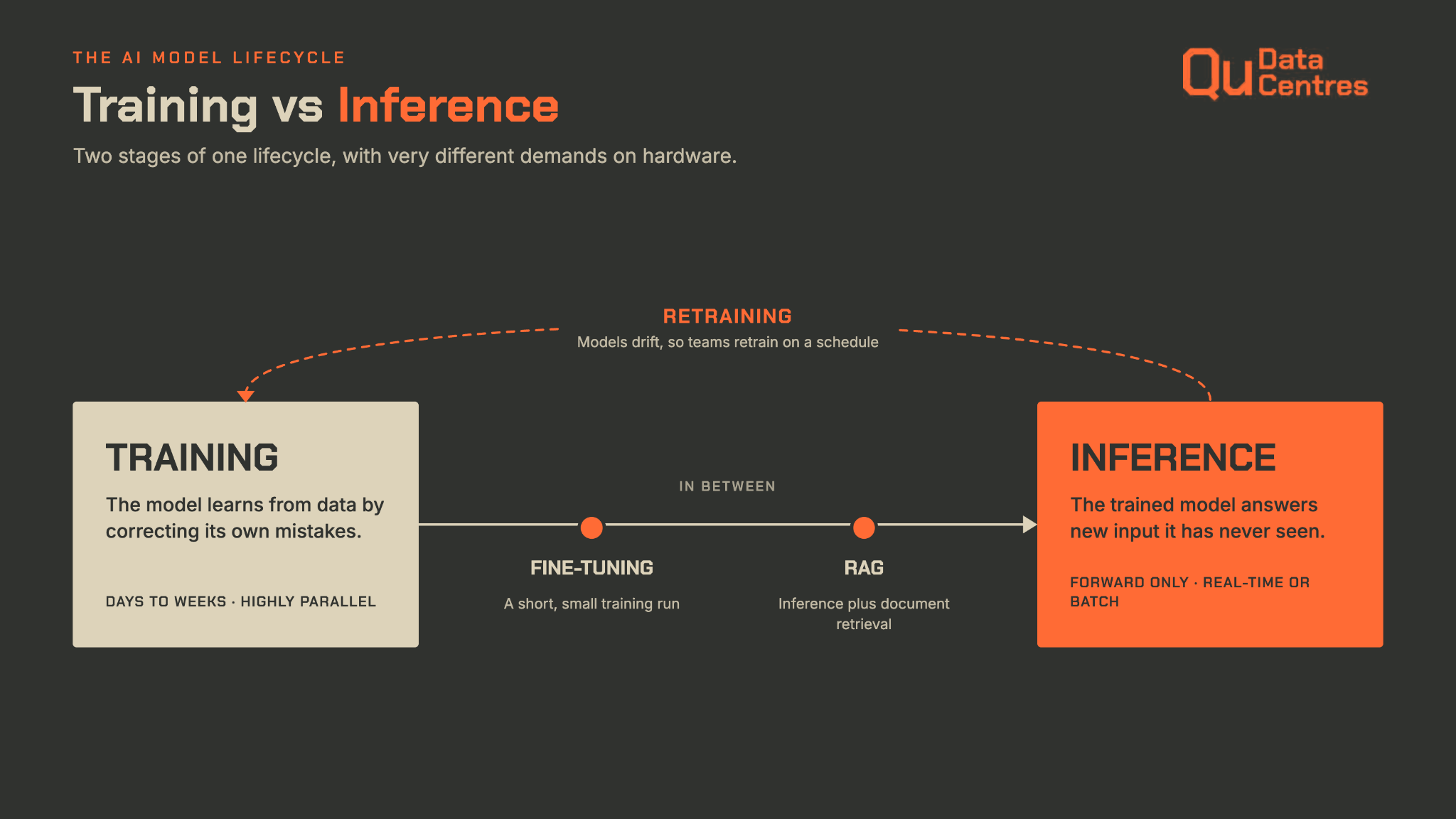
Both terms describe stages of one model lifecycle, and each stage asks very different things of hardware. Short, accurate definitions come first, because the infrastructure differences later in this article all trace back to them. A final section covers the in-between steps that most comparisons leave out.
AI Training: How a Model Learns From Data
Training is the phase where a model adjusts its internal parameters until its outputs match the answers in a dataset. The model sees a batch of examples, makes predictions, measures how wrong they were with a loss function, and corrects itself through backpropagation. This loop repeats across the full dataset many times, and DigitalOcean notes the process can take days or weeks depending on dataset size, model complexity and available compute.
Two traits matter for infrastructure. The work is highly parallel, so thousands of GPU operations run at once, and the GPUs must constantly share their results with each other. That second trait is why training clusters care so much about the network between nodes, which a later section covers.
What Is Inference in AI? How a Trained Model Produces Answers
Every chatbot reply, fraud score and document classification is inference in AI at work. A trained model with frozen weights takes new input it has never seen and returns an output. It runs forward only, with no backward pass and no learning, which is why it is lighter per task than training.
Inference comes in two operating modes. Real-time inference answers a live request inside a strict latency window, usually milliseconds to a few seconds. Batch inference collects inputs and processes them on a schedule, such as tagging last week's support tickets overnight, and trades speed for throughput.
Where Fine-Tuning, RAG and Retraining Sit Between the Two
Real projects rarely follow a clean train-then-serve split. Fine-tuning takes an existing model and keeps training it on a narrower dataset, so it behaves like a short, small training run. Retrieval-augmented generation (RAG) leaves the weights alone and pulls relevant documents into the prompt at request time, which makes it an inference workload with extra moving parts.
Those parts carry a cost. A systematic study of LLM inference on GPUs found that growing a RAG knowledge base shifted the bottleneck from GPU compute to CPU-side retrieval and memory access. Retrieved text also lengthens the prompt, which adds work before the first word is generated. For a regulated enterprise, this matters because the documents a RAG system pulls in are often the most sensitive data in the building.
Retraining is the third piece. Models drift as data changes, so teams schedule periodic retraining even when day-to-day work is almost entirely inference. Planning for both from the start is what keeps a pilot from stalling when it meets production.
AI Training Vs Inference: Differences in Compute, Memory, Network and Power
The difference here is purpose. The practical difference is what each phase does to a data centre: how long it runs, which component limits it and how much heat it leaves behind. This section sets AI inference vs training side by side on the things infrastructure teams actually have to buy and plan, and a summary table closes it out.
1. Workload Pattern: One Long Run Vs Continuous Demand
Training is episodic. A team schedules a run, occupies a cluster for days or weeks, then releases it or moves on to the next model version. Inference has no end date. It runs whenever a user, application or batch job sends a request, and it scales with adoption rather than with a project plan.
That changes how capacity is purchased. Training capacity can be rented or booked in bursts. Inference capacity has to be available at 9 a.m. on a Monday and again at 3 a.m. during a failover, which pushes it toward steady, redundant environments such as colocation instead of short-term rentals.
2. Compute and Memory: Why Inference Is Often Memory-Bound
The common assumption is that more GPU compute always means faster AI. For large language model inference, that is only half right. Each request has two phases that stress the GPU in opposite ways, and the second phase usually decides how fast an answer streams.
During decode, the model produces one token at a time and must read its weights and stored attention history from memory at every step. The same study of LLM inference on GPUs mentioned above also measured arithmetic intensity of roughly 1 to 10 FLOP per byte for decode kernels, against about 55 to 100 for prefill. Low intensity means the GPU spends more time waiting for data than doing math.
This changes the answer to which GPUs are best for AI inference workloads. Memory bandwidth and memory capacity can matter as much as headline compute, because the weights and the cache must fit and stream quickly. Training, by contrast, rewards parallel compute across many GPUs, so AI inference hardware and training hardware are often chosen on different spec lines.
3. Prefill Vs Decode: The Two Phases Inside Every Inference Request
Prefill comes first. The model reads the entire prompt at once and builds a key-value (KV) cache, a stored record of attention results for every prompt token. Because the whole prompt is processed in parallel, prefill keeps the GPU's math units busy, and it sets how long a user waits for the first word.
Decode is second. The model generates the answer one token at a time and re-reads the weights and the full KV cache at each step. The same study notes that decode's growing KV cache intensifies bandwidth pressure, which is why long prompts and long answers put extra strain on GPU memory.
- Prefill: processes the whole prompt in parallel, is compute-bound and drives time to first token
- Decode: generates one token per step, is memory-bound and drives how smoothly the answer streams
- KV Cache: grows with every token, so longer prompts and answers need more GPU memory and bandwidth
Energy follows decode as well. In the researchers' measurements on a single A100 GPU, energy use scaled almost linearly with output length, while prompt length barely moved it.
4. Networking: Training Cluster Fabrics Vs Inference Latency
Training clusters are built around constant GPU-to-GPU conversation. Training prioritizes parallelism, high memory throughput and fast communication between nodes, because gradient computation is spread across the whole cluster. A slow link between nodes leaves expensive GPUs idle.
Inference reverses the priority, and sometimes the intuition. In the GPU study we’ve been referencing, splitting a decode-heavy chat workload for a 32B-parameter model across four A100s with tensor parallelism spent over 60% of decode kernel time on communication, and a single GPU delivered the best latency and throughput. For serving, network design shifts outward to the path between the model and the user or data source.
That is where latency and carrier diversity matter more than a cluster's internal bandwidth. It is also where interconnection to clouds, partners and data providers earns its keep, and where a direct interconnection service can shorten the route.
5. Power and Cooling: Rack Density Differences
Both phases draw serious power. The IEA reports that a typical AI-focused data centre uses as much electricity as 100,000 households, and it projects global data centre demand to reach about 945 TWh by 2030. Those figures cover training and deployment together, so they say little about which phase causes which share.
The shape of the draw is night and day.
Training clusters run hot and flat for weeks, so they are packed as densely as the building allows. Inference can be spread across more modest racks that follow user demand, which widens the range of facilities that can host it. Heat removal still sets the practical ceiling on density, which is why data centre cooling works belongs in any GPU hosting discussion.
6. Cost Profile: One-Time Capital Spike Vs Never-Ending Operating Spend
Training is a bounded expense, paid for a defined period of compute. Inference is a meter that never stops. The DigitalOcean survey cited in its comparison of inference and training found that 44% of respondents put 76% to 100% of their AI budget into inference, and 49% named the high cost of inference as their biggest blocker to scaling AI products.
These AI inference costs rarely appear in the original project plan, because a pilot only serves a handful of users. At scale, small inefficiencies compound into large operating bills. The two bills are also driven by different inputs:
- Training: dataset size, model complexity, number of epochs and the size of the GPU cluster
- Inference: request volume, concurrency, latency targets, memory footprint and autoscaling behaviour
One caution applies to survey figures like these. They reflect a vendor's respondents, so treat them as a direction of travel rather than an industry census.
|
Factor
|
AI Training
|
AI Inference
|
|
Run pattern
|
Episodic runs lasting days or weeks
|
Continuous, driven by request volume
|
|
Main bottleneck
|
Parallel compute and GPU-to-GPU communication
|
Memory bandwidth and capacity during decode
|
|
Latency priority
|
Low, because throughput matters more
|
High, and predictable under live traffic
|
|
Network priority
|
Fast links between cluster nodes
|
Short, diverse paths to users and data
|
|
Power profile
|
Sustained, dense draw for weeks
|
Follows demand and spreads across more sites
|
|
Cost profile
|
Bounded spend per run
|
Ongoing spend that scales with usage
|
Where Should Training and Inference Workloads Run?
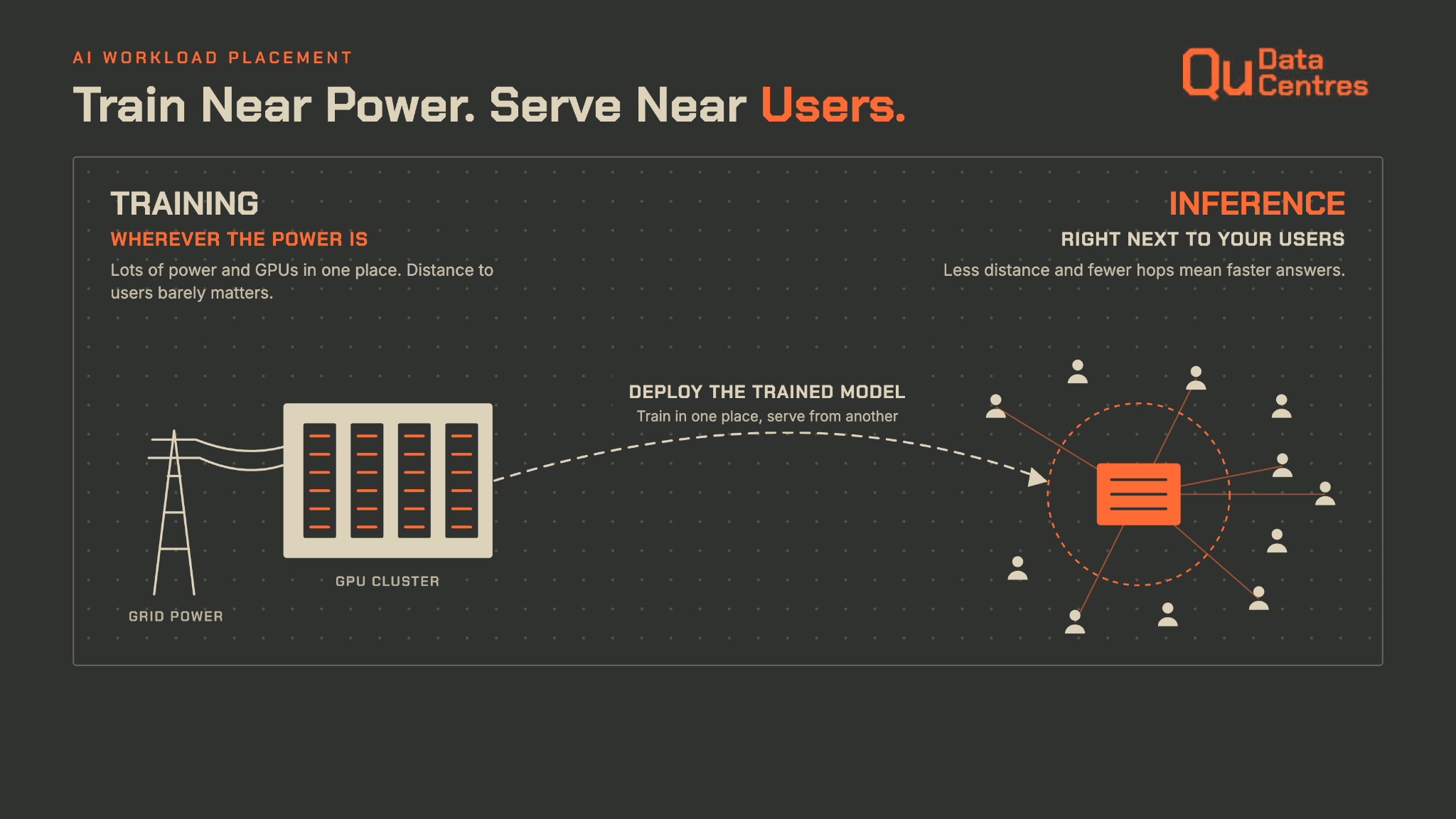
With the workload profiles clear, location stops being an afterthought. Training and inference pull in opposite directions, one toward concentrated power and the other toward proximity to users. The three sections below cover each pull and how teams reconcile them.
Inference Close to Users and Data: Latency and Location
Latency has a physical floor set by distance and the number of network hops between the user and the GPU. A model that responds in 200 milliseconds in testing can feel slow if every request crosses a continent. Placing inference in the same region as the application, the database and the users cuts that delay without touching the model.
Canadian organizations serving Canadian users can host inference in a Toronto data centre, an Ottawa data centre or a Calgary data centre instead of a distant US region.
Training in Concentrated Capacity: Why Density Decides the Site
Training sites are chosen by power first. The IEA notes that AI-focused data centres are far more geographically concentrated than comparable industrial loads, and that around 20% of planned data centre projects could face delays from grid constraints if the risks are not addressed. A large training run needs a lot of power in one place for a long time, so access to power often matters more than proximity to users.
Many enterprises never need that scale. Fine-tuning a model on proprietary data, or training smaller domain models, fits into far more modest deployments. For those teams, the real question is whether the facility can add megawatts as the project grows.
Hybrid Setups: Train in One Place, Serve From Another
Nothing forces training and inference into the same building. A common pattern is to train or fine-tune on rented burst capacity, then deploy the finished model to infrastructure the organization controls. Teams that start in the cloud often make that move once serving demand becomes predictable, a process covered in migrating GPU clusters from cloud to colocation.
Trained weights can reflect the data they learned from, so the serving environment inherits that risk profile. A virtual private cloud can suit lighter serving needs, while dedicated GPU servers in colocation suit steady, heavy ones.
Data Sovereignty and Compliance: How Training and Inference Handle Data Differently
AI projects tend to start as technical experiments and end up as compliance questions. Training and inference touch data in different ways, and there is legal exposure for both.
Training Data and Model Weights: Where They Live and Who Can Compel Access
Training concentrates data in one place for a long time. That includes the source datasets, the intermediate checkpoints and the final weights, which can reflect patterns from the data they learned from. Where those files sit, and which legal system can reach them, are sovereignty questions.
Residency describes where data is stored, while sovereignty asks who operates the systems and which courts can compel access, a distinction laid out in what data sovereignty means. A provider with a foreign parent can face disclosure demands even for data held in a Canadian region, which Canada's CLOUD Act exposure examines in detail.
Inference Data: Live Customer Records Passing Through the Model
Inference is where sensitive data actually flows. Every prompt, uploaded document and retrieved record passes through the serving stack, often in real time and often containing personal information. Under PIPEDA's accountability principle, an organization stays responsible for personal information transferred to a third party for processing and must use contractual or other means to provide comparable protection.
Federally regulated financial institutions face a second layer. OSFI's Guideline B-13 sets expectations for technology and cyber risk management and took effect on January 1, 2024. Any AI serving stack that touches customer data becomes part of the technology risk those institutions have to account for.
Canadian Colocation for Inference Workloads
Inference workloads fit well in carrier-neutral colocation, where steady GPU servers sit close to users, clouds and data sources. Qu Data Centres operates nine facilities across five Canadian markets: Toronto, Ottawa, Calgary, Edmonton and London, Ontario. At the Ottawa site, OTT3, a redundant 2 MW design is upgradeable to 10 MW, with power designed for 5 to 15 kW per rack and six carriers on site. The London site, LDN1, offers 5 MW upgradeable to 20 MW of utility power with N+2 cooling.
Qu is Canadian-incorporated and run by a team of more than 130 Canadians, with no offshore network operations centre. We support inference-scale and enterprise AI deployments rather than hyperscale training campuses, so the fit is strongest for production models serving Canadian users.
Planning AI Infrastructure Budgets Around Inference, Not Just Training
Budgets built around the training run are the ones that break. The model gets approved, the cluster gets booked, and nobody models what happens in month seven when usage triples.
Capacity Planning for Inference Growth
Start from requests, not from model size. Estimate peak concurrent users, expected tokens per request and the latency each interaction can tolerate, then work backwards to GPU memory and power. Longer prompts, retrieved documents and longer answers all grow the KV cache, which raises memory demand and bandwidth pressure on every GPU in the fleet.
Plan power in stages. The IEA projects that data centre electricity demand will more than double by 2030, and grid access is already a constraint in many markets. Confirm a facility's upgrade path in megawatts, not only what is available today, because time-to-power is often the slowest part of a deployment.
Questions to Ask a Data Centre Provider Before You Commit
A short list of questions separates facilities that can host inference from those that only advertise it. A fuller procurement template is laid out in structuring an RFP for AI-ready colocation, and the six questions below cover the ground that matters most.
- Rack Density: What kW per rack is the design rated for, and is that capacity committed or only rated?
- Power Headroom: How many megawatts can the site add, and on what timeline?
- Cooling: What cooling type and redundancy level (N+1 or N+2) back the load?
- Network: Which carriers are on site, and can you connect directly to clouds and partners?
- Jurisdiction: Who owns and operates the facility, and which courts can compel access to your data?
- Support: Is there a named team with 24/7 managed services when a GPU node fails at 3 a.m.?
How Qu Data Centres Supports Inference Workloads Across Canada
Training and inference share hardware but not a profile. Training is a bounded, power-hungry run, while inference is a continuous, latency-sensitive service that touches live customer data every minute. That second profile is where most enterprise AI spend and risk now sit, and it is the one Qu Data Centres is built to host.
Qu operates nine carrier-neutral facilities across Toronto, Ottawa, Calgary, Edmonton and London, Ontario, run by a Canadian team of more than 130 people. Each site pairs redundant power and cooling with diverse carrier connectivity and around-the-clock technical support, so serving infrastructure stays close to users, clouds and data under Canadian jurisdiction. Qu is candid about fit: it supports inference and enterprise AI deployments, not hyperscale training campuses.
See the power, cooling and carrier rooms for yourself and match a facility to your workload. Book a tour and bring your toughest questions.
Frequently Asked Questions About AI Training and Inference
Does AI Inference Require a GPU?
Not always. Small models and low-volume batch jobs can run on CPUs, and some workloads use specialized accelerators. Large language models and real-time services usually need GPUs because decoding is memory-bandwidth heavy and users expect fast responses. The practical test is model size, the number of simultaneous requests and the latency target you must meet.
Can a Model Keep Learning During Inference?
Standard deployed models do not. Their weights stay frozen while they answer requests, so each response reflects only what was learned in training. Models improve through scheduled retraining or fine-tuning on new data. Some systems add fresh information at request time through retrieval, which supplies documents without changing the model itself.
Which Costs More Over Time, Training or Inference?
For most production models, inference. Training is a bounded expense for a defined period, while inference charges accumulate with every request for as long as the product runs. A heavily used model can pass its original training cost, which is why many organizations now put most of their AI budget into serving.
Can You Run Inference Without Training a Model Yourself?
Yes. Most organizations run models trained by someone else, either open-weight models hosted on their own infrastructure or models accessed through an API. You can still adapt them through fine-tuning or retrieval. The decision that matters then is where inference runs, because that determines latency, cost and who can access your data.
How Much Power Does Inference Need Compared to Training?
A single training run draws very high, sustained power for days or weeks across a large cluster. Inference draws less per job but never stops, so its total consumption can add up over a model's life. Energy rises with output length and model size, so efficient serving and right-sized racks keep power costs manageable.
Sources Used for This Article
- DigitalOcean: "AI Inference vs Training: Key Differences Explained" - digitalocean.com/resources/articles/ai-inference-vs-training
- arXiv: "A Systematic Characterization of LLM Inference on GPUs" - arxiv.org/pdf/2512.01644
- International Energy Agency (IEA): "Executive summary – Energy and AI" - iea.org/reports/energy-and-ai/executive-summary
- Justice Laws Website (Government of Canada): "Personal Information Protection and Electronic Documents Act (S.C. 2000, c. 5) - Schedule 1" - lois-laws.justice.gc.ca/eng/acts/P-8.6/page-7.html
- Office of the Superintendent of Financial Institutions: "OSFI releases final Guideline B-13 – Technology and Cyber Risk Management" - osfi-bsif.gc.ca/en/guidance/guidance-library/osfi-releases-final-guideline-b-13-technology-cyber-risk-management-letter-2022






Quick Answer: AI training is the process where a model learns patterns from large datasets by adjusting its internal weights, usually over days or weeks on GPU clusters. AI inference is what happens afterwards, when the finished model answers live requests using those fixed weights. Training is a finite, compute-heavy job, while inference runs continuously and is limited mostly by memory bandwidth and latency. For most production models, inference becomes the larger share of long-term cost, power draw and compliance exposure.
Key Takeaways
Most explanations of AI training and inference stop at the classroom analogy, where training is studying and inference is sitting the exam. That works as a first pass. It does not help an IT leader who has to size a rack, sign a power contract or explain a GPU invoice to a CFO. The infrastructure behind each phase is different enough that buying for one and running the other is a quick route to overspending.
The pain usually shows up after launch. A model that took six weeks to train now answers thousands of requests an hour, and the meter never stops. Users complain about slow responses, security asks where prompts are stored, and finance asks why GPU spend keeps climbing month after month.
This article covers what each phase does, why inference behaves so differently on the same hardware, and what that means for power, networking, placement and compliance in Canada. It also covers where fine-tuning and retrieval sit between the two, a gap most comparisons skip.
What Are AI Training and AI Inference?
Both terms describe stages of one model lifecycle, and each stage asks very different things of hardware. Short, accurate definitions come first, because the infrastructure differences later in this article all trace back to them. A final section covers the in-between steps that most comparisons leave out.
AI Training: How a Model Learns From Data
Training is the phase where a model adjusts its internal parameters until its outputs match the answers in a dataset. The model sees a batch of examples, makes predictions, measures how wrong they were with a loss function, and corrects itself through backpropagation. This loop repeats across the full dataset many times, and DigitalOcean notes the process can take days or weeks depending on dataset size, model complexity and available compute.
Two traits matter for infrastructure. The work is highly parallel, so thousands of GPU operations run at once, and the GPUs must constantly share their results with each other. That second trait is why training clusters care so much about the network between nodes, which a later section covers.
What Is Inference in AI? How a Trained Model Produces Answers
Every chatbot reply, fraud score and document classification is inference in AI at work. A trained model with frozen weights takes new input it has never seen and returns an output. It runs forward only, with no backward pass and no learning, which is why it is lighter per task than training.
Inference comes in two operating modes. Real-time inference answers a live request inside a strict latency window, usually milliseconds to a few seconds. Batch inference collects inputs and processes them on a schedule, such as tagging last week's support tickets overnight, and trades speed for throughput.
Where Fine-Tuning, RAG and Retraining Sit Between the Two
Real projects rarely follow a clean train-then-serve split. Fine-tuning takes an existing model and keeps training it on a narrower dataset, so it behaves like a short, small training run. Retrieval-augmented generation (RAG) leaves the weights alone and pulls relevant documents into the prompt at request time, which makes it an inference workload with extra moving parts.
Those parts carry a cost. A systematic study of LLM inference on GPUs found that growing a RAG knowledge base shifted the bottleneck from GPU compute to CPU-side retrieval and memory access. Retrieved text also lengthens the prompt, which adds work before the first word is generated. For a regulated enterprise, this matters because the documents a RAG system pulls in are often the most sensitive data in the building.
Retraining is the third piece. Models drift as data changes, so teams schedule periodic retraining even when day-to-day work is almost entirely inference. Planning for both from the start is what keeps a pilot from stalling when it meets production.
AI Training Vs Inference: Differences in Compute, Memory, Network and Power
The difference here is purpose. The practical difference is what each phase does to a data centre: how long it runs, which component limits it and how much heat it leaves behind. This section sets AI inference vs training side by side on the things infrastructure teams actually have to buy and plan, and a summary table closes it out.
1. Workload Pattern: One Long Run Vs Continuous Demand
Training is episodic. A team schedules a run, occupies a cluster for days or weeks, then releases it or moves on to the next model version. Inference has no end date. It runs whenever a user, application or batch job sends a request, and it scales with adoption rather than with a project plan.
That changes how capacity is purchased. Training capacity can be rented or booked in bursts. Inference capacity has to be available at 9 a.m. on a Monday and again at 3 a.m. during a failover, which pushes it toward steady, redundant environments such as colocation instead of short-term rentals.
2. Compute and Memory: Why Inference Is Often Memory-Bound
The common assumption is that more GPU compute always means faster AI. For large language model inference, that is only half right. Each request has two phases that stress the GPU in opposite ways, and the second phase usually decides how fast an answer streams.
During decode, the model produces one token at a time and must read its weights and stored attention history from memory at every step. The same study of LLM inference on GPUs mentioned above also measured arithmetic intensity of roughly 1 to 10 FLOP per byte for decode kernels, against about 55 to 100 for prefill. Low intensity means the GPU spends more time waiting for data than doing math.
This changes the answer to which GPUs are best for AI inference workloads. Memory bandwidth and memory capacity can matter as much as headline compute, because the weights and the cache must fit and stream quickly. Training, by contrast, rewards parallel compute across many GPUs, so AI inference hardware and training hardware are often chosen on different spec lines.
3. Prefill Vs Decode: The Two Phases Inside Every Inference Request
Prefill comes first. The model reads the entire prompt at once and builds a key-value (KV) cache, a stored record of attention results for every prompt token. Because the whole prompt is processed in parallel, prefill keeps the GPU's math units busy, and it sets how long a user waits for the first word.
Decode is second. The model generates the answer one token at a time and re-reads the weights and the full KV cache at each step. The same study notes that decode's growing KV cache intensifies bandwidth pressure, which is why long prompts and long answers put extra strain on GPU memory.
Energy follows decode as well. In the researchers' measurements on a single A100 GPU, energy use scaled almost linearly with output length, while prompt length barely moved it.
4. Networking: Training Cluster Fabrics Vs Inference Latency
Training clusters are built around constant GPU-to-GPU conversation. Training prioritizes parallelism, high memory throughput and fast communication between nodes, because gradient computation is spread across the whole cluster. A slow link between nodes leaves expensive GPUs idle.
Inference reverses the priority, and sometimes the intuition. In the GPU study we’ve been referencing, splitting a decode-heavy chat workload for a 32B-parameter model across four A100s with tensor parallelism spent over 60% of decode kernel time on communication, and a single GPU delivered the best latency and throughput. For serving, network design shifts outward to the path between the model and the user or data source.
That is where latency and carrier diversity matter more than a cluster's internal bandwidth. It is also where interconnection to clouds, partners and data providers earns its keep, and where a direct interconnection service can shorten the route.
5. Power and Cooling: Rack Density Differences
Both phases draw serious power. The IEA reports that a typical AI-focused data centre uses as much electricity as 100,000 households, and it projects global data centre demand to reach about 945 TWh by 2030. Those figures cover training and deployment together, so they say little about which phase causes which share.
The shape of the draw is night and day.
Training clusters run hot and flat for weeks, so they are packed as densely as the building allows. Inference can be spread across more modest racks that follow user demand, which widens the range of facilities that can host it. Heat removal still sets the practical ceiling on density, which is why data centre cooling works belongs in any GPU hosting discussion.
6. Cost Profile: One-Time Capital Spike Vs Never-Ending Operating Spend
Training is a bounded expense, paid for a defined period of compute. Inference is a meter that never stops. The DigitalOcean survey cited in its comparison of inference and training found that 44% of respondents put 76% to 100% of their AI budget into inference, and 49% named the high cost of inference as their biggest blocker to scaling AI products.
These AI inference costs rarely appear in the original project plan, because a pilot only serves a handful of users. At scale, small inefficiencies compound into large operating bills. The two bills are also driven by different inputs:
One caution applies to survey figures like these. They reflect a vendor's respondents, so treat them as a direction of travel rather than an industry census.
Factor
AI Training
AI Inference
Run pattern
Episodic runs lasting days or weeks
Continuous, driven by request volume
Main bottleneck
Parallel compute and GPU-to-GPU communication
Memory bandwidth and capacity during decode
Latency priority
Low, because throughput matters more
High, and predictable under live traffic
Network priority
Fast links between cluster nodes
Short, diverse paths to users and data
Power profile
Sustained, dense draw for weeks
Follows demand and spreads across more sites
Cost profile
Bounded spend per run
Ongoing spend that scales with usage
Where Should Training and Inference Workloads Run?
With the workload profiles clear, location stops being an afterthought. Training and inference pull in opposite directions, one toward concentrated power and the other toward proximity to users. The three sections below cover each pull and how teams reconcile them.
Inference Close to Users and Data: Latency and Location
Latency has a physical floor set by distance and the number of network hops between the user and the GPU. A model that responds in 200 milliseconds in testing can feel slow if every request crosses a continent. Placing inference in the same region as the application, the database and the users cuts that delay without touching the model.
Canadian organizations serving Canadian users can host inference in a Toronto data centre, an Ottawa data centre or a Calgary data centre instead of a distant US region.
Training in Concentrated Capacity: Why Density Decides the Site
Training sites are chosen by power first. The IEA notes that AI-focused data centres are far more geographically concentrated than comparable industrial loads, and that around 20% of planned data centre projects could face delays from grid constraints if the risks are not addressed. A large training run needs a lot of power in one place for a long time, so access to power often matters more than proximity to users.
Many enterprises never need that scale. Fine-tuning a model on proprietary data, or training smaller domain models, fits into far more modest deployments. For those teams, the real question is whether the facility can add megawatts as the project grows.
Hybrid Setups: Train in One Place, Serve From Another
Nothing forces training and inference into the same building. A common pattern is to train or fine-tune on rented burst capacity, then deploy the finished model to infrastructure the organization controls. Teams that start in the cloud often make that move once serving demand becomes predictable, a process covered in migrating GPU clusters from cloud to colocation.
Trained weights can reflect the data they learned from, so the serving environment inherits that risk profile. A virtual private cloud can suit lighter serving needs, while dedicated GPU servers in colocation suit steady, heavy ones.
Data Sovereignty and Compliance: How Training and Inference Handle Data Differently
AI projects tend to start as technical experiments and end up as compliance questions. Training and inference touch data in different ways, and there is legal exposure for both.
Training Data and Model Weights: Where They Live and Who Can Compel Access
Training concentrates data in one place for a long time. That includes the source datasets, the intermediate checkpoints and the final weights, which can reflect patterns from the data they learned from. Where those files sit, and which legal system can reach them, are sovereignty questions.
Residency describes where data is stored, while sovereignty asks who operates the systems and which courts can compel access, a distinction laid out in what data sovereignty means. A provider with a foreign parent can face disclosure demands even for data held in a Canadian region, which Canada's CLOUD Act exposure examines in detail.
Inference Data: Live Customer Records Passing Through the Model
Inference is where sensitive data actually flows. Every prompt, uploaded document and retrieved record passes through the serving stack, often in real time and often containing personal information. Under PIPEDA's accountability principle, an organization stays responsible for personal information transferred to a third party for processing and must use contractual or other means to provide comparable protection.
Federally regulated financial institutions face a second layer. OSFI's Guideline B-13 sets expectations for technology and cyber risk management and took effect on January 1, 2024. Any AI serving stack that touches customer data becomes part of the technology risk those institutions have to account for.
Canadian Colocation for Inference Workloads
Inference workloads fit well in carrier-neutral colocation, where steady GPU servers sit close to users, clouds and data sources. Qu Data Centres operates nine facilities across five Canadian markets: Toronto, Ottawa, Calgary, Edmonton and London, Ontario. At the Ottawa site, OTT3, a redundant 2 MW design is upgradeable to 10 MW, with power designed for 5 to 15 kW per rack and six carriers on site. The London site, LDN1, offers 5 MW upgradeable to 20 MW of utility power with N+2 cooling.
Qu is Canadian-incorporated and run by a team of more than 130 Canadians, with no offshore network operations centre. We support inference-scale and enterprise AI deployments rather than hyperscale training campuses, so the fit is strongest for production models serving Canadian users.
Planning AI Infrastructure Budgets Around Inference, Not Just Training
Budgets built around the training run are the ones that break. The model gets approved, the cluster gets booked, and nobody models what happens in month seven when usage triples.
Capacity Planning for Inference Growth
Start from requests, not from model size. Estimate peak concurrent users, expected tokens per request and the latency each interaction can tolerate, then work backwards to GPU memory and power. Longer prompts, retrieved documents and longer answers all grow the KV cache, which raises memory demand and bandwidth pressure on every GPU in the fleet.
Plan power in stages. The IEA projects that data centre electricity demand will more than double by 2030, and grid access is already a constraint in many markets. Confirm a facility's upgrade path in megawatts, not only what is available today, because time-to-power is often the slowest part of a deployment.
Questions to Ask a Data Centre Provider Before You Commit
A short list of questions separates facilities that can host inference from those that only advertise it. A fuller procurement template is laid out in structuring an RFP for AI-ready colocation, and the six questions below cover the ground that matters most.
How Qu Data Centres Supports Inference Workloads Across Canada
Training and inference share hardware but not a profile. Training is a bounded, power-hungry run, while inference is a continuous, latency-sensitive service that touches live customer data every minute. That second profile is where most enterprise AI spend and risk now sit, and it is the one Qu Data Centres is built to host.
Qu operates nine carrier-neutral facilities across Toronto, Ottawa, Calgary, Edmonton and London, Ontario, run by a Canadian team of more than 130 people. Each site pairs redundant power and cooling with diverse carrier connectivity and around-the-clock technical support, so serving infrastructure stays close to users, clouds and data under Canadian jurisdiction. Qu is candid about fit: it supports inference and enterprise AI deployments, not hyperscale training campuses.
See the power, cooling and carrier rooms for yourself and match a facility to your workload. Book a tour and bring your toughest questions.
Frequently Asked Questions About AI Training and Inference
Does AI Inference Require a GPU?
Not always. Small models and low-volume batch jobs can run on CPUs, and some workloads use specialized accelerators. Large language models and real-time services usually need GPUs because decoding is memory-bandwidth heavy and users expect fast responses. The practical test is model size, the number of simultaneous requests and the latency target you must meet.
Can a Model Keep Learning During Inference?
Standard deployed models do not. Their weights stay frozen while they answer requests, so each response reflects only what was learned in training. Models improve through scheduled retraining or fine-tuning on new data. Some systems add fresh information at request time through retrieval, which supplies documents without changing the model itself.
Which Costs More Over Time, Training or Inference?
For most production models, inference. Training is a bounded expense for a defined period, while inference charges accumulate with every request for as long as the product runs. A heavily used model can pass its original training cost, which is why many organizations now put most of their AI budget into serving.
Can You Run Inference Without Training a Model Yourself?
Yes. Most organizations run models trained by someone else, either open-weight models hosted on their own infrastructure or models accessed through an API. You can still adapt them through fine-tuning or retrieval. The decision that matters then is where inference runs, because that determines latency, cost and who can access your data.
How Much Power Does Inference Need Compared to Training?
A single training run draws very high, sustained power for days or weeks across a large cluster. Inference draws less per job but never stops, so its total consumption can add up over a model's life. Energy rises with output length and model size, so efficient serving and right-sized racks keep power costs manageable.
Sources Used for This Article
Paul M
Paul Miedzik is Senior Manager of Marketing at Qu Data Centres, with extensive experience in enterprise cloud and digital infrastructure across the Canadian tech sector.