Quick Answer: The US CLOUD Act (Clarifying Lawful Overseas Use of Data Act) gives American authorities the power to compel US-headquartered technology companies to hand over data they control, regardless of where that data is physically stored. For Canadian businesses, this means that hosting data in a Canadian region of AWS, Microsoft Azure, or Google Cloud does not shield it from US jurisdiction. The legal reach follows the company, not the server. Genuine protection requires infrastructure operated by a provider that falls outside US legal authority entirely.
Key Takeaways
- The US CLOUD Act lets American authorities compel US-headquartered technology companies to produce controlled data, regardless of physical storage location.
- Canadian cloud regions from AWS, Microsoft Azure, or Google Cloud provide data residency, but not full Canadian legal sovereignty.
- The key legal test is whether a provider has possession, custody, or control of data while remaining subject to US jurisdiction.
- CLOUD Act orders may include non-disclosure provisions, meaning Canadian organisations may not be notified when affected data is accessed.
- SaaS tools, managed service providers, analytics platforms, CRMs, and productivity suites can each create separate CLOUD Act exposure points.
- Canadian-owned colocation reduces exposure by keeping infrastructure, operations, ownership, and legal jurisdiction outside US compulsion mechanisms.
- Talk to Qu Data Centres to book a facility tour and see how Canadian-owned colocation can support a provably sovereign infrastructure strategy.
It was supposed to be a solved problem. You host your data in Canada, your privacy policy says so, your vendor contract confirms Canadian data residency, and you move on. Except that for a growing number of Canadian organisations, that framework is coming apart under regulatory scrutiny, board-level risk reviews, and some uncomfortable questions from legal counsel.
The issue is not whether your data physically sits in Toronto or Calgary. The issue is whether the company storing it is subject to US law.
That is a different question entirely, and most infrastructure buying decisions have not been made with that distinction in mind. For enterprises operating in healthcare, financial services, legal, government, or any regulated sector, the gap between "data in Canada" and "data under Canadian jurisdiction" is where real compliance exposure lives.
This piece cuts through the misconceptions about the US CLOUD Act, explains what it means for Canadian enterprises specifically, and maps out what an architecture that genuinely reduces jurisdictional exposure looks like.
What the US CLOUD Act Is and Why It Reaches Canadian Data
The CLOUD Act is often conflated with older, broader US surveillance tools. Before examining the exposure it creates for Canadian businesses, it helps to be precise about what the law actually does and how it differs from other US data access frameworks.
How CLOUD Act Orders Work
The Clarifying Lawful Overseas Use of Data Act was passed by the US Congress in 2018. It amended the Stored Communications Act to clarify that US technology companies must comply with lawful US court orders for data in their possession, custody, or control, regardless of where that data is physically stored.
A warrant is served on the US-based provider directly. No diplomatic channels, no mutual legal assistance treaty, no notice to the Canadian organisation whose data is involved.
The mechanism is straightforward: a US authority issues a warrant for specific data, serves it on a provider subject to US jurisdiction that has access to that data, and the provider is legally obligated to comply.
The Cross-Border Data Forum's authoritative CLOUD Act FAQ confirms that US jurisdiction over a provider is determined by the provider's connections to the US, not by the geographic location of the data. This is what makes the law so far-reaching for Canadian enterprises: jurisdiction follows corporate control, not server coordinates.
One comparison that comes up often is the CLOUD Act vs the Patriot Act. They are not the same thing.
The Patriot Act, passed after September 11, 2001, authorised broad intelligence and surveillance collection. The CLOUD Act is narrower and more procedural: it sets a defined legal process for criminal investigations, requires probable cause, prohibits bulk data collection, and preserves a provider's right to challenge orders on comity grounds if compliance would violate another country's laws.
That difference matters, but it does not remove the core exposure. A lawful, targeted request is still a request your Canadian data is subject to.
Data Residency Vs. Data Sovereignty
Data residency means your data is physically stored within a specific geographic boundary. Data sovereignty means your data is subject only to the laws of a specific jurisdiction.
These are related but genuinely different, and confusing them is where most enterprise infrastructure decisions go wrong.
The Government of Canada's own White Paper on Data Sovereignty and Public Cloud puts this plainly: a cloud service provider with foreign operations could be required to comply with a warrant, court order, or subpoena request from a foreign law enforcement agency. The document explicitly notes that under some foreign laws, disclosure of Canadian government data could take place without notice. Data residency does not mitigate against the application of foreign laws. Only the jurisdictional status of the provider does.
This distinction has moved from academic to operational. Osler's analysis of the CLOUD Act notes that using a Canadian service provider or storing data in Canada does not guarantee data will be beyond the reach of courts in other countries if the provider has any US presence. The relevant question is not where your data lives. It is who has possession, custody, or control of it, and what laws govern that entity.
Why a "Canadian Region" Does Not Mean Canadian Jurisdiction
Canadian regions of AWS, Microsoft Azure, and Google Cloud are marketed as a Canadian hosting solution, and in terms of physical location, they are. But the parent companies are American corporations subject to US law, and the CLOUD Act follows that corporate relationship directly.
The Parent Jurisdiction Problem with US Hyperscalers in Canada
AWS Canada (Central), Azure Canada Central, and Google Cloud's Montreal region are all physically located on Canadian soil. However, Amazon Web Services is incorporated in the United States, as are Microsoft and Google. When a US court issues a valid warrant to AWS for data in that company's possession or control, the fact that the particular servers are in Toronto does not sever the legal obligation.
The parent company's jurisdiction is what the CLOUD Act triggers, not the physical address of the infrastructure.
This is not a problem that we’re making up.
In June 2025, Microsoft France's director of public and legal affairs was asked directly before the French Senate whether he could guarantee that data stored in France would not be transmitted to US authorities under a legal order. He could not. That testimony applies identically to Canadian data hosted with any US-parented provider.
The Balsillie Papers' analysis of the CLOUD Act and Canadian data frames this precisely: data residency is a necessary but insufficient condition for sovereignty. What it cannot resolve is the jurisdictional exposure of the provider itself.
A Canadian subsidiary of a US company does not automatically escape CLOUD Act reach either. The critical test is whether the US parent has possession, custody, or control over the data. In practice, US hyperscalers operate their Canadian regions under unified global platforms, with operational access, support infrastructure, and key management systems that cross borders. The corporate relationship is what creates the exposure.
What "Possession, Custody, or Control" Legally Means for Your Data
The exact language of the CLOUD Act is "possession, custody, or control," and each of those three terms matters.
- Possession means the provider physically holds the data.
- Custody is broader: the provider may have temporary or shared authority over data it doesn't wholly own.
- Control is the widest net: it captures scenarios where a provider can access, retrieve, or produce data even if it is stored in a subsidiary, in another region, or in a physically separate facility.
For enterprise buyers, this means the question is not just whether your data is in Canada. It is whether the entity you have contracted with can technically reach that data through its own systems, and whether that entity is subject to US jurisdiction. If both answers are yes, the CLOUD Act can reach your data. The law's full text at 18 U.S.C. § 2713 makes no geographic exception for where data is held: the obligation follows the provider's access, not the data's address.
Non-Disclosure Orders: When Your Data Is Accessed and You Never Find Out
One of the least-discussed aspects of CLOUD Act orders is the non-disclosure provision. When a US court issues a warrant to a provider, it can also order that provider not to notify the affected customer.
This means a Canadian enterprise could have its data accessed pursuant to a US legal order and have no legal mechanism to find out it happened, at least not immediately.
The Government of Canada's own White Paper acknowledges this directly, noting that under some foreign laws, disclosure of government data could take place without notice. This creates a practical compliance problem that contracts and privacy policies cannot solve: your incident response plan assumes you will know when a data access event occurs.
A CLOUD Act order with a non-disclosure attachment breaks that assumption. For organisations with regulated data, obligations around breach notification and data access logging become difficult to fulfil if the access itself is legally hidden from you.
SaaS Tools and the Hidden Exposure Chain in Your Own Stack
The exposure does not stop at your primary infrastructure provider. Every US-incorporated SaaS tool in your stack that touches personal data or regulated information carries its own jurisdictional profile.
Your HR platform, your project management system, your CRM, your email provider: if any of these are US companies with access to regulated data, each is a distinct CLOUD Act exposure point.
The pattern from legal guidance across multiple Canadian frameworks is consistent: organisations must assess the full chain of data handling, not just the primary hosting provider. This is worth mapping specifically for:
- CRM and Customer Data Platforms: Contact records and behavioural data sitting in US-hosted SaaS tools are often overlooked in sovereignty assessments but covered by PIPEDA and potentially Quebec's Law 25.
- Collaboration and Productivity Tools: Document storage, email archiving, and video call recordings frequently contain privileged or regulated content hosted on US infrastructure.
- Analytics and Logging Tools: Operational and application data piped to US-hosted analytics platforms falls within CLOUD Act reach even when the primary production database is in Canada.
- Managed Service Providers: If your MSP uses US-based tools to remotely administer your environment, those tools may give a US company technical "control" over your data for CLOUD Act purposes.
Auditing the full stack, not just the data centre contract, is where a defensible sovereignty posture begins. Organizations looking to reduce backup and disaster recovery exposure alongside primary infrastructure risk will find that both layers need to be assessed under the same jurisdictional framework.
|
Dimension
|
What It Means
|
Does a US Hyperscale Canadian Region Solve It?
|
What Does Solve It
|
|
Data residency
|
Physical location of data in Canada
|
Yes
|
Canadian-owned colocation or on-premises
|
|
Legal jurisdiction
|
Which country's courts govern access
|
No
|
Provider incorporated and operating in Canada
|
|
Possession/custody/control
|
Can the provider technically access the data?
|
No
|
Provider with no US operational dependency
|
|
Non-disclosure risk
|
Can you be notified if data is accessed?
|
No
|
Canadian legal process with notification rights
|
|
PIPEDA compliance
|
Canadian privacy law accountability
|
Partial
|
Canadian jurisdiction with full accountability
|
|
Regulated sector obligations (OSFI, PHIPA)
|
Sector-specific third-party risk
|
Partial
|
Provider outside foreign compulsion mechanisms
|
Where Different Industries Face the Sharpest CLOUD Act Risk
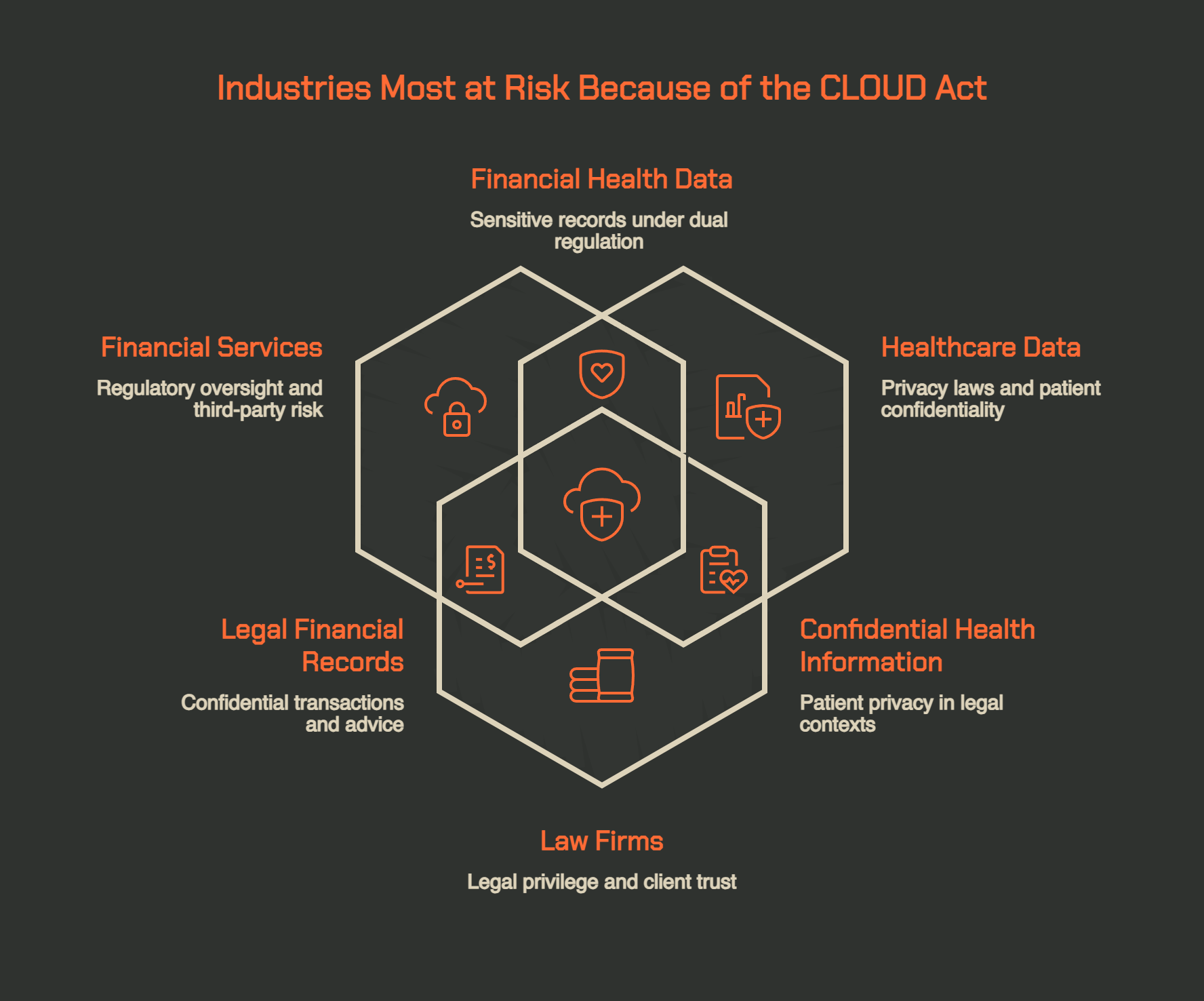
CLOUD Act exposure is not uniform across all organisations. The severity of the compliance risk depends heavily on what type of data you handle and which regulatory regime governs your sector. Three industry groups face the sharpest practical consequences.
Financial Services: OSFI Guideline B-13 and Third-Party Risk
OSFI Guideline B-13, effective January 1, 2024, sets technology and cyber risk expectations for all federally regulated financial institutions. It is principles-based rather than prescriptive, but the supervisory expectations are clear: institutions must demonstrate they understand and can manage jurisdictional and third-party risks.
An institution that cannot account for its exposure to foreign government access through cloud providers will struggle to satisfy OSFI's technology risk governance requirements.
The specific concern is third-party oversight. B-13 requires institutions to maintain meaningful control over outsourced functions, including cloud-hosted systems. When a cloud provider is subject to a legal order your organisation cannot challenge in a Canadian court, the oversight model breaks down.
Three federally regulated financial institutions received formal OSFI letters in 2025 specifically questioning their analysis of foreign government access risks, according to reporting tracked by Augure AI.
Healthcare Data Under PHIPA and Provincial Privacy Acts
Healthcare data in Canada is protected by a web of provincial legislation: Ontario's Personal Health Information Protection Act (PHIPA), Alberta's Health Information Act (HIA), and BC's E-Health Act, among others. These frameworks require health information custodians to protect personal health information against unauthorised access and to maintain meaningful oversight of how that data is handled by third parties.
A US-hosted infrastructure environment creates a category of access that sits outside Canadian judicial oversight entirely. If a CLOUD Act order compels an American cloud provider to produce patient records, the Ontario PHIPA regime has no mechanism to intervene.
Alberta Health Services terminated two vendor contracts in late 2025 after determining their US infrastructure violated Alberta's Health Information Act section 60.1 regarding cross-border disclosures. Healthcare organisations evaluating their colocation options as an alternative to US hyperscale hosting are often motivated precisely by this exposure.
Law Firms, Legal Privilege, and Client Confidentiality
Solicitor-client privilege is foundational to the Canadian legal system. A client communicates with their lawyer in confidence, and that confidence is legally protected. When a law firm's document management system, email archive, or case management platform is hosted by a US-jurisdictioned provider, a CLOUD Act order targeting that provider bypasses Canadian legal process entirely.
This is not a scenario any law society oversight body regards lightly. A CLOUD Act request directed at a US-hosted file storage provider would not require Canadian judicial authorisation, would not necessarily generate notice to the law firm, and would grant access to client-matter files that would otherwise be protected by some of the strongest legal privileges in the country. The risk sits not with the law itself, but with where client data is stored and under whose legal authority it can be compelled.
Where Canada Stands on a CLOUD Act Agreement with the US
Canada and the US announced the beginning of bilateral CLOUD Act agreement negotiations in March 2022. As of mid-2026, no agreement has been finalised. The negotiation was launched through the Cross-Border Crime Forum, an initiative focused on cybercrime, violent extremism, and gun violence, but the negotiations have stalled amid broader bilateral tensions.
The Canadian Bar Association's Privacy and Access Law Section submitted formal recommendations in November 2024 calling for significant safeguards before any agreement is signed: Canadian judicial authorisation before disclosure, preservation of MLAT processes for demands targeting Canadians, and explicit privacy law clarification. Those conditions have not been met in any finalised text.
Canada's Supreme Court has already rejected the US "third-party doctrine" in R. v. Bykovets, 2024 SCC 6, creating meaningful constitutional incompatibility between how the two countries approach digital evidence.
Whether or not an agreement is eventually reached, the core problem does not disappear. US companies are already subject to US law, with or without a bilateral framework. An executive agreement would create a reciprocal process for Canadian law enforcement to request data from US providers, but it would not eliminate the existing mechanism for US authorities to compel disclosure of Canadian data held by US companies.
The CIRA 2025 Cybersecurity Survey found that 69% of Canadian organisations now cite data sovereignty as their top consideration when sourcing technology solutions, ahead of price, functionality, and support. The market has concluded that waiting for a diplomatic solution is not a strategy.
What Infrastructure That Reduces CLOUD Act Exposure Looks Like
Reducing CLOUD Act exposure is an architectural outcome, not a contractual one. Contracts with US providers may include data residency commitments, sovereignty assurances, and notification obligations, but none of those provisions override a valid US court order. The only way to change the legal equation is to change who controls the infrastructure.
For Canadian organisations that have evaluated this landscape and concluded that hyperscale cloud's jurisdictional risk is no longer acceptable, Qu Data Centres offers a concrete infrastructure alternative.
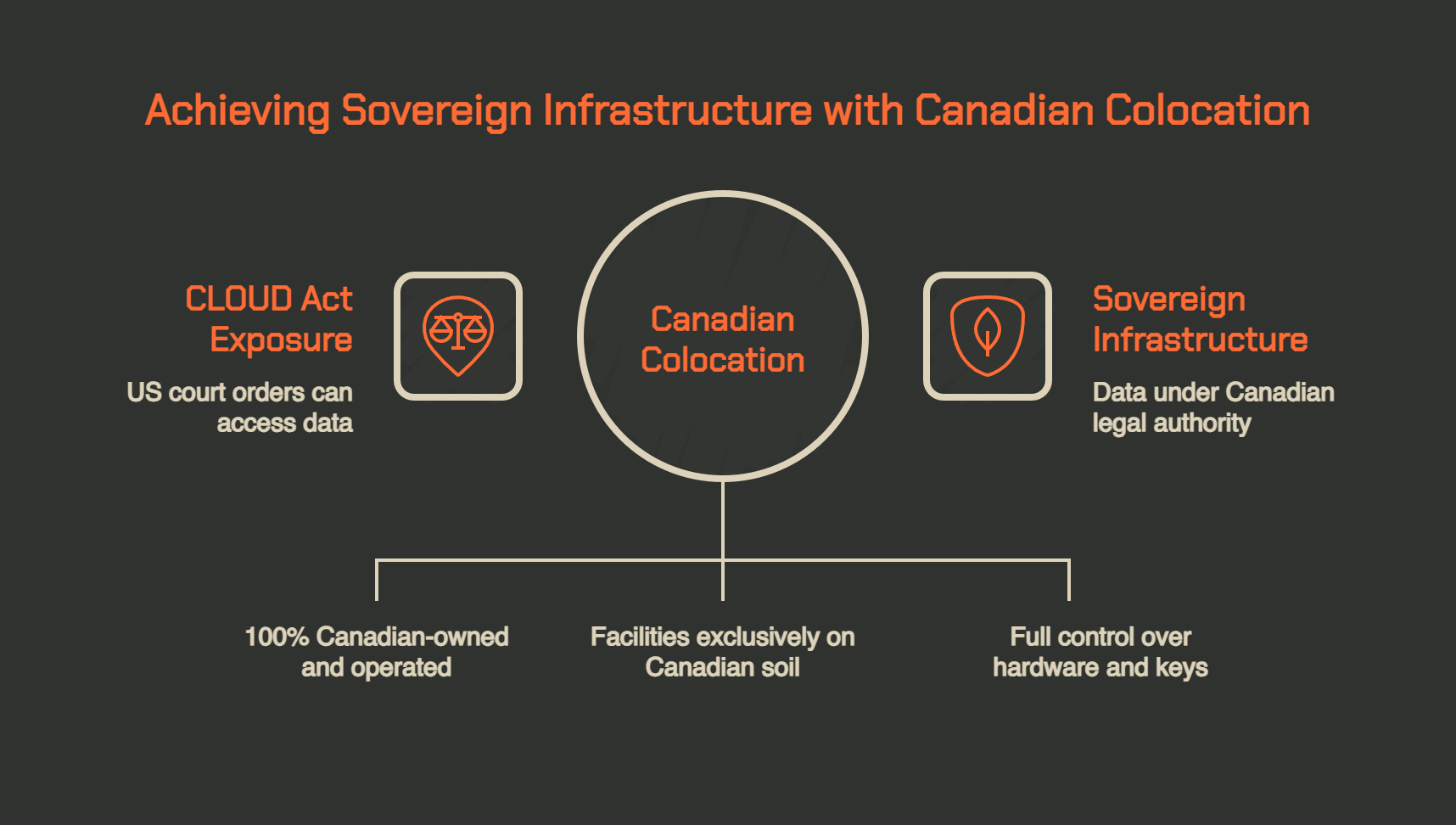
Qu is 100% Canadian-owned, incorporated in Canada, and operates all nine of its carrier-neutral facilities exclusively on Canadian soil across Toronto, Ottawa, Calgary, Edmonton, and London, Ontario. We are not subject to the CLOUD Act. A US court order cannot be served on Qu because Qu is not a US company, has no US parent, and has no US operational dependency.
For CIOs and CISOs working through a sovereignty assessment, the infrastructure layer is where the jurisdictional answer becomes clean. Qu provides colocation infrastructure that keeps your hardware, your data, and your applications under Canadian legal authority, supported by 130+ Canadian employees and 24/7 managed services from teams that have operated these facilities for up to two decades.
Take the first step toward a provably sovereign infrastructure. Talk to our team to book a facility tour and see what Canadian-owned colocation looks like at enterprise scale.
Why Canadian-Owned Colocation Changes the Jurisdictional Equation
The distinction that matters most for CLOUD Act purposes is not "is the data in Canada?" but "is the provider subject to US jurisdiction?" Canadian-owned colocation severs the connection between your data and US legal process at the infrastructure layer. The cloud services running on top of your colocation environment are your choice: Canadian-owned cloud platforms, private virtual infrastructure, or hybrid configurations that avoid US-jurisdictioned dependencies.
Colocation also gives enterprises something that public cloud cannot: full operational control. You own the hardware. You manage the encryption keys. You control who has physical access. There is no technical dependency on a provider that could be legally compelled to produce data without your knowledge.
That combination of Canadian jurisdiction and operational control is what the Balsillie Papers describe when they note that sovereignty requires not just data residency but cryptographic control and audit authority. High-availability connectivity from multiple carriers through a Canadian-owned facility keeps that architecture reliable and flexible without reintroducing foreign jurisdictional exposure.
Encryption and Key Control: Why Contracts With US Providers Are Not Enough
One common mitigation strategy is to use customer-managed encryption keys with a US hyperscale provider. The logic is straightforward: if the data is encrypted and only you hold the key, a CLOUD Act order compelling the provider to produce data effectively produces unintelligible ciphertext. This approach has merit as a technical control and is endorsed by Osler and other legal analysts as a partial mitigation.
The limitation is that encryption protects data at rest, but not necessarily during processing. When your application decrypts data to compute on it, a snapshot of plaintext briefly exists within the provider's infrastructure.
More importantly, encryption key management is itself a dependency that can be targeted: if your key management service runs on the same US provider's platform, the protection is architecturally incomplete. Encryption is a meaningful layer in a sovereignty posture, but it works best when the underlying infrastructure is outside CLOUD Act reach in the first place. Interconnection options through a Canadian-owned colocation facility can support both the network layer and the security architecture without introducing US jurisdictional dependencies.
Why Qu Data Centres Closes Canada's Sovereignty Gap
Most discussions about Canadian data sovereignty end with a list of mitigations: encrypt your data, minimise what you store, negotiate better contracts, wait for bilateral agreements. What they rarely name is the infrastructure choice that makes those mitigations unnecessary at the jurisdictional level.
Qu Data Centres is the only multi-market colocation operator in Canada that delivers all four components of a sovereign infrastructure position simultaneously: data residency across nine facilities on Canadian soil, operational control by 130+ Canadian employees with no offshore dependencies, legal jurisdiction as a Canadian-incorporated entity entirely outside CLOUD Act reach, and Canadian ownership backed by long-term institutional capital with no foreign parent in the chain.
No competitor in the Canadian market replicates this combination across all five of the markets where Qu operates, spanning Calgary, Edmonton, Ottawa, Toronto, and London, Ontario.
For enterprises that need to answer a compliance audit, satisfy an OSFI review, or provide a board with a defensible sovereignty posture, the jurisdictional question has a clean answer when the infrastructure is Qu.
Book a tour today and learn how Qu’s infrastructure guarantees data sovereignty for businesses in Canada.
Frequently Asked Questions About Canada's CLOUD Act Exposure
Does Storing Data in AWS Canada or Azure Canada Protect It from the CLOUD Act?
No. AWS Canada and Azure Canada are operated by US-headquartered parent companies that are subject to US law. The CLOUD Act grants jurisdiction based on corporate control, not server location. A valid US warrant served on Amazon Web Services or Microsoft can compel production of data stored in their Canadian regions, regardless of any data residency commitments in your service agreement.
What Is the Difference Between the CLOUD Act and the Patriot Act?
These are distinct laws with different scopes. The Patriot Act expanded intelligence and surveillance powers broadly after September 11, 2001. The CLOUD Act, passed in 2018, is a narrower procedural law governing how US authorities access electronic data held by technology companies during criminal investigations. It requires probable cause, individual warrants, and prohibits bulk collection. Both create pathways for US government access, but through different mechanisms and for different purposes.
Does PIPEDA Protect Canadian Business Data from the CLOUD Act?
No. PIPEDA governs what Canadian organisations must do with personal information. It does not govern what a US court can compel a US technology company to do. If your cloud provider is a US-incorporated entity, a lawful CLOUD Act order directed at that provider overrides any contractual or policy protections rooted in PIPEDA. Canadian privacy law and US court authority operate on separate legal tracks.
Has the US Ever Actually Accessed Canadian Enterprise Data Under the CLOUD Act?
Documented cases involving Canadian enterprise data specifically are limited. The Osler analysis notes there are no publicly confirmed cases of foreign government access to Canadian enterprise data via cloud providers. That said, US transparency reports show thousands of lawful government requests annually, and non-disclosure provisions mean that affected organisations often have no way to confirm whether they were targeted. The absence of publicised cases does not indicate absence of access.
What Does a CLOUD Act Executive Agreement Between Canada and the US Mean for Businesses?
A bilateral executive agreement would create a reciprocal framework, allowing Canadian law enforcement to request data from US providers more directly, and vice versa. It would not eliminate the existing CLOUD Act mechanism by which US authorities can already compel US providers to produce Canadian data. If anything, a poorly constructed agreement could formalise and expand that access. As of mid-2026, no agreement exists and negotiations remain stalled.
Can Encryption Fully Protect Data from CLOUD Act Requests?
Encryption with customer-managed keys is a meaningful mitigation, but it has limits. It protects data at rest, but when applications decrypt data for processing, plaintext briefly exists within the provider's infrastructure. Key management services hosted on the same US platform can also be reached through legal process. Encryption works best as one layer in a broader architecture that includes a provider outside US jurisdiction, rather than as the sole sovereignty defence.
Sources Used for This Article
- Cross Border Data Forum: "Frequently Asked Questions about the U.S. CLOUD Act" - crossborderdataforum.org/cloudactfaqs/
- Government of Canada: "Government of Canada White Paper: Data Sovereignty and Public Cloud" - canada.ca/en/government/system/digital-government/digital-government-innovations/cloud-services/digital-sovereignty/gc-white-paper-data-sovereignty-public-cloud.html
- Osler: "Data sovereignty in light of the CLOUD Act: back to the future?" - osler.com/en/insights/updates/data-sovereignty-in-light-of-the-cloud-act-back-to-the-future/
- Forbes: "Microsoft Can't Keep EU Data Safe From US Authorities" - forbes.com/sites/emmawoollacott/2025/07/22/microsoft-cant-keep-eu-data-safe-from-us-authorities/
- Legal Information Institute (Cornell Law School): "18 U.S. Code § 2713 - Required disclosure of customer communications or records" - law.cornell.edu/uscode/text/18/2713
- Office of the Superintendent of Financial Institutions: "Technology and Cyber Risk Management (Guideline E-21)" - osfi-bsif.gc.ca/en/risks/technology-cyber-risk-management
- Augure AI: "Canadian data sovereignty in 2026: What's changed" - augureai.ca/blog/canadian-data-sovereignty-in-2026-whats-changed
- National Magazine: "How to address Canada's digital data disclosures with the U.S." - nationalmagazine.ca/en-ca/articles/cba-influence/submissions/2025/how-to-address-canada-s-digital-data-disclosures-with-the-u-s
- Northpoint Legal: "R. v. Bykovets, 2024 SCC 6 – Summary of Case" - northpointlegal.ca/blog/r-v-bykovets-2024-scc-6-summary-of-case
- CIRA: "2025 Cybersecurity Survey" - cira.ca/en/resources/documents/cybersecurity/2025-cybersecurity-survey/





Quick Answer: The US CLOUD Act (Clarifying Lawful Overseas Use of Data Act) gives American authorities the power to compel US-headquartered technology companies to hand over data they control, regardless of where that data is physically stored. For Canadian businesses, this means that hosting data in a Canadian region of AWS, Microsoft Azure, or Google Cloud does not shield it from US jurisdiction. The legal reach follows the company, not the server. Genuine protection requires infrastructure operated by a provider that falls outside US legal authority entirely.
Key Takeaways
It was supposed to be a solved problem. You host your data in Canada, your privacy policy says so, your vendor contract confirms Canadian data residency, and you move on. Except that for a growing number of Canadian organisations, that framework is coming apart under regulatory scrutiny, board-level risk reviews, and some uncomfortable questions from legal counsel.
The issue is not whether your data physically sits in Toronto or Calgary. The issue is whether the company storing it is subject to US law.
That is a different question entirely, and most infrastructure buying decisions have not been made with that distinction in mind. For enterprises operating in healthcare, financial services, legal, government, or any regulated sector, the gap between "data in Canada" and "data under Canadian jurisdiction" is where real compliance exposure lives.
This piece cuts through the misconceptions about the US CLOUD Act, explains what it means for Canadian enterprises specifically, and maps out what an architecture that genuinely reduces jurisdictional exposure looks like.
What the US CLOUD Act Is and Why It Reaches Canadian Data
The CLOUD Act is often conflated with older, broader US surveillance tools. Before examining the exposure it creates for Canadian businesses, it helps to be precise about what the law actually does and how it differs from other US data access frameworks.
How CLOUD Act Orders Work
The Clarifying Lawful Overseas Use of Data Act was passed by the US Congress in 2018. It amended the Stored Communications Act to clarify that US technology companies must comply with lawful US court orders for data in their possession, custody, or control, regardless of where that data is physically stored.
A warrant is served on the US-based provider directly. No diplomatic channels, no mutual legal assistance treaty, no notice to the Canadian organisation whose data is involved.
The mechanism is straightforward: a US authority issues a warrant for specific data, serves it on a provider subject to US jurisdiction that has access to that data, and the provider is legally obligated to comply.
The Cross-Border Data Forum's authoritative CLOUD Act FAQ confirms that US jurisdiction over a provider is determined by the provider's connections to the US, not by the geographic location of the data. This is what makes the law so far-reaching for Canadian enterprises: jurisdiction follows corporate control, not server coordinates.
One comparison that comes up often is the CLOUD Act vs the Patriot Act. They are not the same thing.
The Patriot Act, passed after September 11, 2001, authorised broad intelligence and surveillance collection. The CLOUD Act is narrower and more procedural: it sets a defined legal process for criminal investigations, requires probable cause, prohibits bulk data collection, and preserves a provider's right to challenge orders on comity grounds if compliance would violate another country's laws.
That difference matters, but it does not remove the core exposure. A lawful, targeted request is still a request your Canadian data is subject to.
Data Residency Vs. Data Sovereignty
Data residency means your data is physically stored within a specific geographic boundary. Data sovereignty means your data is subject only to the laws of a specific jurisdiction.
These are related but genuinely different, and confusing them is where most enterprise infrastructure decisions go wrong.
The Government of Canada's own White Paper on Data Sovereignty and Public Cloud puts this plainly: a cloud service provider with foreign operations could be required to comply with a warrant, court order, or subpoena request from a foreign law enforcement agency. The document explicitly notes that under some foreign laws, disclosure of Canadian government data could take place without notice. Data residency does not mitigate against the application of foreign laws. Only the jurisdictional status of the provider does.
This distinction has moved from academic to operational. Osler's analysis of the CLOUD Act notes that using a Canadian service provider or storing data in Canada does not guarantee data will be beyond the reach of courts in other countries if the provider has any US presence. The relevant question is not where your data lives. It is who has possession, custody, or control of it, and what laws govern that entity.
Why a "Canadian Region" Does Not Mean Canadian Jurisdiction
Canadian regions of AWS, Microsoft Azure, and Google Cloud are marketed as a Canadian hosting solution, and in terms of physical location, they are. But the parent companies are American corporations subject to US law, and the CLOUD Act follows that corporate relationship directly.
The Parent Jurisdiction Problem with US Hyperscalers in Canada
AWS Canada (Central), Azure Canada Central, and Google Cloud's Montreal region are all physically located on Canadian soil. However, Amazon Web Services is incorporated in the United States, as are Microsoft and Google. When a US court issues a valid warrant to AWS for data in that company's possession or control, the fact that the particular servers are in Toronto does not sever the legal obligation.
The parent company's jurisdiction is what the CLOUD Act triggers, not the physical address of the infrastructure.
This is not a problem that we’re making up.
In June 2025, Microsoft France's director of public and legal affairs was asked directly before the French Senate whether he could guarantee that data stored in France would not be transmitted to US authorities under a legal order. He could not. That testimony applies identically to Canadian data hosted with any US-parented provider.
The Balsillie Papers' analysis of the CLOUD Act and Canadian data frames this precisely: data residency is a necessary but insufficient condition for sovereignty. What it cannot resolve is the jurisdictional exposure of the provider itself.
A Canadian subsidiary of a US company does not automatically escape CLOUD Act reach either. The critical test is whether the US parent has possession, custody, or control over the data. In practice, US hyperscalers operate their Canadian regions under unified global platforms, with operational access, support infrastructure, and key management systems that cross borders. The corporate relationship is what creates the exposure.
What "Possession, Custody, or Control" Legally Means for Your Data
The exact language of the CLOUD Act is "possession, custody, or control," and each of those three terms matters.
For enterprise buyers, this means the question is not just whether your data is in Canada. It is whether the entity you have contracted with can technically reach that data through its own systems, and whether that entity is subject to US jurisdiction. If both answers are yes, the CLOUD Act can reach your data. The law's full text at 18 U.S.C. § 2713 makes no geographic exception for where data is held: the obligation follows the provider's access, not the data's address.
Non-Disclosure Orders: When Your Data Is Accessed and You Never Find Out
One of the least-discussed aspects of CLOUD Act orders is the non-disclosure provision. When a US court issues a warrant to a provider, it can also order that provider not to notify the affected customer.
This means a Canadian enterprise could have its data accessed pursuant to a US legal order and have no legal mechanism to find out it happened, at least not immediately.
The Government of Canada's own White Paper acknowledges this directly, noting that under some foreign laws, disclosure of government data could take place without notice. This creates a practical compliance problem that contracts and privacy policies cannot solve: your incident response plan assumes you will know when a data access event occurs.
A CLOUD Act order with a non-disclosure attachment breaks that assumption. For organisations with regulated data, obligations around breach notification and data access logging become difficult to fulfil if the access itself is legally hidden from you.
SaaS Tools and the Hidden Exposure Chain in Your Own Stack
The exposure does not stop at your primary infrastructure provider. Every US-incorporated SaaS tool in your stack that touches personal data or regulated information carries its own jurisdictional profile.
Your HR platform, your project management system, your CRM, your email provider: if any of these are US companies with access to regulated data, each is a distinct CLOUD Act exposure point.
The pattern from legal guidance across multiple Canadian frameworks is consistent: organisations must assess the full chain of data handling, not just the primary hosting provider. This is worth mapping specifically for:
Auditing the full stack, not just the data centre contract, is where a defensible sovereignty posture begins. Organizations looking to reduce backup and disaster recovery exposure alongside primary infrastructure risk will find that both layers need to be assessed under the same jurisdictional framework.
Dimension
What It Means
Does a US Hyperscale Canadian Region Solve It?
What Does Solve It
Data residency
Physical location of data in Canada
Yes
Canadian-owned colocation or on-premises
Legal jurisdiction
Which country's courts govern access
No
Provider incorporated and operating in Canada
Possession/custody/control
Can the provider technically access the data?
No
Provider with no US operational dependency
Non-disclosure risk
Can you be notified if data is accessed?
No
Canadian legal process with notification rights
PIPEDA compliance
Canadian privacy law accountability
Partial
Canadian jurisdiction with full accountability
Regulated sector obligations (OSFI, PHIPA)
Sector-specific third-party risk
Partial
Provider outside foreign compulsion mechanisms
Where Different Industries Face the Sharpest CLOUD Act Risk
CLOUD Act exposure is not uniform across all organisations. The severity of the compliance risk depends heavily on what type of data you handle and which regulatory regime governs your sector. Three industry groups face the sharpest practical consequences.
Financial Services: OSFI Guideline B-13 and Third-Party Risk
OSFI Guideline B-13, effective January 1, 2024, sets technology and cyber risk expectations for all federally regulated financial institutions. It is principles-based rather than prescriptive, but the supervisory expectations are clear: institutions must demonstrate they understand and can manage jurisdictional and third-party risks.
An institution that cannot account for its exposure to foreign government access through cloud providers will struggle to satisfy OSFI's technology risk governance requirements.
The specific concern is third-party oversight. B-13 requires institutions to maintain meaningful control over outsourced functions, including cloud-hosted systems. When a cloud provider is subject to a legal order your organisation cannot challenge in a Canadian court, the oversight model breaks down.
Three federally regulated financial institutions received formal OSFI letters in 2025 specifically questioning their analysis of foreign government access risks, according to reporting tracked by Augure AI.
Healthcare Data Under PHIPA and Provincial Privacy Acts
Healthcare data in Canada is protected by a web of provincial legislation: Ontario's Personal Health Information Protection Act (PHIPA), Alberta's Health Information Act (HIA), and BC's E-Health Act, among others. These frameworks require health information custodians to protect personal health information against unauthorised access and to maintain meaningful oversight of how that data is handled by third parties.
A US-hosted infrastructure environment creates a category of access that sits outside Canadian judicial oversight entirely. If a CLOUD Act order compels an American cloud provider to produce patient records, the Ontario PHIPA regime has no mechanism to intervene.
Alberta Health Services terminated two vendor contracts in late 2025 after determining their US infrastructure violated Alberta's Health Information Act section 60.1 regarding cross-border disclosures. Healthcare organisations evaluating their colocation options as an alternative to US hyperscale hosting are often motivated precisely by this exposure.
Law Firms, Legal Privilege, and Client Confidentiality
Solicitor-client privilege is foundational to the Canadian legal system. A client communicates with their lawyer in confidence, and that confidence is legally protected. When a law firm's document management system, email archive, or case management platform is hosted by a US-jurisdictioned provider, a CLOUD Act order targeting that provider bypasses Canadian legal process entirely.
This is not a scenario any law society oversight body regards lightly. A CLOUD Act request directed at a US-hosted file storage provider would not require Canadian judicial authorisation, would not necessarily generate notice to the law firm, and would grant access to client-matter files that would otherwise be protected by some of the strongest legal privileges in the country. The risk sits not with the law itself, but with where client data is stored and under whose legal authority it can be compelled.
Where Canada Stands on a CLOUD Act Agreement with the US
Canada and the US announced the beginning of bilateral CLOUD Act agreement negotiations in March 2022. As of mid-2026, no agreement has been finalised. The negotiation was launched through the Cross-Border Crime Forum, an initiative focused on cybercrime, violent extremism, and gun violence, but the negotiations have stalled amid broader bilateral tensions.
The Canadian Bar Association's Privacy and Access Law Section submitted formal recommendations in November 2024 calling for significant safeguards before any agreement is signed: Canadian judicial authorisation before disclosure, preservation of MLAT processes for demands targeting Canadians, and explicit privacy law clarification. Those conditions have not been met in any finalised text.
Canada's Supreme Court has already rejected the US "third-party doctrine" in R. v. Bykovets, 2024 SCC 6, creating meaningful constitutional incompatibility between how the two countries approach digital evidence.
Whether or not an agreement is eventually reached, the core problem does not disappear. US companies are already subject to US law, with or without a bilateral framework. An executive agreement would create a reciprocal process for Canadian law enforcement to request data from US providers, but it would not eliminate the existing mechanism for US authorities to compel disclosure of Canadian data held by US companies.
The CIRA 2025 Cybersecurity Survey found that 69% of Canadian organisations now cite data sovereignty as their top consideration when sourcing technology solutions, ahead of price, functionality, and support. The market has concluded that waiting for a diplomatic solution is not a strategy.
What Infrastructure That Reduces CLOUD Act Exposure Looks Like
Reducing CLOUD Act exposure is an architectural outcome, not a contractual one. Contracts with US providers may include data residency commitments, sovereignty assurances, and notification obligations, but none of those provisions override a valid US court order. The only way to change the legal equation is to change who controls the infrastructure.
For Canadian organisations that have evaluated this landscape and concluded that hyperscale cloud's jurisdictional risk is no longer acceptable, Qu Data Centres offers a concrete infrastructure alternative.
Qu is 100% Canadian-owned, incorporated in Canada, and operates all nine of its carrier-neutral facilities exclusively on Canadian soil across Toronto, Ottawa, Calgary, Edmonton, and London, Ontario. We are not subject to the CLOUD Act. A US court order cannot be served on Qu because Qu is not a US company, has no US parent, and has no US operational dependency.
For CIOs and CISOs working through a sovereignty assessment, the infrastructure layer is where the jurisdictional answer becomes clean. Qu provides colocation infrastructure that keeps your hardware, your data, and your applications under Canadian legal authority, supported by 130+ Canadian employees and 24/7 managed services from teams that have operated these facilities for up to two decades.
Take the first step toward a provably sovereign infrastructure. Talk to our team to book a facility tour and see what Canadian-owned colocation looks like at enterprise scale.
Why Canadian-Owned Colocation Changes the Jurisdictional Equation
The distinction that matters most for CLOUD Act purposes is not "is the data in Canada?" but "is the provider subject to US jurisdiction?" Canadian-owned colocation severs the connection between your data and US legal process at the infrastructure layer. The cloud services running on top of your colocation environment are your choice: Canadian-owned cloud platforms, private virtual infrastructure, or hybrid configurations that avoid US-jurisdictioned dependencies.
Colocation also gives enterprises something that public cloud cannot: full operational control. You own the hardware. You manage the encryption keys. You control who has physical access. There is no technical dependency on a provider that could be legally compelled to produce data without your knowledge.
That combination of Canadian jurisdiction and operational control is what the Balsillie Papers describe when they note that sovereignty requires not just data residency but cryptographic control and audit authority. High-availability connectivity from multiple carriers through a Canadian-owned facility keeps that architecture reliable and flexible without reintroducing foreign jurisdictional exposure.
Encryption and Key Control: Why Contracts With US Providers Are Not Enough
One common mitigation strategy is to use customer-managed encryption keys with a US hyperscale provider. The logic is straightforward: if the data is encrypted and only you hold the key, a CLOUD Act order compelling the provider to produce data effectively produces unintelligible ciphertext. This approach has merit as a technical control and is endorsed by Osler and other legal analysts as a partial mitigation.
The limitation is that encryption protects data at rest, but not necessarily during processing. When your application decrypts data to compute on it, a snapshot of plaintext briefly exists within the provider's infrastructure.
More importantly, encryption key management is itself a dependency that can be targeted: if your key management service runs on the same US provider's platform, the protection is architecturally incomplete. Encryption is a meaningful layer in a sovereignty posture, but it works best when the underlying infrastructure is outside CLOUD Act reach in the first place. Interconnection options through a Canadian-owned colocation facility can support both the network layer and the security architecture without introducing US jurisdictional dependencies.
Why Qu Data Centres Closes Canada's Sovereignty Gap
Most discussions about Canadian data sovereignty end with a list of mitigations: encrypt your data, minimise what you store, negotiate better contracts, wait for bilateral agreements. What they rarely name is the infrastructure choice that makes those mitigations unnecessary at the jurisdictional level.
Qu Data Centres is the only multi-market colocation operator in Canada that delivers all four components of a sovereign infrastructure position simultaneously: data residency across nine facilities on Canadian soil, operational control by 130+ Canadian employees with no offshore dependencies, legal jurisdiction as a Canadian-incorporated entity entirely outside CLOUD Act reach, and Canadian ownership backed by long-term institutional capital with no foreign parent in the chain.
No competitor in the Canadian market replicates this combination across all five of the markets where Qu operates, spanning Calgary, Edmonton, Ottawa, Toronto, and London, Ontario.
For enterprises that need to answer a compliance audit, satisfy an OSFI review, or provide a board with a defensible sovereignty posture, the jurisdictional question has a clean answer when the infrastructure is Qu.
Book a tour today and learn how Qu’s infrastructure guarantees data sovereignty for businesses in Canada.
Frequently Asked Questions About Canada's CLOUD Act Exposure
Does Storing Data in AWS Canada or Azure Canada Protect It from the CLOUD Act?
No. AWS Canada and Azure Canada are operated by US-headquartered parent companies that are subject to US law. The CLOUD Act grants jurisdiction based on corporate control, not server location. A valid US warrant served on Amazon Web Services or Microsoft can compel production of data stored in their Canadian regions, regardless of any data residency commitments in your service agreement.
What Is the Difference Between the CLOUD Act and the Patriot Act?
These are distinct laws with different scopes. The Patriot Act expanded intelligence and surveillance powers broadly after September 11, 2001. The CLOUD Act, passed in 2018, is a narrower procedural law governing how US authorities access electronic data held by technology companies during criminal investigations. It requires probable cause, individual warrants, and prohibits bulk collection. Both create pathways for US government access, but through different mechanisms and for different purposes.
Does PIPEDA Protect Canadian Business Data from the CLOUD Act?
No. PIPEDA governs what Canadian organisations must do with personal information. It does not govern what a US court can compel a US technology company to do. If your cloud provider is a US-incorporated entity, a lawful CLOUD Act order directed at that provider overrides any contractual or policy protections rooted in PIPEDA. Canadian privacy law and US court authority operate on separate legal tracks.
Has the US Ever Actually Accessed Canadian Enterprise Data Under the CLOUD Act?
Documented cases involving Canadian enterprise data specifically are limited. The Osler analysis notes there are no publicly confirmed cases of foreign government access to Canadian enterprise data via cloud providers. That said, US transparency reports show thousands of lawful government requests annually, and non-disclosure provisions mean that affected organisations often have no way to confirm whether they were targeted. The absence of publicised cases does not indicate absence of access.
What Does a CLOUD Act Executive Agreement Between Canada and the US Mean for Businesses?
A bilateral executive agreement would create a reciprocal framework, allowing Canadian law enforcement to request data from US providers more directly, and vice versa. It would not eliminate the existing CLOUD Act mechanism by which US authorities can already compel US providers to produce Canadian data. If anything, a poorly constructed agreement could formalise and expand that access. As of mid-2026, no agreement exists and negotiations remain stalled.
Can Encryption Fully Protect Data from CLOUD Act Requests?
Encryption with customer-managed keys is a meaningful mitigation, but it has limits. It protects data at rest, but when applications decrypt data for processing, plaintext briefly exists within the provider's infrastructure. Key management services hosted on the same US platform can also be reached through legal process. Encryption works best as one layer in a broader architecture that includes a provider outside US jurisdiction, rather than as the sole sovereignty defence.
Sources Used for This Article
Paul M
Paul Miedzik is Senior Manager of Marketing at Qu Data Centres, with extensive experience in enterprise cloud and digital infrastructure across the Canadian tech sector.