Quick Answer: GPU-as-a-Service (GPUaaS) is a cloud model where organisations access GPU compute on demand without purchasing physical hardware. Providers own and manage the infrastructure; customers pay per hour or per job. For teams still building out their AI strategy, rental is often the right starting point. As workloads scale and data becomes more sensitive, the cost and compliance calculus often shifts toward dedicated GPU infrastructure housed in a certified colocation facility.
Key Takeaways
- GPU-as-a-Service gives organisations on-demand access to high-performance GPU compute, including NVIDIA H100 and A100 GPUs, through the cloud on a pay-per-use basis with no hardware ownership required
- Cloud GPU rental suits burst workloads and early-stage AI development, but sustained production workloads can cost four to six times more than equivalent owned infrastructure over time
- Owning GPU hardware on-premises requires more than just the hardware itself: power density, cooling, and physical infrastructure add significant cost and operational complexity
- GPU colocation is a middle path that most comparisons ignore: you own the GPUs, a certified data centre operator handles everything around them
- For Canadian enterprises processing sensitive or regulated data, the legal ownership chain of your GPU infrastructure matters as much as where the servers physically sit.
- Qu Data Centres operates high-density, sovereign colocation environments built for exactly this across five Canadian markets. Book a tour to learn more today.
GPU compute was once specialised territory for research labs and graphics workloads. Now it sits at the centre of how organisations run inference pipelines, fine-tune internal models, and process data volumes that traditional server configurations were never designed for.
Most companies started with cloud GPUs, and that worked well enough during the experimental phase. But as AI workloads move from proof-of-concept into production, there are harder questions you have to answer. Is the rental model still financially sound at this scale? Where exactly does training data sit when it is actively being processed, and does the infrastructure create legal or compliance exposure?
These are not questions you can avoid answering. They separate organisations building AI on a durable footing from those who will spend the next several years renegotiating expensive cloud contracts.
Most published guidance on this topic is written for AI startups. Regulated Canadian enterprises in financial services, healthcare, energy, and government face a different version of this decision entirely. One where GPU infrastructure is also a compliance and sovereignty question.
How GPU-as-a-Service Works
GPU-as-a-Service sits within the broader Infrastructure-as-a-Service (IaaS) category. What makes it distinct is the hardware it delivers: GPUs, which process thousands of operations in parallel and are built for the compute demands of AI training and inference workloads. Rather than purchasing and managing GPU servers, organisations access this compute through a cloud platform, paying for what they use and releasing it when the job is done.
The model became commercially widespread once providers built the supporting infrastructure around the GPU itself. High-speed interconnects between nodes, storage systems capable of feeding data at the rate GPUs consume it, and orchestration tools that reduce cluster provisioning from months to minutes made GPU-as-a-service practical for organisations without deep hardware operations expertise.
On-Demand, Reserved, and Dedicated: The Three Rental Models
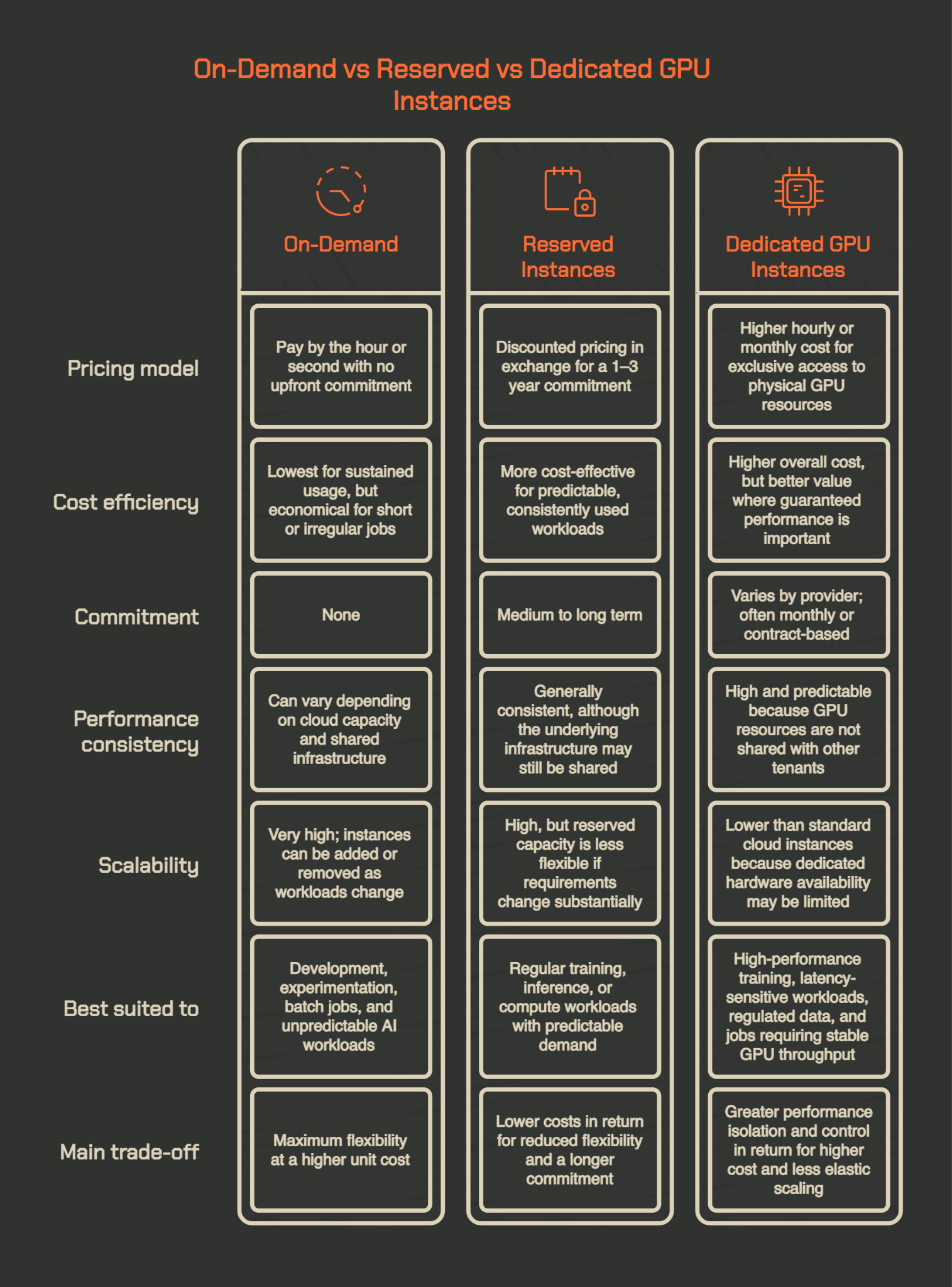
Not all GPU-as-a-service setups are structured the same way. The access model an organisation selects shapes both cost and performance characteristics over time:
- On-Demand: Billed per hour or per second with no upfront commitment. Best suited to variable or unpredictable workloads where job frequency and duration change significantly from week to week.
- Reserved Instances: A term commitment, typically one to three years, in exchange for lower hourly rates. Works well for organisations with predictable workloads that want cloud-managed infrastructure without full capital expenditure.
- Dedicated GPU Instances: Exclusive physical access to a GPU server, removing shared-tenancy performance variability. Higher per-hour cost, but consistent throughput and data isolation that approaches what owned hardware delivers.
This may seem like a menial choice but the gap between on-demand and reserved rates can be substantial, often 40 to 60 percent for the same hardware over a committed term.
What the Provider Manages Vs. What You Control
In any GPUaaS arrangement, the provider handles hardware procurement, data centre power and cooling, driver and firmware updates, hardware replacement on failure, and the networking fabric between GPU nodes. The customer controls the software stack above that layer: the model, the training pipeline, the data, and the security configuration of the workload environment. That trade-off is operational simplicity in exchange for reduced visibility into and control over the physical infrastructure layer.
Cloud GPU Pricing at Enterprise Scale
Cloud GPU rental is often the right starting point, and the per-hour economics at small scale make a compelling case. Organisations running intermittent training jobs or testing model architectures can access current-generation hardware without committing capital to equipment that may sit underutilised between experiments. The low friction of getting started is a genuine advantage in the early stages of an AI programme.
The picture changes as workloads become sustained and predictable.
The Per-Hour Cost Over Sustained Workloads
Cloud GPU costs can run four to six times higher than equivalent owned infrastructure at sustained production scale, once hardware, power, cooling, and staffing are factored in.
That multiple reflects the legitimate operational overhead the provider absorbs on the customer's behalf, not an inefficiency in the model itself. But for organisations running training jobs continuously or inference endpoints that cannot be turned off between business hours, cost per compute hour accumulates in ways that look very different at 80 percent utilisation than they did at 10 percent.
A single eight-GPU H100 training node starts at roughly $220,000 before networking and storage. At cloud rental rates for equivalent hardware, that capital outlay is often recovered within twelve to eighteen months of sustained usage. Beyond that horizon, the organisation is paying the rental premium indefinitely.
On shared GPU infrastructure, neighbouring tenants affect performance. This matters less for short, isolated inference jobs and significantly more for large distributed training runs where consistency across nodes is critical to completing the job on schedule. High-performance interconnects like InfiniBand fabric, which can operate at 400 Gb/s between nodes, are available on specialist GPU clouds but shared infrastructure introduces run-to-run variability that dedicated environments eliminate. For regulated industries where model reproducibility is an audit requirement, that variability is more than a performance inconvenience.
What Running Your Own GPU Cluster Requires
When cloud GPU costs hit an inflection point, the logical question is whether to bring the hardware in-house. For most mid-market enterprises, the answer is more complicated than the hardware invoice suggests. The GPU itself is only one component of what makes a training cluster function reliably at production scale.
This is the part of the rent-vs-buy conversation that most cost calculators skip entirely.
Power, Cooling, and Space at GPU Rack Density
Each H100 server draws approximately 10 kilowatts of power. An eight-GPU training node in a standard rack configuration draws more power than most enterprise server rooms were ever designed to support. Standard enterprise data centres typically provision three to five kilowatts per rack, while GPU-dense AI workloads frequently require 15 kW or more, demanding dedicated power distribution, upgraded cooling, and in many cases structural modifications to the facility itself.
Why On-Premises GPU Infrastructure Rarely Pencils Out
Beyond power and cooling, running a GPU cluster on-premises requires a set of operational capabilities that most enterprises do not already have in place:
- 24/7 operations staff trained on GPU hardware and high-density infrastructure management
- Hardware maintenance capability for equipment representing hundreds of thousands of dollars per node
- Physical security appropriate for high-value, mission-critical assets
- High-speed internal networking capable of sustaining the bandwidth GPU nodes require between themselves during distributed training
- Spare hardware inventory to avoid extended downtime when components fail
For organisations that have costed all of this honestly, building the infrastructure around the GPUs often exceeds the cost of the GPUs themselves. This is precisely why GPU colocation has grown as a distinct infrastructure model.
GPU Colocation: Own the Hardware, Not the Facility
For enterprises that have crossed the utilisation threshold where cloud GPU rental no longer makes financial sense, GPU colocation offers a model that most rent-vs-buy comparisons ignore entirely. The organisation purchases or leases the GPU hardware. A certified data centre operator houses it in a purpose-built facility with the power density, cooling infrastructure, physical security, and carrier connectivity the hardware requires. The organisation retains full control of the equipment and everything it processes, while the provider handles everything at the facility layer.
This is where Qu Data Centres becomes the relevant part of the conversation. Qu operates nine carrier-neutral colocation facilities across five Canadian markets, spanning Calgary, Edmonton, Ottawa, Toronto, and London, Ontario, with high-density environments engineered specifically for GPU and AI workloads.
Several facilities support power densities up to 15 kW per rack, matching the requirements of current-generation GPU servers without modifications on the customer's side.
For Canadian enterprises that need dedicated AI compute on sovereign infrastructure available now rather than in eighteen months, Qu's colocation environments are built for that deployment model. Here’s how Qu’s colocation can help.
How GPU Colocation Differs From Cloud Rental and On-Premises
The three infrastructure models are often conflated in comparisons, but they represent genuinely different ownership and control structures:
- Cloud GPU Rental: The provider owns both the hardware and the facility. You pay per hour for access with no hardware commitment and no physical control over the equipment.
- On-Premises GPU Ownership: You own the hardware and are fully responsible for the facility it runs in. Maximum control, maximum infrastructure obligation.
- GPU Colocation: You own the hardware. A certified data centre operator maintains the facility infrastructure around it. You control the equipment and the data, without the facility build cost.
Colocation sits between the other two models in terms of commitment and control. It is the model that makes sense once workloads are sustained enough to justify hardware ownership but where building or upgrading an on-premises facility is not operationally or financially practical.
What High-Density Colocation Environments Deliver
A GPU-ready colocation facility provides more than physical rack space. The infrastructure stack covers redundant power distribution with automatic failover, precision cooling engineered for the thermal output of dense GPU configurations, carrier-neutral high-speed fibre connectivity, physical access controls, and around-the-clock monitoring.
The cooling infrastructure required to sustain GPU workloads reliably is a significant engineering undertaking that most enterprise server rooms cannot accommodate without major capital investment. For organisations with compliance requirements, facilities certified to SOC 2, ISO 27001, and PCI DSS provide the audit trail and control documentation that regulated industries require.
Compliance and Sovereignty in Canadian AI Workloads
For many organisations evaluating GPU infrastructure, compliance is the variable that changes the entire calculation. The cost comparison between cloud rental and dedicated infrastructure looks different once you factor in what happens if the jurisdiction of your compute environment creates a regulatory exposure. In regulated Canadian industries, that exposure is not theoretical.
Data Sovereignty Applies During Processing, Not Just Storage
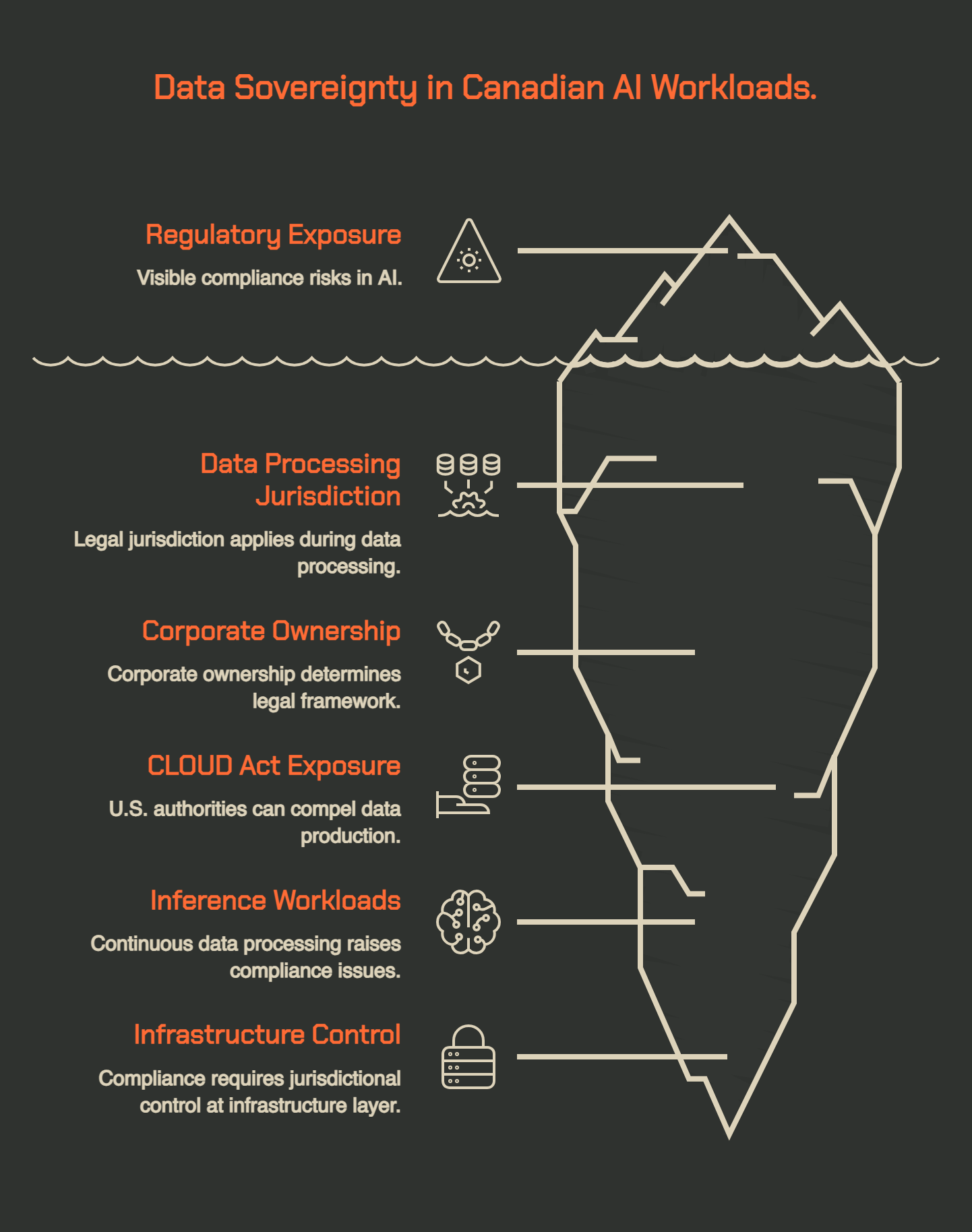
Most data sovereignty discussions focus on where data is stored. The more operationally significant question for AI workloads is where data is actively processed. When an organisation trains a model on patient records, financial transaction data, or sensitive government information, that data is present in the GPU memory of the infrastructure running the job.
If that infrastructure is owned or operated by a company incorporated in the United States, the legal jurisdiction of the compute applies to the data during processing, not only when it is at rest in storage.
Physical location in a Canadian region of a U.S.-owned provider does not resolve this exposure. The corporate ownership chain, not the geographic coordinates of the server, determines which legal framework governs the infrastructure operator.
CLOUD Act Exposure in U.S.-Parented GPU Infrastructure
The U.S. CLOUD Act enables American authorities to compel U.S.-incorporated companies to produce data stored or processed on their infrastructure, regardless of where that infrastructure physically sits. This applies to hyperscaler GPU instances in Canadian regions and to any GPU cloud provider with a U.S. parent entity. Organisations in regulated Canadian industries need to verify not only where their GPU infrastructure is located geographically, but who owns and operates the company providing it.
Our breakdown of Canada's CLOUD Act exposure covers the legal mechanics in full. This consideration extends to inference workloads as well: if a production AI endpoint is processing sensitive data continuously, the jurisdiction of that compute environment is a live compliance issue throughout the application lifecycle. When GPU workloads involve regulated data, compliance requires jurisdictional control at the infrastructure layer, not just at the application level, and shared cloud tenancy rarely provides that level of control.
Renting vs. Owning GPUs: How to Decide for Your Organisation
The decision between cloud GPU rental and dedicated infrastructure is not purely a cost question, though cost is usually where the analysis begins. The more durable framework evaluates four variables together: workload predictability, compliance obligations, time-to-deployment constraints, and whether the data being processed triggers sovereignty considerations.
|
Factor
|
Cloud GPU Rental
|
GPU Colocation
|
|
Upfront cost
|
None
|
Hardware purchase and setup
|
|
Cost at sustained scale
|
High, often 4 to 6x owned over time
|
Predictable, lower per compute hour
|
|
Hardware control
|
Provider-managed
|
Customer-owned
|
|
Data jurisdiction
|
Provider's legal framework
|
Determined by facility ownership
|
|
Compliance suitability
|
Limited for regulated data
|
High, with certified facility
|
|
Time to first deployment
|
Minutes
|
Days to weeks
|
|
Best workload fit
|
Variable, burst, early-stage AI
|
Sustained, production, compliance-bound
|
Why Qu Data Centres for Dedicated AI Infrastructure
Enterprises at the point where cloud GPU costs are no longer justified need infrastructure that is ready now. Qu Data Centres operates nine facilities across Calgary, Edmonton, Ottawa, Toronto, and London, Ontario, all on Canadian soil, under Canadian legal jurisdiction, and operated entirely by Canadian staff with no offshore network operations centre. Four facilities hold Uptime Institute Tier III certification, covering the redundancy and concurrent maintainability that production AI workloads depend on.
Qu's high-density environments are built for GPU rack densities that standard enterprise data centres cannot support, with power distribution and cooling infrastructure matched to current-generation GPU server requirements. Connectivity across 15 or more carrier networks gives AI infrastructure the diverse, low-latency routing that inference endpoints and distributed training clusters require.
SOC 1, SOC 2, ISO 27001, HIPAA, and PCI DSS certifications satisfy the audit requirements of regulated industries across financial services, healthcare, energy, and government across Qu's full range of solutions.
If your AI workloads have outgrown cloud GPU economics or your compliance posture demands infrastructure you can genuinely control, we can help. Book a tour to learn more today.
Frequently Asked Questions About GPU-as-a-Service
What Is GPU-as-a-Service and How Does It Work?
GPU-as-a-Service is a cloud model where organisations access GPU compute over the internet on a pay-per-use basis. Providers own and manage the physical GPU hardware and data centre infrastructure. Customers pay per hour, per second, or per completed job through an API or cloud portal, with no hardware purchase or facility management required.
Is GPU-as-a-Service Worth It for Enterprise AI Workloads?
For variable or early-stage workloads, cloud GPU rental is typically the most practical starting point. As workloads become sustained and predictable, the economics shift. Organisations running continuous training jobs or always-on inference at high utilisation often find that dedicated GPU infrastructure costs significantly less per compute hour over a twelve to eighteen month horizon.
What Is the Difference Between Shared and Dedicated GPU Instances?
Shared GPU instances divide physical GPU resources among multiple tenants, reducing the per-hour cost but introducing performance variability. Dedicated instances give a single customer exclusive access to the physical GPU, eliminating resource contention. Dedicated instances deliver consistent throughput and full data isolation, making them better suited to production workloads with strict performance or compliance requirements.
Does Data Sovereignty Apply to Cloud GPU Workloads?
Yes, in ways many organisations do not anticipate. Data sovereignty applies to data during active processing, not only when it is at rest. If your GPU compute runs on infrastructure owned by a company incorporated in another country, that country's legal framework may apply to your data during training or inference, regardless of where the servers physically sit.
What Infrastructure Do NVIDIA H100 and A100 GPUs Require in a Data Centre?
Both GPU families draw significant power per server. An H100-based server requires approximately 10 kilowatts per node, well beyond standard enterprise rack densities of three to five kilowatts. Facilities housing these GPUs need dedicated power distribution, precision cooling, and high-speed node-to-node interconnects sized for the thermal and networking demands of GPU-dense AI workloads.
Sources Used for This Article
- Penguin Solutions: "Rent or Buy My AI Factory? Every Enterprise CIO's Question As They Scale AI" - penguinsolutions.com/en-us/resources/blog/rent-vs-buy-ai-factory
- NVIDIA: "NVIDIA InfiniBand Switches" - nvidia.com/en-us/networking/infiniband-switching/
- NVIDIA: "Planning a Data Center Deployment — NVIDIA DGX SuperPOD: Data Center Design Featuring NVIDIA DGX H100 Systems" - docs.nvidia.com/dgx-superpod/design-guides/dgx-superpod-data-center-design-h100/latest/planning.html
- Spheron: "Canada GPU Availability 2026: Sovereign AI & Data Residency" - spheron.network/blog/canada-gpu-availability-2026/



Quick Answer: GPU-as-a-Service (GPUaaS) is a cloud model where organisations access GPU compute on demand without purchasing physical hardware. Providers own and manage the infrastructure; customers pay per hour or per job. For teams still building out their AI strategy, rental is often the right starting point. As workloads scale and data becomes more sensitive, the cost and compliance calculus often shifts toward dedicated GPU infrastructure housed in a certified colocation facility.
Key Takeaways
GPU compute was once specialised territory for research labs and graphics workloads. Now it sits at the centre of how organisations run inference pipelines, fine-tune internal models, and process data volumes that traditional server configurations were never designed for.
Most companies started with cloud GPUs, and that worked well enough during the experimental phase. But as AI workloads move from proof-of-concept into production, there are harder questions you have to answer. Is the rental model still financially sound at this scale? Where exactly does training data sit when it is actively being processed, and does the infrastructure create legal or compliance exposure?
These are not questions you can avoid answering. They separate organisations building AI on a durable footing from those who will spend the next several years renegotiating expensive cloud contracts.
Most published guidance on this topic is written for AI startups. Regulated Canadian enterprises in financial services, healthcare, energy, and government face a different version of this decision entirely. One where GPU infrastructure is also a compliance and sovereignty question.
How GPU-as-a-Service Works
GPU-as-a-Service sits within the broader Infrastructure-as-a-Service (IaaS) category. What makes it distinct is the hardware it delivers: GPUs, which process thousands of operations in parallel and are built for the compute demands of AI training and inference workloads. Rather than purchasing and managing GPU servers, organisations access this compute through a cloud platform, paying for what they use and releasing it when the job is done.
The model became commercially widespread once providers built the supporting infrastructure around the GPU itself. High-speed interconnects between nodes, storage systems capable of feeding data at the rate GPUs consume it, and orchestration tools that reduce cluster provisioning from months to minutes made GPU-as-a-service practical for organisations without deep hardware operations expertise.
On-Demand, Reserved, and Dedicated: The Three Rental Models
Not all GPU-as-a-service setups are structured the same way. The access model an organisation selects shapes both cost and performance characteristics over time:
This may seem like a menial choice but the gap between on-demand and reserved rates can be substantial, often 40 to 60 percent for the same hardware over a committed term.
What the Provider Manages Vs. What You Control
In any GPUaaS arrangement, the provider handles hardware procurement, data centre power and cooling, driver and firmware updates, hardware replacement on failure, and the networking fabric between GPU nodes. The customer controls the software stack above that layer: the model, the training pipeline, the data, and the security configuration of the workload environment. That trade-off is operational simplicity in exchange for reduced visibility into and control over the physical infrastructure layer.
Cloud GPU Pricing at Enterprise Scale
Cloud GPU rental is often the right starting point, and the per-hour economics at small scale make a compelling case. Organisations running intermittent training jobs or testing model architectures can access current-generation hardware without committing capital to equipment that may sit underutilised between experiments. The low friction of getting started is a genuine advantage in the early stages of an AI programme.
The picture changes as workloads become sustained and predictable.
The Per-Hour Cost Over Sustained Workloads
Cloud GPU costs can run four to six times higher than equivalent owned infrastructure at sustained production scale, once hardware, power, cooling, and staffing are factored in.
That multiple reflects the legitimate operational overhead the provider absorbs on the customer's behalf, not an inefficiency in the model itself. But for organisations running training jobs continuously or inference endpoints that cannot be turned off between business hours, cost per compute hour accumulates in ways that look very different at 80 percent utilisation than they did at 10 percent.
A single eight-GPU H100 training node starts at roughly $220,000 before networking and storage. At cloud rental rates for equivalent hardware, that capital outlay is often recovered within twelve to eighteen months of sustained usage. Beyond that horizon, the organisation is paying the rental premium indefinitely.
Performance Variability on Shared Infrastructure
On shared GPU infrastructure, neighbouring tenants affect performance. This matters less for short, isolated inference jobs and significantly more for large distributed training runs where consistency across nodes is critical to completing the job on schedule. High-performance interconnects like InfiniBand fabric, which can operate at 400 Gb/s between nodes, are available on specialist GPU clouds but shared infrastructure introduces run-to-run variability that dedicated environments eliminate. For regulated industries where model reproducibility is an audit requirement, that variability is more than a performance inconvenience.
What Running Your Own GPU Cluster Requires
When cloud GPU costs hit an inflection point, the logical question is whether to bring the hardware in-house. For most mid-market enterprises, the answer is more complicated than the hardware invoice suggests. The GPU itself is only one component of what makes a training cluster function reliably at production scale.
This is the part of the rent-vs-buy conversation that most cost calculators skip entirely.
Power, Cooling, and Space at GPU Rack Density
Each H100 server draws approximately 10 kilowatts of power. An eight-GPU training node in a standard rack configuration draws more power than most enterprise server rooms were ever designed to support. Standard enterprise data centres typically provision three to five kilowatts per rack, while GPU-dense AI workloads frequently require 15 kW or more, demanding dedicated power distribution, upgraded cooling, and in many cases structural modifications to the facility itself.
Why On-Premises GPU Infrastructure Rarely Pencils Out
Beyond power and cooling, running a GPU cluster on-premises requires a set of operational capabilities that most enterprises do not already have in place:
For organisations that have costed all of this honestly, building the infrastructure around the GPUs often exceeds the cost of the GPUs themselves. This is precisely why GPU colocation has grown as a distinct infrastructure model.
GPU Colocation: Own the Hardware, Not the Facility
For enterprises that have crossed the utilisation threshold where cloud GPU rental no longer makes financial sense, GPU colocation offers a model that most rent-vs-buy comparisons ignore entirely. The organisation purchases or leases the GPU hardware. A certified data centre operator houses it in a purpose-built facility with the power density, cooling infrastructure, physical security, and carrier connectivity the hardware requires. The organisation retains full control of the equipment and everything it processes, while the provider handles everything at the facility layer.
This is where Qu Data Centres becomes the relevant part of the conversation. Qu operates nine carrier-neutral colocation facilities across five Canadian markets, spanning Calgary, Edmonton, Ottawa, Toronto, and London, Ontario, with high-density environments engineered specifically for GPU and AI workloads.
Several facilities support power densities up to 15 kW per rack, matching the requirements of current-generation GPU servers without modifications on the customer's side.
For Canadian enterprises that need dedicated AI compute on sovereign infrastructure available now rather than in eighteen months, Qu's colocation environments are built for that deployment model. Here’s how Qu’s colocation can help.
How GPU Colocation Differs From Cloud Rental and On-Premises
The three infrastructure models are often conflated in comparisons, but they represent genuinely different ownership and control structures:
Colocation sits between the other two models in terms of commitment and control. It is the model that makes sense once workloads are sustained enough to justify hardware ownership but where building or upgrading an on-premises facility is not operationally or financially practical.
What High-Density Colocation Environments Deliver
A GPU-ready colocation facility provides more than physical rack space. The infrastructure stack covers redundant power distribution with automatic failover, precision cooling engineered for the thermal output of dense GPU configurations, carrier-neutral high-speed fibre connectivity, physical access controls, and around-the-clock monitoring.
The cooling infrastructure required to sustain GPU workloads reliably is a significant engineering undertaking that most enterprise server rooms cannot accommodate without major capital investment. For organisations with compliance requirements, facilities certified to SOC 2, ISO 27001, and PCI DSS provide the audit trail and control documentation that regulated industries require.
Compliance and Sovereignty in Canadian AI Workloads
For many organisations evaluating GPU infrastructure, compliance is the variable that changes the entire calculation. The cost comparison between cloud rental and dedicated infrastructure looks different once you factor in what happens if the jurisdiction of your compute environment creates a regulatory exposure. In regulated Canadian industries, that exposure is not theoretical.
Data Sovereignty Applies During Processing, Not Just Storage
Most data sovereignty discussions focus on where data is stored. The more operationally significant question for AI workloads is where data is actively processed. When an organisation trains a model on patient records, financial transaction data, or sensitive government information, that data is present in the GPU memory of the infrastructure running the job.
If that infrastructure is owned or operated by a company incorporated in the United States, the legal jurisdiction of the compute applies to the data during processing, not only when it is at rest in storage.
Physical location in a Canadian region of a U.S.-owned provider does not resolve this exposure. The corporate ownership chain, not the geographic coordinates of the server, determines which legal framework governs the infrastructure operator.
CLOUD Act Exposure in U.S.-Parented GPU Infrastructure
The U.S. CLOUD Act enables American authorities to compel U.S.-incorporated companies to produce data stored or processed on their infrastructure, regardless of where that infrastructure physically sits. This applies to hyperscaler GPU instances in Canadian regions and to any GPU cloud provider with a U.S. parent entity. Organisations in regulated Canadian industries need to verify not only where their GPU infrastructure is located geographically, but who owns and operates the company providing it.
Our breakdown of Canada's CLOUD Act exposure covers the legal mechanics in full. This consideration extends to inference workloads as well: if a production AI endpoint is processing sensitive data continuously, the jurisdiction of that compute environment is a live compliance issue throughout the application lifecycle. When GPU workloads involve regulated data, compliance requires jurisdictional control at the infrastructure layer, not just at the application level, and shared cloud tenancy rarely provides that level of control.
Renting vs. Owning GPUs: How to Decide for Your Organisation
The decision between cloud GPU rental and dedicated infrastructure is not purely a cost question, though cost is usually where the analysis begins. The more durable framework evaluates four variables together: workload predictability, compliance obligations, time-to-deployment constraints, and whether the data being processed triggers sovereignty considerations.
Factor
Cloud GPU Rental
GPU Colocation
Upfront cost
None
Hardware purchase and setup
Cost at sustained scale
High, often 4 to 6x owned over time
Predictable, lower per compute hour
Hardware control
Provider-managed
Customer-owned
Data jurisdiction
Provider's legal framework
Determined by facility ownership
Compliance suitability
Limited for regulated data
High, with certified facility
Time to first deployment
Minutes
Days to weeks
Best workload fit
Variable, burst, early-stage AI
Sustained, production, compliance-bound
Why Qu Data Centres for Dedicated AI Infrastructure
Enterprises at the point where cloud GPU costs are no longer justified need infrastructure that is ready now. Qu Data Centres operates nine facilities across Calgary, Edmonton, Ottawa, Toronto, and London, Ontario, all on Canadian soil, under Canadian legal jurisdiction, and operated entirely by Canadian staff with no offshore network operations centre. Four facilities hold Uptime Institute Tier III certification, covering the redundancy and concurrent maintainability that production AI workloads depend on.
Qu's high-density environments are built for GPU rack densities that standard enterprise data centres cannot support, with power distribution and cooling infrastructure matched to current-generation GPU server requirements. Connectivity across 15 or more carrier networks gives AI infrastructure the diverse, low-latency routing that inference endpoints and distributed training clusters require.
SOC 1, SOC 2, ISO 27001, HIPAA, and PCI DSS certifications satisfy the audit requirements of regulated industries across financial services, healthcare, energy, and government across Qu's full range of solutions.
If your AI workloads have outgrown cloud GPU economics or your compliance posture demands infrastructure you can genuinely control, we can help. Book a tour to learn more today.
Frequently Asked Questions About GPU-as-a-Service
What Is GPU-as-a-Service and How Does It Work?
GPU-as-a-Service is a cloud model where organisations access GPU compute over the internet on a pay-per-use basis. Providers own and manage the physical GPU hardware and data centre infrastructure. Customers pay per hour, per second, or per completed job through an API or cloud portal, with no hardware purchase or facility management required.
Is GPU-as-a-Service Worth It for Enterprise AI Workloads?
For variable or early-stage workloads, cloud GPU rental is typically the most practical starting point. As workloads become sustained and predictable, the economics shift. Organisations running continuous training jobs or always-on inference at high utilisation often find that dedicated GPU infrastructure costs significantly less per compute hour over a twelve to eighteen month horizon.
What Is the Difference Between Shared and Dedicated GPU Instances?
Shared GPU instances divide physical GPU resources among multiple tenants, reducing the per-hour cost but introducing performance variability. Dedicated instances give a single customer exclusive access to the physical GPU, eliminating resource contention. Dedicated instances deliver consistent throughput and full data isolation, making them better suited to production workloads with strict performance or compliance requirements.
Does Data Sovereignty Apply to Cloud GPU Workloads?
Yes, in ways many organisations do not anticipate. Data sovereignty applies to data during active processing, not only when it is at rest. If your GPU compute runs on infrastructure owned by a company incorporated in another country, that country's legal framework may apply to your data during training or inference, regardless of where the servers physically sit.
What Infrastructure Do NVIDIA H100 and A100 GPUs Require in a Data Centre?
Both GPU families draw significant power per server. An H100-based server requires approximately 10 kilowatts per node, well beyond standard enterprise rack densities of three to five kilowatts. Facilities housing these GPUs need dedicated power distribution, precision cooling, and high-speed node-to-node interconnects sized for the thermal and networking demands of GPU-dense AI workloads.
Sources Used for This Article
Paul M
Paul Miedzik is Senior Manager of Marketing at Qu Data Centres, with extensive experience in enterprise cloud and digital infrastructure across the Canadian tech sector.