Quick Answer: AI inference is the process by which a trained machine learning model receives new real-world inputs and produces outputs based on what it learned during training. Every time a user sends a message to a chatbot, triggers an automated recommendation, or submits a document for AI-assisted analysis, that is inference at work. Unlike training, which is a bounded compute event that eventually ends, inference runs continuously once a model is deployed, under strict latency requirements, at a scale that grows with every user interaction. For Canadian enterprise IT leaders, the infrastructure decisions that follow from that reality are among the most consequential they will face as AI moves from pilot to production.
Key Takeaways
- AI inference is the production-stage process where trained models receive new inputs and generate outputs for real-world applications.
- Unlike training, inference runs continuously after deployment, making latency, uptime, power density, and operating cost central infrastructure concerns.
- Enterprise inference workloads often need 15–30 kW per rack, redundant connectivity, advanced cooling, and 99.9% availability or better.
- Public cloud suits early or variable workloads, while colocation can reduce costs once inference volumes become predictable and high.
- Inference data includes prompts, outputs, documents, and user details, making processing location and provider jurisdiction important for Canadian compliance.
- Qu Data Centres operates nine Canadian-owned facilities across five markets, with AI-ready density, carrier-neutral connectivity, managed services, and Tier III-certified sites.
- Book a facility tour to see how Qu Data Centres supports sovereign, low-latency AI inference infrastructure for Canadian enterprise workloads.
Most conversations about AI infrastructure concentrate on the dramatic: the GPU clusters, the hyperscale facilities being built at a pace the grid can barely absorb, the billions flowing into compute. For most enterprises, that conversation is adjacent to the decision they actually need to make. The real operational question is not how to build a model. It is what happens the moment that model goes live and starts serving users.
When an AI system enters production, every interaction, every prompt, every automated decision draws on the same underlying compute infrastructure. The volume of those events compounds quickly.
An enterprise deploying AI across multiple business workflows can generate hundreds of millions of queries per month, each one a small but real infrastructure event with a latency requirement, an energy cost, and a data trail. Getting the infrastructure placement wrong means degraded performance, runaway cloud bills, compliance exposure, or all three.
For Canadian IT leaders specifically, there is an additional dimension to this decision that their counterparts in the U.S. often do not contend with. The question of where inference runs is also a question of whose legal jurisdiction governs the data flowing through it, and those two questions do not always have the same answer.
What AI Inference Is and How It Differs from Training
Training and inference are the two most misunderstood terms in enterprise AI discussions, and they are also the two that drive the largest infrastructure decisions.
They describe fundamentally different processes, with different cost structures, different operational profiles, and very different infrastructure requirements. Conflating them leads to deployment models that work well in one dimension and badly in another.
The Training Phase: Where Models Learn
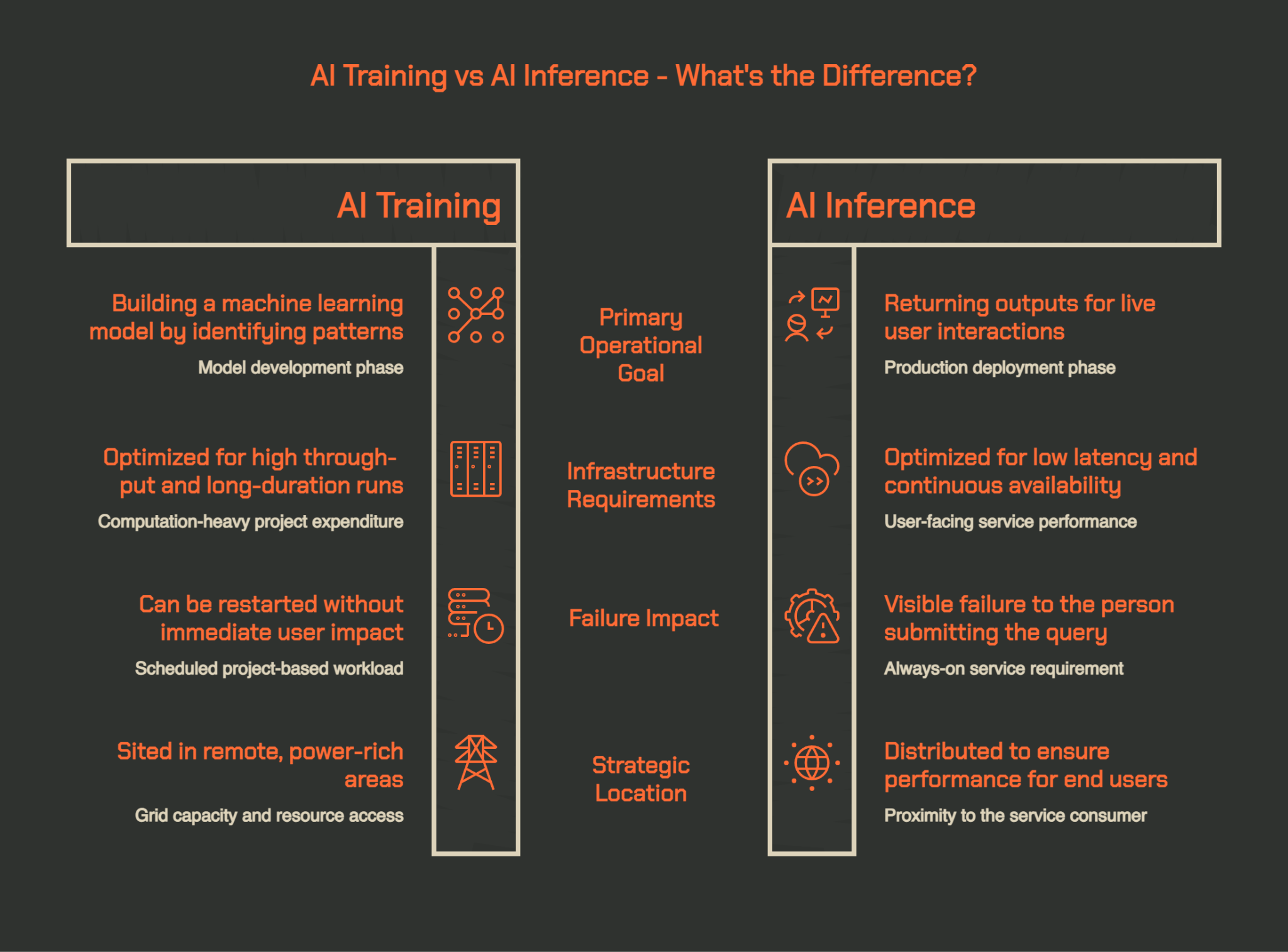
Training is the process of building a machine learning model. It involves feeding enormous volumes of data into a model architecture, running billions of calculations to identify patterns and relationships, and progressively refining the model's internal parameters until it can produce reliable and useful outputs.
Training is computation-heavy, power-intensive, and time-bounded. A training run takes days or weeks across dense GPU clusters, then ends when the model reaches a sufficient level of performance. For most organisations, training is a project cost: a defined capital expenditure with a defined endpoint.
The infrastructure requirements for training reflect this profile. Training workloads tolerate high latency between nodes because the job is optimised for throughput, not response time.
McKinsey's analysis of hyperscaler strategies notes that training workloads can absorb delays of up to 100 milliseconds between adjacent regions, which is why they are often sited in remote, power-rich areas where grid capacity, land, and water availability are more accessible. These are scheduled workloads designed to be optimised over time and run to completion.
The Inference Phase: Where Models Work
Inference is what happens once a model is deployed and users start interacting with it. It is the process of taking a new input, running it through the trained model, and returning an output.
Every generative AI interaction, every text completion, every document analysis, every automated classification decision is an inference event. Unlike training, inference does not stop when a job finishes. It runs continuously, around the clock, for as long as the product or service is live.
That continuous, user-facing nature is what separates inference from training in infrastructure terms. A training job that fails mid-run can be restarted with no immediate user impact. An inference failure is visible to the person who submitted the query, right now.
In that same research, McKinsey projects that by 2030, inference will surpass training to become the dominant workload in AI data centres, representing more than half of all AI compute and growing at a 35 per cent compound annual rate through 2030.
AI inference is not a secondary concern for enterprise IT leaders. It is the infrastructure challenge that defines what AI deployment actually costs and how well it performs.
The Infrastructure Demands That Make Inference Hard to Run Well
Running inference reliably is not simply a matter of provisioning sufficient compute. The requirements that define a well-designed inference environment differ significantly from those that define a good training environment, and many enterprises figure this out after committing to an infrastructure model that does not hold up under production conditions.
The three areas where inference demands differ most sharply from what enterprise IT teams typically plan for are latency sensitivity, power density, and uptime standards.
Latency Is the Constraint That Doesn't Negotiate
Training workloads can absorb network delays without user impact. Inference workloads cannot. When a user submits a query to a deployed AI system, the round-trip time from request to response is measured in milliseconds, and anything above an application-specific threshold produces a noticeably degraded experience.
For enterprise applications where AI is embedded in customer-facing tools, real-time decision workflows, or internal productivity platforms, response latency is not a performance preference. It is a service-level requirement that sits alongside uptime commitments in vendor contracts.
This is why inference workloads are increasingly co-located with the applications and data they serve. Geographic proximity to end users is a hard constraint.
An inference node serving Canadian enterprise users must be in Canada, physically close to where those users are concentrated. Routing inference queries to data centres in the U.S. or overseas adds latency that accumulates across every single interaction and introduces cross-border data flows with the compliance implications that follow.
For enterprises with users distributed across multiple Canadian provinces, a multi-site inference architecture across Canadian markets is not over-engineering. It is operational planning.
Power and Density Requirements for Inference Workloads
Inference is less power-dense than training on a per-rack basis, but it is far more demanding than standard enterprise IT. Enterprise AI inference workloads typically require 15 to 30 kilowatts per rack, depending on model size and hardware generation, compared to the 100 to 200-plus kilowatts that hyperscale training clusters consume.
This means not every data centre can support inference effectively, but the bar is meaningfully lower than the infrastructure required for training at hyperscale.
The energy picture over the lifetime of a deployed model is less forgiving than the per-rack draw suggests. At deployment scale, 80 to 90 per cent of a production AI system's total energy consumption comes from inference, not training.
Training is a bounded event. Inference runs indefinitely. A model trained once will serve millions of queries over years, each one consuming compute and energy. Planning an inference deployment on training-era assumptions about power draw will produce a budget that does not survive contact with production traffic. The AI inference vs training energy consumption disparity is real, and it only widens as the model scales.
Uptime Expectations That Go Beyond Standard SLAs
An inference failure is a user-facing failure.
A downed inference node means that AI features stop working in production, which in most enterprise deployments means a customer-facing product degrades or an internal workflow stalls.
The uptime standard for a production inference environment is closer to that of a mission-critical application than a back-end data processing system. Most production AI deployments require 99.9 per cent availability or better, and missing that target has immediate operational consequences.
Meeting that standard requires specific facility characteristics. A data centre supporting production AI inference needs:
- Redundant Power Delivery: Dual power paths to rack loads, with N+1 or N+2 generator backup and on-site fuel for extended outages
- Carrier-Neutral Connectivity: Multiple independent network paths through physically isolated carrier interconnect rooms, eliminating single-carrier dependency
- Advanced Cooling: Sufficient cooling tonnage and control systems to sustain the thermal output of continuous GPU operation at full load
- 24/7 Physical Monitoring: On-site security and monitoring to respond immediately to physical facility events that could affect uptime
Not all colocation facilities meet this bar, which makes the evaluation criteria for choosing a data centre in Canada a meaningful exercise, not a formality.
|
Factor
|
AI Inference
|
AI Training
|
|
Primary concern
|
Latency to end users
|
Sustained GPU throughput
|
|
Typical rack power
|
15 to 30 kW
|
100 to 200+ kW
|
|
Location requirement
|
Near end users and applications
|
Remote power-rich areas acceptable
|
|
Workload pattern
|
Continuous, 24/7
|
Scheduled, time-bounded
|
|
Failure impact
|
Immediate, user-facing
|
Delayed (job can be restarted)
|
|
Cost driver
|
Per-query, ongoing operating cost
|
One-time capital and project cost
|
Where Enterprises Are Running Inference Workloads
The decision about where to run production AI inference is not purely technical. It involves cost at scale, operational capability of the team, compliance posture, and the degree of control the organisation needs over its hardware and data.
Most enterprises are choosing from three models, and each carries trade-offs that are worth mapping before a commitment is made.
1. Public Cloud: Accessible, Expensive at Scale
Public cloud is the default starting point for enterprise AI inference, and for good reason. Cloud providers offer immediate access to GPU resources with no capital expenditure, per-token billing makes early-stage deployments easy to cost, and the managed infrastructure removes significant operational complexity during experimentation.
For organisations still determining their AI strategy or running variable, unpredictable inference volumes, cloud inference is the practical choice.
The economics shift substantially as volumes grow. Analysis of enterprise inference deployments shows that at 500 million tokens per day, even at the lower end of current cloud API pricing, annual spend reaches $180,000 or more.
Scale to a billion tokens per day, which is realistic for organisations with AI embedded across multiple high-volume workflows, and cloud API costs can reach several million dollars annually. At that volume, the question is no longer which cloud provider to use for AI inference. It is whether cloud should be hosting production inference at all.
When evaluating which path makes sense, cloud inference remains the right choice when:
- Inference volumes are unpredictable or early-stage and elasticity matters more than unit economics
- The organisation lacks internal expertise to manage dedicated GPU hardware
- Workloads are experimental and hardware commitments would be premature
2. On-Premises: Full Control, High Overhead
Running inference on-premises gives organisations full control over hardware selection, software configuration, and network architecture. For enterprises with existing data centre infrastructure and the internal expertise to manage GPU hardware, on-premises inference can deliver strong unit economics over a multi-year horizon.
The capital cost of the hardware is a one-time expenditure that amortises over the deployment lifetime, and the per-token cost at scale is substantially lower than managed cloud API pricing.
The operational overhead is the problem here.
Managing GPU servers in-house requires specialised skills, ongoing maintenance cycles, and the physical facility infrastructure to sustain high-density compute. Most enterprise IT organisations have not historically operated GPU clusters, and the gap between managing standard servers and managing a production inference environment is significant.
If your business doesn’t already have the facilities to host the hardware, the cost of building an environment that meets inference uptime and connectivity standards can erode the unit economics advantage before the hardware has amortised.
3. Colocation: Production-Ready Inference Without the Cloud Premium
Colocation sits between cloud and on-premises, and for production AI inference in Canada, it is where the economics and operational practicality converge for a growing number of enterprises. The organisation brings its own GPU hardware to a purpose-built colocation facility.
The facility provides power, cooling, connectivity, physical security, and uptime guarantees. The capital cost of the hardware stays on the balance sheet, while the facility overhead is handled by an operator with dedicated infrastructure expertise.
This model fits inference well because inference workloads, once stable, have predictable demand profiles that make dedicated hardware economical. Cloud repatriation trends show enterprises moving stable AI workloads off managed APIs once token volumes cross the threshold where cloud unit economics become untenable.
Colocation captures the cost advantage without requiring in-house facility management, and carrier-neutral interconnection at a well-connected facility provides the network diversity that inference-at-scale requires.
|
Criteria
|
Public Cloud
|
On-Premises
|
Colocation
|
|
Best suited for
|
Early-stage, experimental, or unpredictable workloads
|
High-volume workloads with strong internal infrastructure capabilities
|
Stable, production-scale inference workloads
|
|
Cost profile
|
Low upfront cost, but expensive at sustained scale
|
High upfront CapEx, lower long-term unit cost
|
Hardware CapEx plus facility fees; strong economics at scale
|
|
Scalability
|
Very high and highly elastic
|
Limited by owned infrastructure and procurement cycles
|
High for predictable growth, but less elastic than cloud
|
|
Operational burden
|
Low. Infrastructure is managed by the provider
|
High. Enterprise manages hardware, facilities, power, cooling, and uptime
|
Moderate. Enterprise manages compute; provider manages the facility
|
|
Control & sovereignty
|
Moderate; depends on provider and region
|
Very high; full control over hardware and data
|
High; dedicated hardware with strong data residency options
|
|
Key trade-off
|
Convenience and flexibility vs. higher long-term cost
|
Maximum control and low unit cost vs. operational complexity
|
Dedicated infrastructure economics without the burden of running a data centre
|
Qu Data Centres operates nine purpose-built, sovereign facilities across five Canadian markets, with AI-ready infrastructure supporting enterprise inference workloads within Canadian jurisdiction.
The Toronto facility supports rack densities up to 30 kW, purpose-built for high-density AI compute. Ottawa, Calgary, Edmonton, and London, Ontario provide additional inference-capable capacity across Canada's key enterprise markets, connected through 15-plus carrier networks.
For organisations that need geographically distributed inference to serve users across Canadian regions, a single operator with facilities in all five markets removes the coordination complexity of managing multiple provider relationships.
If your inference volumes are approaching the point where cloud API pricing stops making sense, we can help. Talk to a solutions architect at Qu Data Centres to learn more today.
Why Inference Data Is Sovereignty Data
The infrastructure decision for AI inference carries a legal dimension that most discussions of AI costs and latency leave out entirely. When an enterprise AI system runs inference, every query submitted and every response generated is a data transaction.
The content of those transactions, including the prompts, the user information they contain, and the model outputs they produce, is business data subject to the same privacy and compliance requirements as any other sensitive information the organisation handles.
Where that data is processed, and which legal jurisdiction governs the company processing it, are material compliance questions, not secondary considerations.
Every AI Query Is a Business Data Transaction
Consider what travels through an inference endpoint in a typical enterprise AI deployment:
- Legal and Financial Data: Documents submitted for AI-assisted contract review, financial records queried against a risk assessment model, transaction data processed for fraud detection
- Health and Personal Information: Patient intake forms processed by an AI triage tool, employee health records handled by an AI benefits assistant, any personally identifiable information included in a prompt
- Confidential Business Information: Internal communications summarised by a generative AI assistant, proprietary product data passed to an AI for analysis, customer account details included in a query
None of these are abstract queries. They are sensitive records that pass through the inference layer in the normal course of AI-assisted work. The compliance frameworks that govern where this data can be stored also govern where it can be processed.
Canadian enterprises in financial services, healthcare, government, and legal services are subject to PIPEDA at the federal level, Quebec's Law 25, and sector-specific frameworks including PHIPA, FIPPA, and OSFI guidelines. The fact that a query travels to an inference endpoint and back in milliseconds does not exempt it from data sovereignty requirements.
The CLOUD Act Problem for AI Inference in Canada
The deeper issue for Canadian enterprises running inference on U.S.-owned infrastructure is jurisdictional. The U.S. Clarifying Lawful Overseas Use of Data Act, enacted in 2018, gives American authorities the legal power to compel any U.S.-incorporated company to produce data in its possession, custody, or control, regardless of where that data is physically stored.
This is not a theoretical exposure. It is the explicit design of the law, enacted to resolve a longstanding jurisdictional question about whether U.S. warrants applied to data stored on foreign servers.
Upper Harbour's analysis of the Canadian technology stack found that 53 per cent of tracked tools operate under U.S. jurisdiction. A U.S. warrant served to a U.S.-parented provider for data stored in a Canadian data centre is legally enforceable under the CLOUD Act, and the physical location of the server is legally irrelevant to that analysis.
In June 2025, Microsoft France's director of public and legal affairs testified before the French Senate and was directly asked whether he could guarantee that data stored in France would not be transmitted to U.S. authorities. He could not.
The same legal reality applies to Canadian enterprise data processed through inference endpoints operated by any U.S.-parented provider.
As Borden Ladner Gervais noted in their 2026 data sovereignty analysis, a company incorporated in Canada and wholly owned and managed in Canada generally falls outside the scope of the CLOUD Act.
The question enterprise IT leaders must ask when evaluating inference infrastructure is not which provider has a Canadian data centre. It is whether the company operating that infrastructure is Canadian-incorporated, with no U.S. parent entity that could be compelled to produce the inference data flowing through its systems.
Why Qu Data Centres Supports Enterprise AI Inference
Qu Data Centres provides the infrastructure that Canadian enterprise inference specifically requires: purpose-built colocation across five Canadian markets, full Canadian sovereignty at every level of ownership and operation, and the facility certifications that compliance teams need before a contract is signed.
Qu is 100 per cent Canadian-owned and operated, incorporated in Canada, with no U.S. parent entity in the ownership or management structure. All nine facilities sit on Canadian soil, operated by 130-plus Canadian employees, which places Qu structurally outside the reach of CLOUD Act compulsion.
Our colocation and high-availability connectivity infrastructure supports enterprise AI inference across Toronto, Ottawa, Calgary, Edmonton, and London, Ontario, with AI-ready power density across our facility portfolio and carrier-neutral access to 15-plus carrier networks.
The managed services team provides 24/7 operational coverage so inference environments meet the uptime standards that production AI demands. Four Qu facilities hold Uptime Institute Tier III certification, alongside SOC 1, SOC 2, ISO 27001, and PCI DSS, giving your audit committee and compliance team the independent documentation they need.
Book a facility tour and see the infrastructure in person. Our team will walk you through the right deployment model for your inference workload.
Frequently Asked Questions About AI Inference
Does AI Inference Consume More Energy Than Training?
Over the operational lifetime of a deployed model, yes. A single training run is energy-intensive but ends when the model is built. Inference runs continuously for as long as the model serves users. At deployment scale, inference accounts for roughly 80 to 90 per cent of a production AI system's total energy consumption. Training is a project cost with a defined endpoint. Inference is an operating cost that compounds as user adoption grows.
How Does AI Inference Contribute to Generative AI?
Generative AI tools produce outputs through inference, not training. A large language model learns language patterns during training, then applies those patterns to new prompts through inference at the time of each interaction. Every text completion, every chatbot reply, every AI-generated summary is a discrete inference event. Generative AI at scale is, operationally, a very large inference-at-scale problem, which is why it places such specific demands on data centre infrastructure.
Are GPUs Necessary for Enterprise AI Inference?
Not always, but typically yes at enterprise scale. GPUs accelerate inference for large language models and reduce the time and energy required per query. For smaller or quantised models, CPUs can handle inference at acceptable performance. At production scale with real-time latency requirements, GPU-accelerated inference is typically necessary to meet service-level targets. The hardware requirement depends on model size, the degree of quantisation applied, and what response time the application demands.
How Do Companies Use AI Chips to Reduce Inference Costs?
The primary levers are model quantisation, which reduces the numerical precision of model weights to lower memory and compute requirements; model distillation, which trains smaller models to approximate the behaviour of larger ones; and purpose-built inference silicon, where ASICs and FPGAs can deliver 5 to 20 times better performance per watt compared to general-purpose GPUs for specific inference tasks. These optimisations allow organisations to serve more queries per dollar of infrastructure without replacing the underlying hardware.
What Is the Difference Between AI Inference and Training in Data Centre Requirements?
Training facilities are optimised for sustained, high-density compute and can be sited in remote areas where land and power are available without regard to end-user proximity. Inference facilities need to be close to the users and applications they serve, with redundant connectivity, strong uptime guarantees, and power density in the 15 to 30 kW per rack range for enterprise workloads. Training is sited for power availability. Inference is sited for proximity and latency.
Sources Used for This Article
- McKinsey & Company: "The future of AI workloads" - mckinsey.com/featured-insights/week-in-charts/the-future-of-ai-workloads
- Spheron: "AI Inference Power Consumption and GPU Electricity Costs: 2026 Guide" - spheron.network/blog/ai-inference-power-electricity-cost-2026/
- Compute Forecast: "AI Inference Cost in Enterprise Infrastructure" - computeforecast.com/long-reads/ai-inference-cost-enterprise-infrastructure/
- Upper Harbour: "Impact of the US CLOUD Act on Data Sovereignty for Canadian Organizations" - upperharbour.ca/resources/us-cloud-act-impact-data-sovereignty-canadian-organizations
- Forbes: "Microsoft Can't Keep EU Data Safe From US Authorities" - forbes.com/sites/emmawoollacott/2025/07/22/microsoft-cant-keep-eu-data-safe-from-us-authorities/
- BLG: "Data sovereignty and the CLOUD Act: What Canadian organizations should know" - blg.com/en/insights/2026/04/data-sovereignty-and-the-cloud-act-what-canadian-organizations-should-know






Quick Answer: AI inference is the process by which a trained machine learning model receives new real-world inputs and produces outputs based on what it learned during training. Every time a user sends a message to a chatbot, triggers an automated recommendation, or submits a document for AI-assisted analysis, that is inference at work. Unlike training, which is a bounded compute event that eventually ends, inference runs continuously once a model is deployed, under strict latency requirements, at a scale that grows with every user interaction. For Canadian enterprise IT leaders, the infrastructure decisions that follow from that reality are among the most consequential they will face as AI moves from pilot to production.
Key Takeaways
Most conversations about AI infrastructure concentrate on the dramatic: the GPU clusters, the hyperscale facilities being built at a pace the grid can barely absorb, the billions flowing into compute. For most enterprises, that conversation is adjacent to the decision they actually need to make. The real operational question is not how to build a model. It is what happens the moment that model goes live and starts serving users.
When an AI system enters production, every interaction, every prompt, every automated decision draws on the same underlying compute infrastructure. The volume of those events compounds quickly.
An enterprise deploying AI across multiple business workflows can generate hundreds of millions of queries per month, each one a small but real infrastructure event with a latency requirement, an energy cost, and a data trail. Getting the infrastructure placement wrong means degraded performance, runaway cloud bills, compliance exposure, or all three.
For Canadian IT leaders specifically, there is an additional dimension to this decision that their counterparts in the U.S. often do not contend with. The question of where inference runs is also a question of whose legal jurisdiction governs the data flowing through it, and those two questions do not always have the same answer.
What AI Inference Is and How It Differs from Training
Training and inference are the two most misunderstood terms in enterprise AI discussions, and they are also the two that drive the largest infrastructure decisions.
They describe fundamentally different processes, with different cost structures, different operational profiles, and very different infrastructure requirements. Conflating them leads to deployment models that work well in one dimension and badly in another.
The Training Phase: Where Models Learn
Training is the process of building a machine learning model. It involves feeding enormous volumes of data into a model architecture, running billions of calculations to identify patterns and relationships, and progressively refining the model's internal parameters until it can produce reliable and useful outputs.
Training is computation-heavy, power-intensive, and time-bounded. A training run takes days or weeks across dense GPU clusters, then ends when the model reaches a sufficient level of performance. For most organisations, training is a project cost: a defined capital expenditure with a defined endpoint.
The infrastructure requirements for training reflect this profile. Training workloads tolerate high latency between nodes because the job is optimised for throughput, not response time.
McKinsey's analysis of hyperscaler strategies notes that training workloads can absorb delays of up to 100 milliseconds between adjacent regions, which is why they are often sited in remote, power-rich areas where grid capacity, land, and water availability are more accessible. These are scheduled workloads designed to be optimised over time and run to completion.
The Inference Phase: Where Models Work
Inference is what happens once a model is deployed and users start interacting with it. It is the process of taking a new input, running it through the trained model, and returning an output.
Every generative AI interaction, every text completion, every document analysis, every automated classification decision is an inference event. Unlike training, inference does not stop when a job finishes. It runs continuously, around the clock, for as long as the product or service is live.
That continuous, user-facing nature is what separates inference from training in infrastructure terms. A training job that fails mid-run can be restarted with no immediate user impact. An inference failure is visible to the person who submitted the query, right now.
In that same research, McKinsey projects that by 2030, inference will surpass training to become the dominant workload in AI data centres, representing more than half of all AI compute and growing at a 35 per cent compound annual rate through 2030.
AI inference is not a secondary concern for enterprise IT leaders. It is the infrastructure challenge that defines what AI deployment actually costs and how well it performs.
The Infrastructure Demands That Make Inference Hard to Run Well
Running inference reliably is not simply a matter of provisioning sufficient compute. The requirements that define a well-designed inference environment differ significantly from those that define a good training environment, and many enterprises figure this out after committing to an infrastructure model that does not hold up under production conditions.
The three areas where inference demands differ most sharply from what enterprise IT teams typically plan for are latency sensitivity, power density, and uptime standards.
Latency Is the Constraint That Doesn't Negotiate
Training workloads can absorb network delays without user impact. Inference workloads cannot. When a user submits a query to a deployed AI system, the round-trip time from request to response is measured in milliseconds, and anything above an application-specific threshold produces a noticeably degraded experience.
For enterprise applications where AI is embedded in customer-facing tools, real-time decision workflows, or internal productivity platforms, response latency is not a performance preference. It is a service-level requirement that sits alongside uptime commitments in vendor contracts.
This is why inference workloads are increasingly co-located with the applications and data they serve. Geographic proximity to end users is a hard constraint.
An inference node serving Canadian enterprise users must be in Canada, physically close to where those users are concentrated. Routing inference queries to data centres in the U.S. or overseas adds latency that accumulates across every single interaction and introduces cross-border data flows with the compliance implications that follow.
For enterprises with users distributed across multiple Canadian provinces, a multi-site inference architecture across Canadian markets is not over-engineering. It is operational planning.
Power and Density Requirements for Inference Workloads
Inference is less power-dense than training on a per-rack basis, but it is far more demanding than standard enterprise IT. Enterprise AI inference workloads typically require 15 to 30 kilowatts per rack, depending on model size and hardware generation, compared to the 100 to 200-plus kilowatts that hyperscale training clusters consume.
This means not every data centre can support inference effectively, but the bar is meaningfully lower than the infrastructure required for training at hyperscale.
The energy picture over the lifetime of a deployed model is less forgiving than the per-rack draw suggests. At deployment scale, 80 to 90 per cent of a production AI system's total energy consumption comes from inference, not training.
Training is a bounded event. Inference runs indefinitely. A model trained once will serve millions of queries over years, each one consuming compute and energy. Planning an inference deployment on training-era assumptions about power draw will produce a budget that does not survive contact with production traffic. The AI inference vs training energy consumption disparity is real, and it only widens as the model scales.
Uptime Expectations That Go Beyond Standard SLAs
An inference failure is a user-facing failure.
A downed inference node means that AI features stop working in production, which in most enterprise deployments means a customer-facing product degrades or an internal workflow stalls.
The uptime standard for a production inference environment is closer to that of a mission-critical application than a back-end data processing system. Most production AI deployments require 99.9 per cent availability or better, and missing that target has immediate operational consequences.
Meeting that standard requires specific facility characteristics. A data centre supporting production AI inference needs:
Not all colocation facilities meet this bar, which makes the evaluation criteria for choosing a data centre in Canada a meaningful exercise, not a formality.
Factor
AI Inference
AI Training
Primary concern
Latency to end users
Sustained GPU throughput
Typical rack power
15 to 30 kW
100 to 200+ kW
Location requirement
Near end users and applications
Remote power-rich areas acceptable
Workload pattern
Continuous, 24/7
Scheduled, time-bounded
Failure impact
Immediate, user-facing
Delayed (job can be restarted)
Cost driver
Per-query, ongoing operating cost
One-time capital and project cost
Where Enterprises Are Running Inference Workloads
The decision about where to run production AI inference is not purely technical. It involves cost at scale, operational capability of the team, compliance posture, and the degree of control the organisation needs over its hardware and data.
Most enterprises are choosing from three models, and each carries trade-offs that are worth mapping before a commitment is made.
1. Public Cloud: Accessible, Expensive at Scale
Public cloud is the default starting point for enterprise AI inference, and for good reason. Cloud providers offer immediate access to GPU resources with no capital expenditure, per-token billing makes early-stage deployments easy to cost, and the managed infrastructure removes significant operational complexity during experimentation.
For organisations still determining their AI strategy or running variable, unpredictable inference volumes, cloud inference is the practical choice.
The economics shift substantially as volumes grow. Analysis of enterprise inference deployments shows that at 500 million tokens per day, even at the lower end of current cloud API pricing, annual spend reaches $180,000 or more.
Scale to a billion tokens per day, which is realistic for organisations with AI embedded across multiple high-volume workflows, and cloud API costs can reach several million dollars annually. At that volume, the question is no longer which cloud provider to use for AI inference. It is whether cloud should be hosting production inference at all.
When evaluating which path makes sense, cloud inference remains the right choice when:
2. On-Premises: Full Control, High Overhead
Running inference on-premises gives organisations full control over hardware selection, software configuration, and network architecture. For enterprises with existing data centre infrastructure and the internal expertise to manage GPU hardware, on-premises inference can deliver strong unit economics over a multi-year horizon.
The capital cost of the hardware is a one-time expenditure that amortises over the deployment lifetime, and the per-token cost at scale is substantially lower than managed cloud API pricing.
The operational overhead is the problem here.
Managing GPU servers in-house requires specialised skills, ongoing maintenance cycles, and the physical facility infrastructure to sustain high-density compute. Most enterprise IT organisations have not historically operated GPU clusters, and the gap between managing standard servers and managing a production inference environment is significant.
If your business doesn’t already have the facilities to host the hardware, the cost of building an environment that meets inference uptime and connectivity standards can erode the unit economics advantage before the hardware has amortised.
3. Colocation: Production-Ready Inference Without the Cloud Premium
Colocation sits between cloud and on-premises, and for production AI inference in Canada, it is where the economics and operational practicality converge for a growing number of enterprises. The organisation brings its own GPU hardware to a purpose-built colocation facility.
The facility provides power, cooling, connectivity, physical security, and uptime guarantees. The capital cost of the hardware stays on the balance sheet, while the facility overhead is handled by an operator with dedicated infrastructure expertise.
This model fits inference well because inference workloads, once stable, have predictable demand profiles that make dedicated hardware economical. Cloud repatriation trends show enterprises moving stable AI workloads off managed APIs once token volumes cross the threshold where cloud unit economics become untenable.
Colocation captures the cost advantage without requiring in-house facility management, and carrier-neutral interconnection at a well-connected facility provides the network diversity that inference-at-scale requires.
Criteria
Public Cloud
On-Premises
Colocation
Best suited for
Early-stage, experimental, or unpredictable workloads
High-volume workloads with strong internal infrastructure capabilities
Stable, production-scale inference workloads
Cost profile
Low upfront cost, but expensive at sustained scale
High upfront CapEx, lower long-term unit cost
Hardware CapEx plus facility fees; strong economics at scale
Scalability
Very high and highly elastic
Limited by owned infrastructure and procurement cycles
High for predictable growth, but less elastic than cloud
Operational burden
Low. Infrastructure is managed by the provider
High. Enterprise manages hardware, facilities, power, cooling, and uptime
Moderate. Enterprise manages compute; provider manages the facility
Control & sovereignty
Moderate; depends on provider and region
Very high; full control over hardware and data
High; dedicated hardware with strong data residency options
Key trade-off
Convenience and flexibility vs. higher long-term cost
Maximum control and low unit cost vs. operational complexity
Dedicated infrastructure economics without the burden of running a data centre
Qu Data Centres operates nine purpose-built, sovereign facilities across five Canadian markets, with AI-ready infrastructure supporting enterprise inference workloads within Canadian jurisdiction.
The Toronto facility supports rack densities up to 30 kW, purpose-built for high-density AI compute. Ottawa, Calgary, Edmonton, and London, Ontario provide additional inference-capable capacity across Canada's key enterprise markets, connected through 15-plus carrier networks.
For organisations that need geographically distributed inference to serve users across Canadian regions, a single operator with facilities in all five markets removes the coordination complexity of managing multiple provider relationships.
If your inference volumes are approaching the point where cloud API pricing stops making sense, we can help. Talk to a solutions architect at Qu Data Centres to learn more today.
Why Inference Data Is Sovereignty Data
The infrastructure decision for AI inference carries a legal dimension that most discussions of AI costs and latency leave out entirely. When an enterprise AI system runs inference, every query submitted and every response generated is a data transaction.
The content of those transactions, including the prompts, the user information they contain, and the model outputs they produce, is business data subject to the same privacy and compliance requirements as any other sensitive information the organisation handles.
Where that data is processed, and which legal jurisdiction governs the company processing it, are material compliance questions, not secondary considerations.
Every AI Query Is a Business Data Transaction
Consider what travels through an inference endpoint in a typical enterprise AI deployment:
None of these are abstract queries. They are sensitive records that pass through the inference layer in the normal course of AI-assisted work. The compliance frameworks that govern where this data can be stored also govern where it can be processed.
Canadian enterprises in financial services, healthcare, government, and legal services are subject to PIPEDA at the federal level, Quebec's Law 25, and sector-specific frameworks including PHIPA, FIPPA, and OSFI guidelines. The fact that a query travels to an inference endpoint and back in milliseconds does not exempt it from data sovereignty requirements.
The CLOUD Act Problem for AI Inference in Canada
The deeper issue for Canadian enterprises running inference on U.S.-owned infrastructure is jurisdictional. The U.S. Clarifying Lawful Overseas Use of Data Act, enacted in 2018, gives American authorities the legal power to compel any U.S.-incorporated company to produce data in its possession, custody, or control, regardless of where that data is physically stored.
This is not a theoretical exposure. It is the explicit design of the law, enacted to resolve a longstanding jurisdictional question about whether U.S. warrants applied to data stored on foreign servers.
Upper Harbour's analysis of the Canadian technology stack found that 53 per cent of tracked tools operate under U.S. jurisdiction. A U.S. warrant served to a U.S.-parented provider for data stored in a Canadian data centre is legally enforceable under the CLOUD Act, and the physical location of the server is legally irrelevant to that analysis.
In June 2025, Microsoft France's director of public and legal affairs testified before the French Senate and was directly asked whether he could guarantee that data stored in France would not be transmitted to U.S. authorities. He could not.
The same legal reality applies to Canadian enterprise data processed through inference endpoints operated by any U.S.-parented provider.
As Borden Ladner Gervais noted in their 2026 data sovereignty analysis, a company incorporated in Canada and wholly owned and managed in Canada generally falls outside the scope of the CLOUD Act.
The question enterprise IT leaders must ask when evaluating inference infrastructure is not which provider has a Canadian data centre. It is whether the company operating that infrastructure is Canadian-incorporated, with no U.S. parent entity that could be compelled to produce the inference data flowing through its systems.
Why Qu Data Centres Supports Enterprise AI Inference
Qu Data Centres provides the infrastructure that Canadian enterprise inference specifically requires: purpose-built colocation across five Canadian markets, full Canadian sovereignty at every level of ownership and operation, and the facility certifications that compliance teams need before a contract is signed.
Qu is 100 per cent Canadian-owned and operated, incorporated in Canada, with no U.S. parent entity in the ownership or management structure. All nine facilities sit on Canadian soil, operated by 130-plus Canadian employees, which places Qu structurally outside the reach of CLOUD Act compulsion.
Our colocation and high-availability connectivity infrastructure supports enterprise AI inference across Toronto, Ottawa, Calgary, Edmonton, and London, Ontario, with AI-ready power density across our facility portfolio and carrier-neutral access to 15-plus carrier networks.
The managed services team provides 24/7 operational coverage so inference environments meet the uptime standards that production AI demands. Four Qu facilities hold Uptime Institute Tier III certification, alongside SOC 1, SOC 2, ISO 27001, and PCI DSS, giving your audit committee and compliance team the independent documentation they need.
Book a facility tour and see the infrastructure in person. Our team will walk you through the right deployment model for your inference workload.
Frequently Asked Questions About AI Inference
Does AI Inference Consume More Energy Than Training?
Over the operational lifetime of a deployed model, yes. A single training run is energy-intensive but ends when the model is built. Inference runs continuously for as long as the model serves users. At deployment scale, inference accounts for roughly 80 to 90 per cent of a production AI system's total energy consumption. Training is a project cost with a defined endpoint. Inference is an operating cost that compounds as user adoption grows.
How Does AI Inference Contribute to Generative AI?
Generative AI tools produce outputs through inference, not training. A large language model learns language patterns during training, then applies those patterns to new prompts through inference at the time of each interaction. Every text completion, every chatbot reply, every AI-generated summary is a discrete inference event. Generative AI at scale is, operationally, a very large inference-at-scale problem, which is why it places such specific demands on data centre infrastructure.
Are GPUs Necessary for Enterprise AI Inference?
Not always, but typically yes at enterprise scale. GPUs accelerate inference for large language models and reduce the time and energy required per query. For smaller or quantised models, CPUs can handle inference at acceptable performance. At production scale with real-time latency requirements, GPU-accelerated inference is typically necessary to meet service-level targets. The hardware requirement depends on model size, the degree of quantisation applied, and what response time the application demands.
How Do Companies Use AI Chips to Reduce Inference Costs?
The primary levers are model quantisation, which reduces the numerical precision of model weights to lower memory and compute requirements; model distillation, which trains smaller models to approximate the behaviour of larger ones; and purpose-built inference silicon, where ASICs and FPGAs can deliver 5 to 20 times better performance per watt compared to general-purpose GPUs for specific inference tasks. These optimisations allow organisations to serve more queries per dollar of infrastructure without replacing the underlying hardware.
What Is the Difference Between AI Inference and Training in Data Centre Requirements?
Training facilities are optimised for sustained, high-density compute and can be sited in remote areas where land and power are available without regard to end-user proximity. Inference facilities need to be close to the users and applications they serve, with redundant connectivity, strong uptime guarantees, and power density in the 15 to 30 kW per rack range for enterprise workloads. Training is sited for power availability. Inference is sited for proximity and latency.
Sources Used for This Article
Paul M
Paul Miedzik is Senior Manager of Marketing at Qu Data Centres, with extensive experience in enterprise cloud and digital infrastructure across the Canadian tech sector.