Quick Answer: Cloud repatriation is the process of moving applications, data, or workloads out of public cloud environments and into alternative infrastructure, such as on-premises servers, private cloud, or colocation facilities. It is not a wholesale rejection of cloud computing. It is a strategic recalibration where organisations decide that certain workloads no longer belong in a public cloud environment based on cost, performance, compliance, or sovereignty requirements.
Key Takeaways
- Cloud repatriation moves selected workloads from public cloud to on-premises, private cloud, or colocation infrastructure; it is a workload optimisation strategy, not a cloud exit.
- A Barclays CIO survey found 86% of CIOs planned to move some workloads from public cloud environments, while most organisations still retain hybrid cloud architectures.
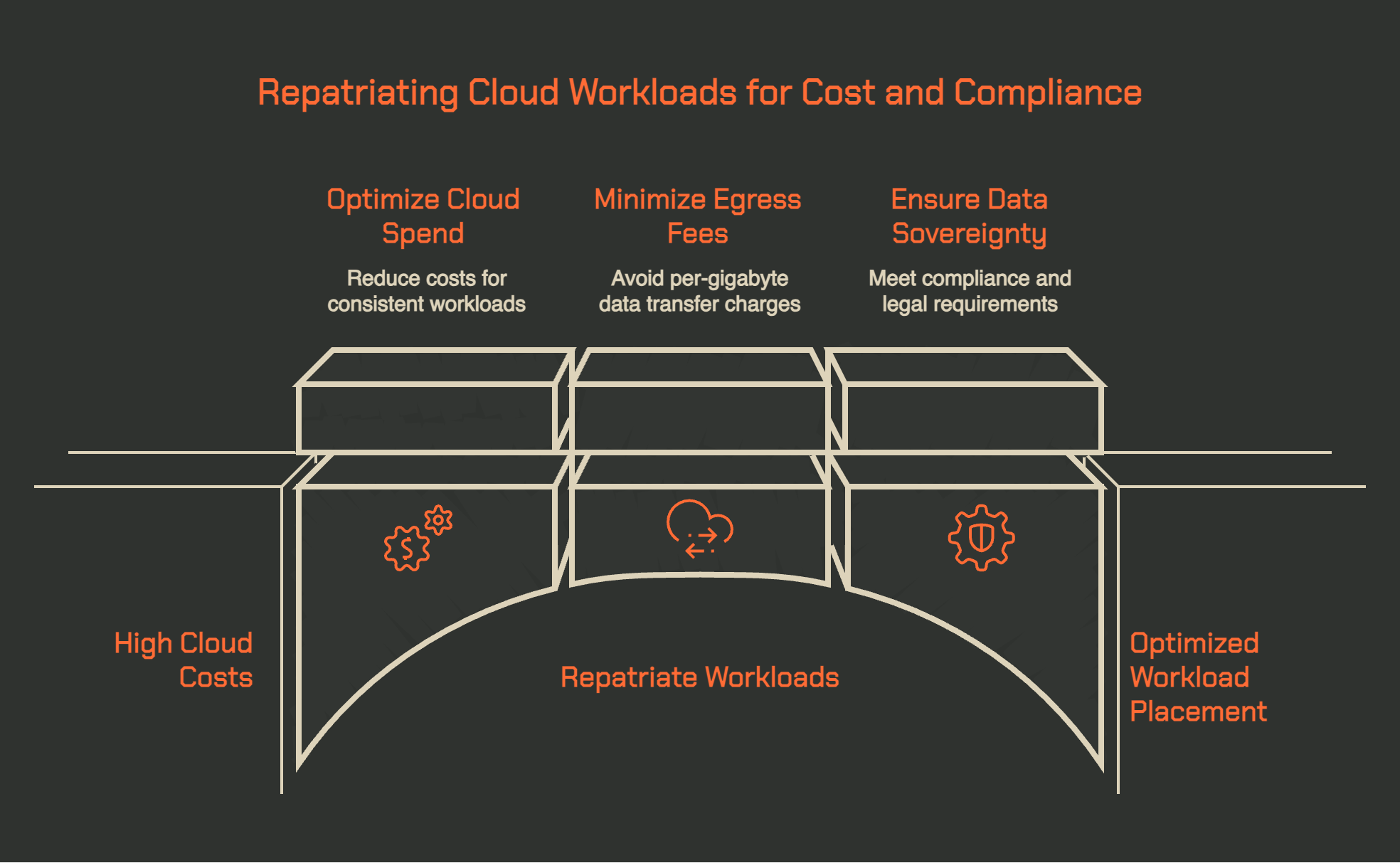
- Common drivers include rising cloud costs, unpredictable spending, high data egress fees, latency requirements, and growing data sovereignty and compliance concerns.
- Workloads best suited for repatriation typically have predictable compute demand, large data-transfer volumes, strict residency requirements, or limited benefit from cloud-native elasticity.
- Organisations can repatriate to on-premises infrastructure, private cloud, or colocation facilities, with colocation often balancing control, compliance, and operational efficiency.
- Book a tour of Qu Data Centres to evaluate Canadian-owned colocation options that support cloud repatriation, compliance requirements, and long-term infrastructure control.
Cloud repatriation has picked up momentum among enterprise IT leaders. According to a Barclays CIO Survey from Q4 2024, 86% of CIOs planned to move some workloads from public cloud to private cloud or on-premises infrastructure, the highest figure that survey had ever recorded.
That number is overwhelmingly large, but it needs context before it means anything useful.
The conversation around cloud repatriation tends to get pulled in two directions. On one side, you have vendors and analysts declaring that the cloud era is over. On the other hand, hyperscalers argue it is a marginal trend that barely registers against continued cloud growth. Both readings are incomplete.
What is actually happening is something more deliberate: organisations that spent the last decade defaulting to the cloud are now making workload placement decisions they should have been making all along.
Why Cloud Repatriation Is Not a Cloud Exit
Repatriation does not mean cancelling your AWS account.
IDC research from 2024 found that only about 8% of organisations plan to move entire workloads off the cloud entirely. The vast majority are moving specific workloads, such as production databases, backup repositories, or high-compute jobs, while leaving others in public cloud environments where they genuinely perform well.
The more accurate way to frame this is as a hybrid cloud maturation.
Organisations in the early cloud-adoption years made a reasonable bet: get everything into the cloud quickly and optimise later. "Later" has arrived, and the optimisation step often involves pulling certain workloads back out. Public cloud remains the right answer for burst compute, globally distributed applications, and workloads with unpredictable demand. It is a poor fit for steady-state, high-volume, latency-sensitive, or tightly regulated workloads, and that is where repatriation decisions are being made.
Workloads That Were Never a Strong Cloud Fit
Not every workload was built for the cloud in the first place. Many enterprises lifted and shifted existing on-premises applications directly into cloud environments without refactoring them for cloud-native architecture.
Those workloads never gained the cost or performance benefits that the cloud was supposed to deliver, because they were not designed to take advantage of elasticity or managed services.
Workloads that consistently underperform in public cloud environments tend to share a few characteristics:
- Predictable, Steady-State Compute: Resources are consumed at a consistent rate with little variability, which means the pay-as-you-go pricing model offers no advantage over owned or leased infrastructure.
- High Data Egress Volume: Applications that continuously move large datasets out of a cloud environment generate transfer fees that accumulate well beyond the cost of the compute itself.
- Strict Latency Requirements: Real-time processing applications, financial transaction systems, and industrial control workloads often cannot tolerate the variable latency introduced by shared cloud infrastructure.
- Regulatory Data Residency Mandates: Workloads subject to healthcare, financial, or government privacy regulations may have specific jurisdictional requirements that public cloud environments, including their sovereign cloud tiers, cannot satisfy.
Why Enterprises Are Repatriating Cloud Workloads Right Now
The repatriation trend is not driven by a single pressure point. Cost tends to be what triggers the conversation, but once organisations start pulling the thread, they usually find several compounding reasons to act.
Each one reinforces the others, which is why the decision to move a workload rarely comes down to cost alone.
Cloud Costs That Scale Faster Than Your Business
Public cloud pricing was designed around variability. You pay for what you use, which makes economic sense for unpredictable workloads. For workloads with predictable, consistent resource consumption, that model becomes progressively more expensive over time than owning or leasing equivalent infrastructure.
The Flexera 2025 State of the Cloud Report found that 84% of organisations cite managing cloud spend as their single biggest challenge. IDC found that 59% of organisations exceeded their cloud budget in 2024.
The problem is not that cloud is inherently expensive. It is that cloud pricing rewards usage variability, and most enterprise workloads are not particularly variable. When you are paying cloud rates month after month for a database that runs at roughly the same load every day, you are subsidising a pricing model that offers you no benefit.
Egress Fees
If cloud compute costs are the visible part of the bill, egress fees are the part that surprises finance teams six months into a deployment. Cloud egress fees are the per-gigabyte charges levied by cloud providers when data leaves their network. Ingress, bringing data into the cloud, is typically free. Getting it back out is not.
AWS charges approximately $0.09 per GB for internet egress. Azure charges $0.087 per GB. Google Cloud charges $0.12 per GB for the first terabyte. Egresscost.com, the source for these numbers, is an incredibly helpful independent resource that pulls its data from official sources and is updated monthly.
Those figures may look modest in isolation, but for organisations running analytics pipelines, backup restore testing, or large data exports on a regular basis, egress costs can account for 60 to 70% of total cloud storage spend. A workload storing 50TB with 20TB of monthly egress can generate over $1,700 per month in transfer fees on Azure alone, a line item that does not exist in a colocation or on-premises model.
That asymmetry between ingress and egress pricing is by design, and once organisations recognise it as a structural feature of public cloud economics rather than a configuration problem, it changes how they evaluate where workloads should live.
Data Sovereignty and Compliance Requirements
Sovereignty has become a decisive factor for Canadian enterprises evaluating cloud infrastructure, and it is a significant advantage for cloud repatriation. Data residency, meaning your data sits on servers located in Canada, is the starting point. It is not sufficient on its own.
What matters beyond physical location is who owns and operates the infrastructure, which legal jurisdiction governs access to that data, and whether a foreign court could compel a provider to disclose or transfer it.
For Canadian organisations in regulated sectors, hosting sensitive data on foreign-owned platforms can introduce audit risk or outright compliance violations under frameworks like PIPEDA, provincial health privacy laws, and OSFI's third-party risk management guidelines.
The U.S. CLOUD Act is a particular concern: it gives U.S. authorities the authority to compel American-incorporated cloud providers to produce data regardless of where that data physically resides. No Canadian data residency tier from a U.S.-headquartered provider resolves that exposure. It is a legal reality that flows from corporate ownership, not server location.
Where Repatriated Workloads End Up
This is the part most repatriation articles skip over. They establish that workloads are moving out of public cloud and then leave the destination vague, described generically as "on-premises or private infrastructure." In practice, there are three distinct destinations with meaningfully different tradeoffs, and choosing the wrong one can eliminate the cost and performance benefits that motivated the repatriation in the first place.
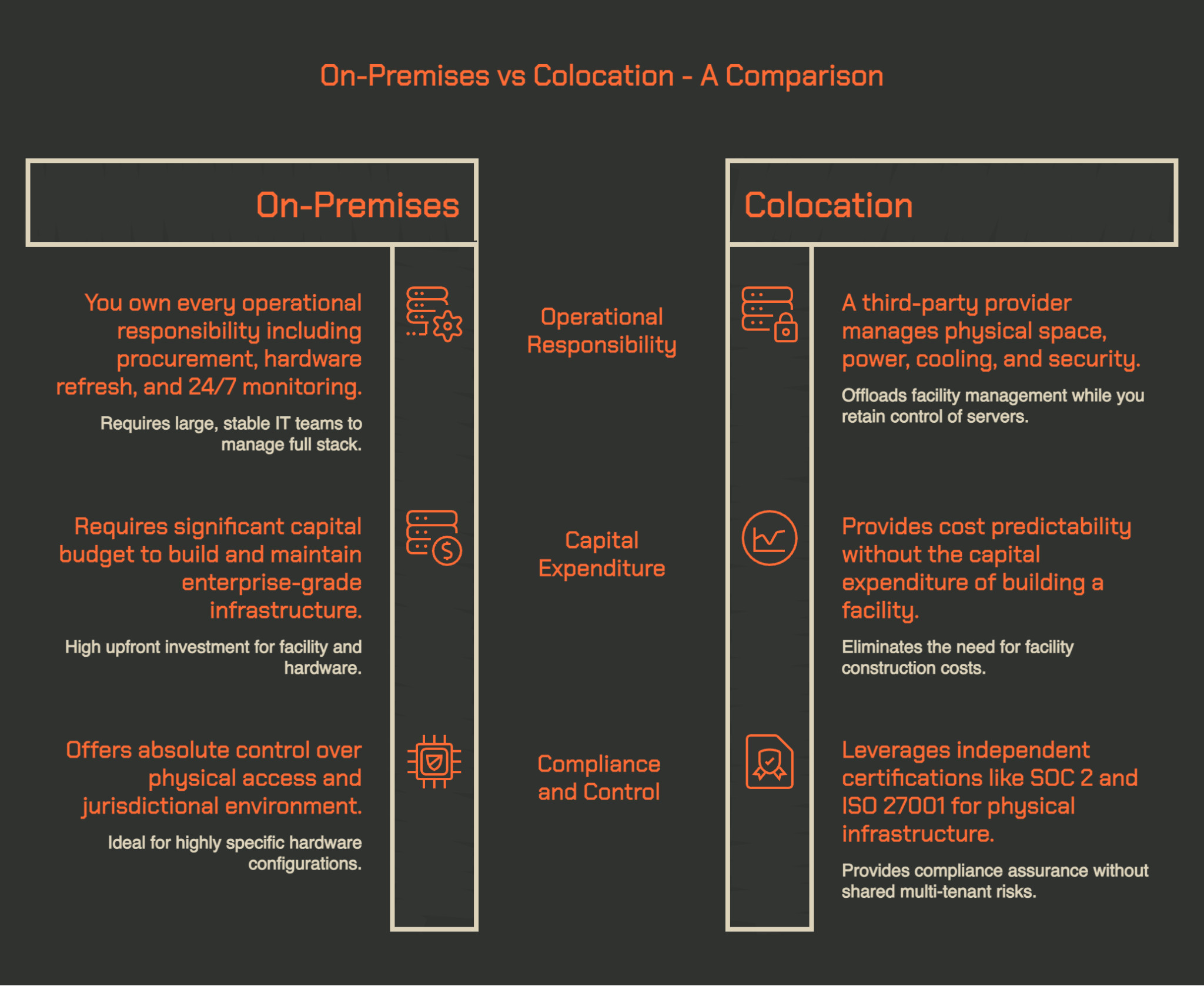
The destination decision typically comes down to three variables: how much capital you want to deploy, how much operational responsibility your team can absorb, and how tightly your compliance posture governs physical access and jurisdictional control.
On-Premises Vs. Colocation Vs. Private Cloud: How to Choose
Each destination serves a different organisational profile:
- On-Premises: You own the servers, the space, the power infrastructure, the cooling systems, and the connectivity. You also own every operational responsibility that comes with them, including procurement cycles, hardware refresh, physical security, and 24/7 monitoring. On-premises makes sense for organisations with large, stable IT teams, workloads with highly specific hardware configurations, and sufficient capital budget to build and maintain enterprise-grade infrastructure. The control is real. So is the burden.
- Colocation: You own the servers and the workloads. A third-party data centre provides the physical space, redundant power, cooling, physical security, and carrier-neutral network access. Colocation is the process of housing your own equipment in a professionally managed facility rather than hosting it yourself. It gives you the cost predictability of owned infrastructure without the capital expenditure and operational overhead of building your own facility.
- Private Cloud: A single-tenant, dedicated cloud environment operated by a managed services provider inside a data centre facility. You get the flexibility and abstraction layer of cloud-style infrastructure without the shared tenancy, unpredictable pricing, and jurisdictional exposure of a public cloud. It suits organisations that want managed operations and cloud-style provisioning but need dedicated, sovereign infrastructure underneath.
Why Colocation Is the Practical Middle Ground for Most Enterprises
For most enterprises evaluating cloud repatriation, colocation sits at a practical intersection that on-premises and private cloud do not simultaneously reach.
You recover control over your infrastructure and eliminate egress fees. You gain carrier-neutral connectivity, which means you can connect to multiple network providers and maintain redundant paths rather than depending on a single provider's backbone. And you avoid the capital expenditure and staffing requirements of building and operating your own facility from scratch.
Certifications are also something you should think about here. A well-operated colocation facility carries independent certifications, including SOC 1, SOC 2, ISO 27001, and for some facilities, Uptime Institute Tier III, which guarantees N+1 redundancy and concurrent maintainability.
Those certifications matter to compliance teams the same way cloud certifications do, but they apply to physical infrastructure under your direct control rather than a shared, multi-tenant environment governed by a foreign provider's terms of service.
Cloud Repatriation Risks Worth Knowing Before You Start
Repatriation is not a guaranteed win. The same organisations that rushed into public cloud without proper planning are capable of rushing back out with the same lack of rigor.
A Bad Workload Design Follows You Off the Cloud
The most common repatriation mistake is treating the move as a fix for underlying architectural problems.
If a workload generates excessive egress fees in a public cloud environment, the root cause might be inefficient data transfer patterns that will persist regardless of where the workload runs. Moving it to colocation or private infrastructure eliminates the per-GB billing, but the inefficiency is still there.
Before any workload leaves a public cloud environment, it is worth mapping out why it is underperforming or overspending there. Some workloads need refactoring, not relocation. Others are genuinely a poor fit for cloud economics and will benefit immediately from a move.
The assessment criteria worth applying are compute pattern, data gravity, regulatory scope, dependency mapping, and operational maturity. Skipping that audit risks spending the capital and effort of migration only to inherit the same problems in a different environment.
On-Premises Has Its Own Cost and Staffing Reality
Repatriation to a fully owned on-premises environment involves capital expenditures that are easy to underestimate at the planning stage. Hardware acquisition, network provisioning, physical security, redundant power infrastructure, cooling capacity, and round-the-clock staffing are all costs that public cloud absorbed as part of its service pricing.
When you move on-premises, you absorb them directly.
Companies with a mature internal IT team and the budget to build properly can make strong economic sense over a three-to-five-year horizon. For organisations that are primarily attracted to repatriation because of cost reduction, the on-premises route requires a rigorous total cost of ownership model that accounts for staffing, hardware refresh cycles, power and cooling, and the opportunity cost of the migration effort itself.
Colocation, in that context, is often the more financially predictable path: you get the infrastructure environment without absorbing the full operational cost of running it.
How to Decide Which Workloads to Repatriate
Not every workload belongs in the cloud, and the organisations that get repatriation right tend to run a structured assessment before making any migration decision. The goal is to identify which workloads will genuinely benefit from a move and which ones are better left where they are.
Here are some questions you should ask yourself:
- Compute Pattern: Is the resource consumption steady and predictable, or does it spike unpredictably? Steady-state workloads rarely benefit from cloud pricing models.
- Egress Volume: How much data does this workload push out of the cloud environment each month? High-egress workloads often find their total cost of ownership dramatically lower outside a public cloud.
- Regulatory Scope: Does this workload handle data subject to Canadian privacy legislation, sector-specific regulations, or internal sovereignty policies? If the answer is yes, the jurisdictional question needs to be resolved before placement decisions are made.
- Dependency Mapping: Does the workload rely on cloud-native managed services, proprietary APIs, or platform-specific integrations that would be difficult or expensive to replicate outside the cloud? Workloads with deep cloud-native dependencies carry a higher migration cost.
- Operational Maturity: Does your IT team have the capacity to manage this workload outside a cloud environment, or would a managed backup and disaster recovery layer be required to maintain the same service levels?
The output of that assessment should be three categories: workloads to repatriate now, workloads to repatriate with preparation, and workloads to keep in public cloud. Most organisations find the third category is smaller than expected once the analysis is complete.
Why Qu Data Centres for Cloud Repatriation in Canada
For Canadian organisations moving workloads out of public cloud environments, the destination matters as much as the decision to leave. Qu Data Centres operates nine carrier-neutral facilities across Calgary, Edmonton, Ottawa, Toronto, and London, Ontario, making it the only colocation operator with a presence in all five of Canada's primary enterprise IT markets. Four of those facilities hold Uptime Institute Tier III certification, and all nine carry independent SOC 1, SOC 2, and ISO 27001 certifications that satisfy the compliance requirements of regulated industries, including financial services, healthcare, energy, and government.
Qu is 100% Canadian-owned and operated, with no foreign parent and no entity in the ownership chain subject to the U.S. CLOUD Act. Every facility is staffed by Canadian employees operating under Canadian jurisdiction, which means sovereignty is a structural reality rather than a marketing claim.
For organisations repatriating workloads under PIPEDA, OSFI, provincial health privacy legislation, or internal data governance policies, that distinction is critical.
If the cloud is proving out to be costly or inefficient for your use case, we can help. Book a tour of our facilities today and see what Qu Data Centres’ Canadian-owned colocation services can do for you.
Frequently Asked Questions About Cloud Repatriation
What Is the Difference Between Cloud Repatriation and Hybrid Cloud?
Hybrid cloud is an architecture model where workloads run across both public cloud and private infrastructure simultaneously. Cloud repatriation is a migration event where workloads move out of a public cloud environment. The two are related: most repatriation decisions result in a hybrid architecture where some workloads return to private infrastructure while others remain in public cloud.
Which Workloads Are the Best Candidates for Repatriation?
Steady-state workloads with predictable resource consumption, high-egress applications that generate significant data transfer fees, latency-sensitive real-time processing systems, and workloads subject to strict data residency or sovereignty requirements are consistently the strongest candidates. Bursty, globally distributed, or cloud-native applications are generally better left in public cloud environments.
Does Cloud Repatriation Save Money?
It depends on the workload and the destination. Predictable, high-volume workloads moved to colocation or private cloud typically see meaningful cost reductions, particularly by eliminating egress fees and moving from variable to fixed infrastructure pricing. Poorly scoped migrations or workloads that require significant refactoring can increase costs rather than reduce them. A total cost of ownership analysis that accounts for staffing, hardware, power, and migration effort is the only reliable way to evaluate the economics.
Is Cloud Repatriation Relevant for Canadian Businesses Specifically?
Yes, particularly for organisations in regulated sectors. Canadian privacy legislation, OSFI's third-party risk management guidelines, and sector-specific compliance frameworks create data sovereignty requirements that public cloud environments, including their Canadian data residency tiers, may not fully satisfy. The U.S. CLOUD Act means that U.S.-headquartered cloud providers can be compelled to produce data regardless of where it physically resides. Canadian-owned and operated infrastructure removes that exposure.
How Long Does a Cloud Repatriation Migration Take?
Timeline depends heavily on workload complexity, dependency mapping, and the readiness of the destination environment. Simple workloads with few cloud-native dependencies can be migrated in weeks. Complex, multi-tier applications with deep integrations may take several months to prepare and execute properly. A structured assessment phase before any migration begins is the most reliable way to establish a realistic timeline and avoid scope surprises mid-project.
Sources Used for This Article
- Barclays: "Technology: 1H24 CIO Survey: 2024 Outlook Sustained" - 8198920.fs1.hubspotusercontent-na1.net/hubfs/8198920/Barclays_Cio_Survey_2024-1.pdf
- Puppet: "Cloud Repatriation: Examples, 2025 Trends & Tips for Reverse Migration" - puppet.com/blog/cloud-repatriation
- InfoWorld: "Cloud trends 2025: Repatriation and sustainability make their marks" - infoworld.com/article/3842349/cloud-trends-2025-repatriation-and-sustainability-make-their-marks.html
- mrc's Cup of Joe Blog: "What's Driving Cloud Repatriation in 2026?" - mrc-productivity.com/blog/2026/04/whats-driving-cloud-repatriation-in-2026/
- Cloudflare: "What are data egress fees?" - cloudflare.com/learning/cloud/what-are-data-egress-fees/
- EgressCost: "Cloud Egress 2026: $0 on R2 vs $1,127 on GCP for 10 TB" - egresscost.com






Quick Answer: Cloud repatriation is the process of moving applications, data, or workloads out of public cloud environments and into alternative infrastructure, such as on-premises servers, private cloud, or colocation facilities. It is not a wholesale rejection of cloud computing. It is a strategic recalibration where organisations decide that certain workloads no longer belong in a public cloud environment based on cost, performance, compliance, or sovereignty requirements.
Key Takeaways
Cloud repatriation has picked up momentum among enterprise IT leaders. According to a Barclays CIO Survey from Q4 2024, 86% of CIOs planned to move some workloads from public cloud to private cloud or on-premises infrastructure, the highest figure that survey had ever recorded.
That number is overwhelmingly large, but it needs context before it means anything useful.
The conversation around cloud repatriation tends to get pulled in two directions. On one side, you have vendors and analysts declaring that the cloud era is over. On the other hand, hyperscalers argue it is a marginal trend that barely registers against continued cloud growth. Both readings are incomplete.
What is actually happening is something more deliberate: organisations that spent the last decade defaulting to the cloud are now making workload placement decisions they should have been making all along.
Why Cloud Repatriation Is Not a Cloud Exit
Repatriation does not mean cancelling your AWS account.
IDC research from 2024 found that only about 8% of organisations plan to move entire workloads off the cloud entirely. The vast majority are moving specific workloads, such as production databases, backup repositories, or high-compute jobs, while leaving others in public cloud environments where they genuinely perform well.
The more accurate way to frame this is as a hybrid cloud maturation.
Organisations in the early cloud-adoption years made a reasonable bet: get everything into the cloud quickly and optimise later. "Later" has arrived, and the optimisation step often involves pulling certain workloads back out. Public cloud remains the right answer for burst compute, globally distributed applications, and workloads with unpredictable demand. It is a poor fit for steady-state, high-volume, latency-sensitive, or tightly regulated workloads, and that is where repatriation decisions are being made.
Workloads That Were Never a Strong Cloud Fit
Not every workload was built for the cloud in the first place. Many enterprises lifted and shifted existing on-premises applications directly into cloud environments without refactoring them for cloud-native architecture.
Those workloads never gained the cost or performance benefits that the cloud was supposed to deliver, because they were not designed to take advantage of elasticity or managed services.
Workloads that consistently underperform in public cloud environments tend to share a few characteristics:
Why Enterprises Are Repatriating Cloud Workloads Right Now
The repatriation trend is not driven by a single pressure point. Cost tends to be what triggers the conversation, but once organisations start pulling the thread, they usually find several compounding reasons to act.
Each one reinforces the others, which is why the decision to move a workload rarely comes down to cost alone.
Cloud Costs That Scale Faster Than Your Business
Public cloud pricing was designed around variability. You pay for what you use, which makes economic sense for unpredictable workloads. For workloads with predictable, consistent resource consumption, that model becomes progressively more expensive over time than owning or leasing equivalent infrastructure.
The Flexera 2025 State of the Cloud Report found that 84% of organisations cite managing cloud spend as their single biggest challenge. IDC found that 59% of organisations exceeded their cloud budget in 2024.
The problem is not that cloud is inherently expensive. It is that cloud pricing rewards usage variability, and most enterprise workloads are not particularly variable. When you are paying cloud rates month after month for a database that runs at roughly the same load every day, you are subsidising a pricing model that offers you no benefit.
Egress Fees
If cloud compute costs are the visible part of the bill, egress fees are the part that surprises finance teams six months into a deployment. Cloud egress fees are the per-gigabyte charges levied by cloud providers when data leaves their network. Ingress, bringing data into the cloud, is typically free. Getting it back out is not.
AWS charges approximately $0.09 per GB for internet egress. Azure charges $0.087 per GB. Google Cloud charges $0.12 per GB for the first terabyte. Egresscost.com, the source for these numbers, is an incredibly helpful independent resource that pulls its data from official sources and is updated monthly.
Those figures may look modest in isolation, but for organisations running analytics pipelines, backup restore testing, or large data exports on a regular basis, egress costs can account for 60 to 70% of total cloud storage spend. A workload storing 50TB with 20TB of monthly egress can generate over $1,700 per month in transfer fees on Azure alone, a line item that does not exist in a colocation or on-premises model.
That asymmetry between ingress and egress pricing is by design, and once organisations recognise it as a structural feature of public cloud economics rather than a configuration problem, it changes how they evaluate where workloads should live.
Data Sovereignty and Compliance Requirements
Sovereignty has become a decisive factor for Canadian enterprises evaluating cloud infrastructure, and it is a significant advantage for cloud repatriation. Data residency, meaning your data sits on servers located in Canada, is the starting point. It is not sufficient on its own.
What matters beyond physical location is who owns and operates the infrastructure, which legal jurisdiction governs access to that data, and whether a foreign court could compel a provider to disclose or transfer it.
For Canadian organisations in regulated sectors, hosting sensitive data on foreign-owned platforms can introduce audit risk or outright compliance violations under frameworks like PIPEDA, provincial health privacy laws, and OSFI's third-party risk management guidelines.
The U.S. CLOUD Act is a particular concern: it gives U.S. authorities the authority to compel American-incorporated cloud providers to produce data regardless of where that data physically resides. No Canadian data residency tier from a U.S.-headquartered provider resolves that exposure. It is a legal reality that flows from corporate ownership, not server location.
Where Repatriated Workloads End Up
This is the part most repatriation articles skip over. They establish that workloads are moving out of public cloud and then leave the destination vague, described generically as "on-premises or private infrastructure." In practice, there are three distinct destinations with meaningfully different tradeoffs, and choosing the wrong one can eliminate the cost and performance benefits that motivated the repatriation in the first place.
The destination decision typically comes down to three variables: how much capital you want to deploy, how much operational responsibility your team can absorb, and how tightly your compliance posture governs physical access and jurisdictional control.
On-Premises Vs. Colocation Vs. Private Cloud: How to Choose
Each destination serves a different organisational profile:
Why Colocation Is the Practical Middle Ground for Most Enterprises
For most enterprises evaluating cloud repatriation, colocation sits at a practical intersection that on-premises and private cloud do not simultaneously reach.
You recover control over your infrastructure and eliminate egress fees. You gain carrier-neutral connectivity, which means you can connect to multiple network providers and maintain redundant paths rather than depending on a single provider's backbone. And you avoid the capital expenditure and staffing requirements of building and operating your own facility from scratch.
Certifications are also something you should think about here. A well-operated colocation facility carries independent certifications, including SOC 1, SOC 2, ISO 27001, and for some facilities, Uptime Institute Tier III, which guarantees N+1 redundancy and concurrent maintainability.
Those certifications matter to compliance teams the same way cloud certifications do, but they apply to physical infrastructure under your direct control rather than a shared, multi-tenant environment governed by a foreign provider's terms of service.
Cloud Repatriation Risks Worth Knowing Before You Start
Repatriation is not a guaranteed win. The same organisations that rushed into public cloud without proper planning are capable of rushing back out with the same lack of rigor.
A Bad Workload Design Follows You Off the Cloud
The most common repatriation mistake is treating the move as a fix for underlying architectural problems.
If a workload generates excessive egress fees in a public cloud environment, the root cause might be inefficient data transfer patterns that will persist regardless of where the workload runs. Moving it to colocation or private infrastructure eliminates the per-GB billing, but the inefficiency is still there.
Before any workload leaves a public cloud environment, it is worth mapping out why it is underperforming or overspending there. Some workloads need refactoring, not relocation. Others are genuinely a poor fit for cloud economics and will benefit immediately from a move.
The assessment criteria worth applying are compute pattern, data gravity, regulatory scope, dependency mapping, and operational maturity. Skipping that audit risks spending the capital and effort of migration only to inherit the same problems in a different environment.
On-Premises Has Its Own Cost and Staffing Reality
Repatriation to a fully owned on-premises environment involves capital expenditures that are easy to underestimate at the planning stage. Hardware acquisition, network provisioning, physical security, redundant power infrastructure, cooling capacity, and round-the-clock staffing are all costs that public cloud absorbed as part of its service pricing.
When you move on-premises, you absorb them directly.
Companies with a mature internal IT team and the budget to build properly can make strong economic sense over a three-to-five-year horizon. For organisations that are primarily attracted to repatriation because of cost reduction, the on-premises route requires a rigorous total cost of ownership model that accounts for staffing, hardware refresh cycles, power and cooling, and the opportunity cost of the migration effort itself.
Colocation, in that context, is often the more financially predictable path: you get the infrastructure environment without absorbing the full operational cost of running it.
How to Decide Which Workloads to Repatriate
Not every workload belongs in the cloud, and the organisations that get repatriation right tend to run a structured assessment before making any migration decision. The goal is to identify which workloads will genuinely benefit from a move and which ones are better left where they are.
Here are some questions you should ask yourself:
The output of that assessment should be three categories: workloads to repatriate now, workloads to repatriate with preparation, and workloads to keep in public cloud. Most organisations find the third category is smaller than expected once the analysis is complete.
Why Qu Data Centres for Cloud Repatriation in Canada
For Canadian organisations moving workloads out of public cloud environments, the destination matters as much as the decision to leave. Qu Data Centres operates nine carrier-neutral facilities across Calgary, Edmonton, Ottawa, Toronto, and London, Ontario, making it the only colocation operator with a presence in all five of Canada's primary enterprise IT markets. Four of those facilities hold Uptime Institute Tier III certification, and all nine carry independent SOC 1, SOC 2, and ISO 27001 certifications that satisfy the compliance requirements of regulated industries, including financial services, healthcare, energy, and government.
Qu is 100% Canadian-owned and operated, with no foreign parent and no entity in the ownership chain subject to the U.S. CLOUD Act. Every facility is staffed by Canadian employees operating under Canadian jurisdiction, which means sovereignty is a structural reality rather than a marketing claim.
For organisations repatriating workloads under PIPEDA, OSFI, provincial health privacy legislation, or internal data governance policies, that distinction is critical.
If the cloud is proving out to be costly or inefficient for your use case, we can help. Book a tour of our facilities today and see what Qu Data Centres’ Canadian-owned colocation services can do for you.
Frequently Asked Questions About Cloud Repatriation
What Is the Difference Between Cloud Repatriation and Hybrid Cloud?
Hybrid cloud is an architecture model where workloads run across both public cloud and private infrastructure simultaneously. Cloud repatriation is a migration event where workloads move out of a public cloud environment. The two are related: most repatriation decisions result in a hybrid architecture where some workloads return to private infrastructure while others remain in public cloud.
Which Workloads Are the Best Candidates for Repatriation?
Steady-state workloads with predictable resource consumption, high-egress applications that generate significant data transfer fees, latency-sensitive real-time processing systems, and workloads subject to strict data residency or sovereignty requirements are consistently the strongest candidates. Bursty, globally distributed, or cloud-native applications are generally better left in public cloud environments.
Does Cloud Repatriation Save Money?
It depends on the workload and the destination. Predictable, high-volume workloads moved to colocation or private cloud typically see meaningful cost reductions, particularly by eliminating egress fees and moving from variable to fixed infrastructure pricing. Poorly scoped migrations or workloads that require significant refactoring can increase costs rather than reduce them. A total cost of ownership analysis that accounts for staffing, hardware, power, and migration effort is the only reliable way to evaluate the economics.
Is Cloud Repatriation Relevant for Canadian Businesses Specifically?
Yes, particularly for organisations in regulated sectors. Canadian privacy legislation, OSFI's third-party risk management guidelines, and sector-specific compliance frameworks create data sovereignty requirements that public cloud environments, including their Canadian data residency tiers, may not fully satisfy. The U.S. CLOUD Act means that U.S.-headquartered cloud providers can be compelled to produce data regardless of where it physically resides. Canadian-owned and operated infrastructure removes that exposure.
How Long Does a Cloud Repatriation Migration Take?
Timeline depends heavily on workload complexity, dependency mapping, and the readiness of the destination environment. Simple workloads with few cloud-native dependencies can be migrated in weeks. Complex, multi-tier applications with deep integrations may take several months to prepare and execute properly. A structured assessment phase before any migration begins is the most reliable way to establish a realistic timeline and avoid scope surprises mid-project.
Sources Used for This Article
Paul M
Paul Miedzik is Senior Manager of Marketing at Qu Data Centres, with extensive experience in enterprise cloud and digital infrastructure across the Canadian tech sector.