Quick Answer: Data centre interconnection is the direct, private exchange of data between networks, cloud environments, and systems within or through a facility, without routing traffic over the public internet. It includes cross connects, internet exchange points, and cloud on-ramps, each with distinct performance, cost, and compliance implications. For Canadian organisations, the choices embedded in interconnection have consequences that extend well beyond network speed.
Key Takeaways
- Data centre interconnection is the private exchange of data between networks, cloud environments, and systems without using the public internet.
- Core interconnection options include cross connects, internet exchange points, cloud on-ramps, and multi-homed colocation internet with automatic failover.
- Carrier-neutral facilities give tenants access to multiple providers, improving routing flexibility, redundancy design, pricing leverage, and cloud connectivity options.
- Meet-me rooms enable carrier-neutral interconnection by housing carrier, cloud, and network equipment for cross-connect patching inside the facility.
- For Canadian organisations, interconnection choices affect compliance because traffic routing can create cross-border exposure under U.S. jurisdiction.
- Qu Data Centres connects tenants to 15+ carrier networks, Megaport cloud on-ramps, dual-path routing, and Canadian multi-site disaster recovery options.
- Book a facility tour to see how Qu Data Centres delivers audit-defensible interconnection through Canadian-owned facilities and carrier-neutral connectivity infrastructure.
When a colocation provider lists "carrier-neutral interconnection" in their spec sheet, it sounds straightforward. In practice, a facility with a single carrier and a building with fifteen are worlds apart and can mean the difference between infrastructure that performs under pressure and infrastructure that creates bottlenecks at exactly the wrong moment.
Connectivity is easy to overlook in procurement because it is hard to evaluate without knowing what to ask.
Part of the challenge is that interconnection covers several distinct technical concepts that often get collapsed into a single term on a brochure. A cross connect, an internet exchange, and a cloud on-ramp are all forms of data centre interconnection, but they work differently, cost differently, and serve different architectural purposes. Treating them as a single checkbox misses the decisions embedded in each one.
For Canadian enterprises in regulated sectors, there is an additional layer: network routing decisions do not just affect performance and cost.
They can create compliance exposure that auditors and legal teams are increasingly flagging during procurement reviews. The question of what interconnection means has both a technical answer and a regulatory one, and both matter when you are signing a multi-year infrastructure contract.
What is Data Centre Interconnection
Let’s talk about what a standard connection is first.
A standard internet "connection" is any link to the public internet, where traffic travels across shared infrastructure owned by carriers, ISPs, and exchanges you have no direct relationship with. Data centre interconnection is different: it refers to direct, private links between two organisations, networks, or systems, where traffic moves without touching the public internet at any point in the path.
The scope of what counts as interconnection is broader than a single cable or service agreement.
A colocation deployment can involve multiple overlapping forms of interconnection running simultaneously, each serving a different part of the network architecture. What those options look like in practice depends almost entirely on what is available inside the facility you have chosen.
Cross Connects: Point-To-Point Private Links
A cross connect is the foundational unit of data centre interconnection. It is a dedicated physical cable, almost always fibre, running between two termination points inside the same facility.
The latency advantage has the biggest impact here. Traffic stays inside the building, follows a deterministic path, and avoids the variability of shared internet routing. For real-time applications, financial systems, database replication, and anything with tight SLA commitments, that predictability matters considerably.
The value of a cross connect depends on who is on the other end of it.
A cross connect to a carrier with strong national routing and genuine redundancy is an architectural asset. A cross connect to a carrier with limited reach or a single-path configuration is a point of concentrated risk. Inside a carrier-neutral facility, a single deployment can use cross connects to reach multiple distinct endpoints:
- A network carrier's port for dedicated internet access or IP transit
- A cloud provider's edge node for a private on-ramp connection
- An internet exchange point fabric for network peering
- Another tenant in the same building for direct, private data exchange
The cross connects available to you are only as useful as the parties accessible on the other end. This is why carrier density inside a data centre matters more than the word "interconnection" on its own and why asking specifically who is in the building is one of the first questions worth raising in any colocation evaluation.
Internet Exchange Points: Where Multiple Networks Peer
An internet exchange point (IXP) is a shared switching fabric where multiple networks connect to each other and exchange traffic directly. Rather than requiring a separate physical cross connect to every network you want to reach, an IXP lets you connect once and establish peering relationships with every other participant on that exchange, including ISPs, content delivery networks, cloud providers, and large enterprise networks.
The performance benefit of IXP access is measurable.
Every additional network hop adds latency, a small amount per hop that compounds across millions of transactions for high-throughput workloads. For organisations running content delivery, financial platforms, or real-time collaboration tools, proximity to a major exchange is a workload requirement.
Peering through an IXP is also typically less expensive than paying for transit to a carrier that routes to the same destination via a longer, less direct path.
Cloud On-Ramps: Private Access to Public Cloud
A cloud on-ramp is a dedicated, private connection from a data centre directly into a public cloud provider's network, bypassing the public internet entirely. The major platforms each offer a named equivalent: AWS Direct Connect, Microsoft Azure ExpressRoute, and Google Cloud Interconnect are the most common examples, typically provisioned through a cross connect inside a colocation facility or through a Network-as-a-Service platform like Megaport.
The difference between reaching cloud resources over the public internet versus through a private on-ramp is significant in both performance and compliance terms.
Public internet paths are variable by design. Latency fluctuates with congestion, packet loss happens, and the route traffic takes can change without notice.
A cloud on-ramp provides a committed, private path with consistent throughput and a service level agreement behind it. For colocation environments running hybrid architectures where workloads span both on-premises hardware and cloud, the on-ramp is what makes that hybrid model function reliably rather than just theoretically.
|
Interconnection Type
|
How It Works
|
Primary Use Case
|
Key Evaluation Factor
|
|
Cross Connect
|
Dedicated physical cable between two parties in the same facility
|
Carrier access, cloud node links, tenant-to-tenant connectivity
|
Who is available on the other end
|
|
Internet Exchange Point (IXP)
|
Shared switching fabric for multi-network peering
|
Latency reduction, peering cost efficiency
|
Exchange participation and routing depth
|
|
Cloud On-Ramp
|
Dedicated private link to a public cloud provider
|
Hybrid cloud performance and compliance
|
Consistency vs. public internet variability
|
|
Colocation Internet (Multi-homed)
|
Multiple upstream ISP paths with automatic failover
|
General internet access with built-in redundancy
|
ISP mix and failover configuration
|
Why Carrier Neutrality Shapes Your Interconnection Options
The types of interconnection a data centre supports only matter if you can access them on terms that work for your organisation. Carrier neutrality determines whether you have genuine choice over how you connect or whether the facility's commercial arrangements narrow that choice before the contract is signed.
It is one of the first questions worth asking when evaluating any colocation provider, and the answer reveals more about a deployment's practical flexibility than most other items on a spec sheet.
Carrier-Locked Vs. Carrier-Neutral Facilities
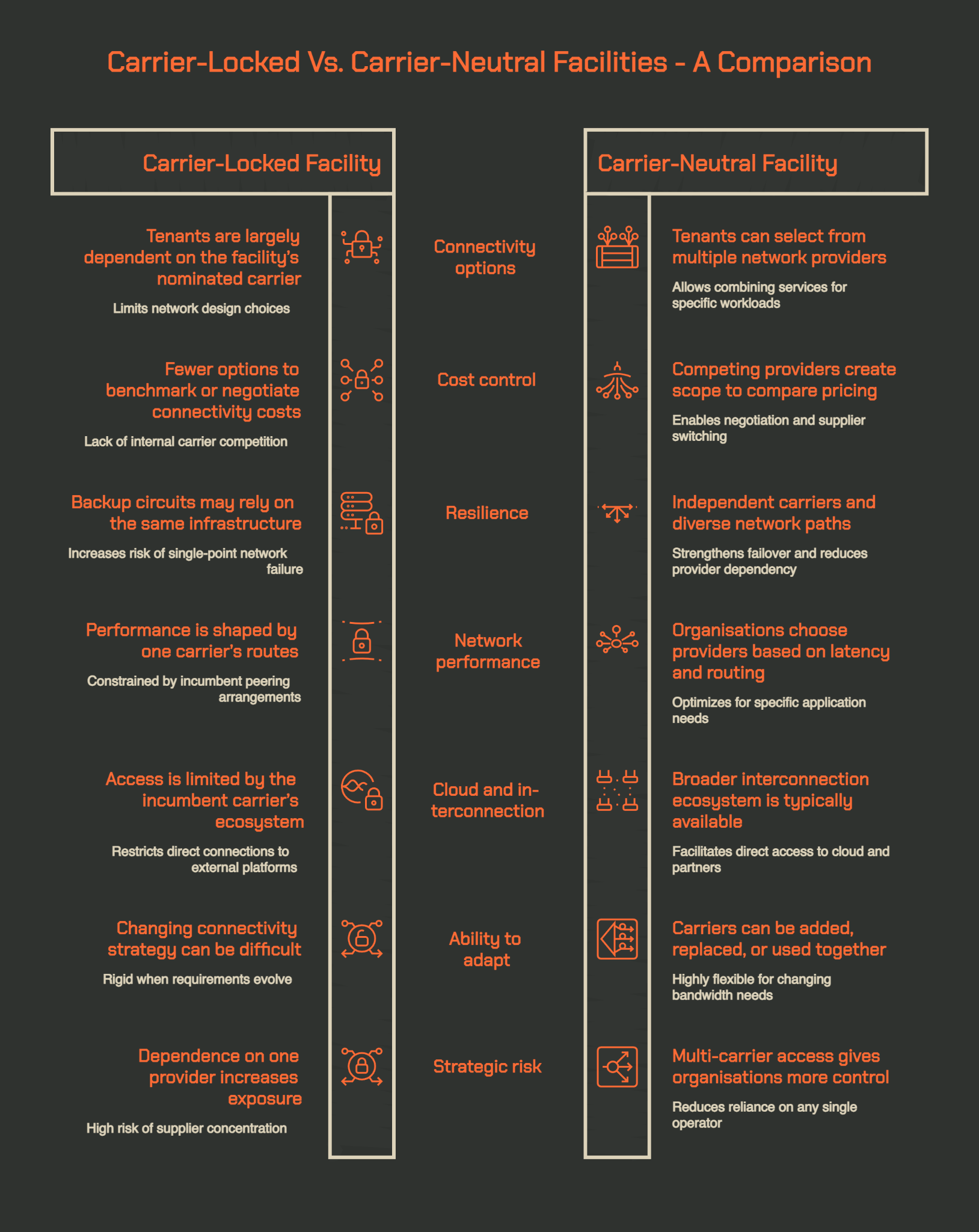
A carrier-locked facility has a commercial arrangement, sometimes exclusive and sometimes preferential, with a single network provider. Tenants who need connectivity must purchase it from that carrier regardless of whether its pricing, routing architecture, or redundancy configuration is the right fit for their workload.
This constraint does not always surface during initial evaluation, but it becomes apparent when that carrier has an outage, raises prices, or simply cannot serve the latency profile a specific application requires.
A carrier-neutral facility, sometimes also called a network-neutral interconnection facility, operates on a different model.
Multiple carriers are present in the building, and tenants can choose among them, use more than one simultaneously, and structure connectivity to prioritise cost, performance, or redundancy in whatever combination their workload demands. That flexibility compounds over time: as requirements change, you reconfigure your network rather than renegotiate your data centre contract.
The practical differences between the two models are significant:
- Provider Choice: Carrier-neutral facilities typically offer access to ten or more carriers. Carrier-locked facilities offer one, occasionally two.
- Pricing Leverage: Competition between carriers in a neutral facility creates negotiating flexibility. A single-carrier arrangement removes it.
- Redundancy Design: Multi-carrier access lets you build diverse network paths from two independent providers. Single-carrier facilities require redundancy to be built entirely within one provider's network.
- Cloud On-Ramp Access: Carrier-neutral facilities generally support multiple cloud on-ramps. Carrier-locked buildings may limit on-ramp options to those aligned with their preferred carrier's existing partnerships.
- Compliance Documentation: Regulated organisations that need to demonstrate network routing control benefit from being able to select which carriers handle their traffic and document that selection for auditors.
The Meet-Me Room and What It Enables
The physical infrastructure that makes carrier-neutral interconnection possible is the meet-me room (MMR). This is the designated space inside a data centre where carriers, cloud providers, and network participants terminate their equipment and make it available for cross connect patching. When a tenant orders a cross connect, the cable typically runs from their cabinet through the MMR and terminates at the carrier's port on the other side.
The density and organisation of a meet-me room tells you a great deal about what a facility can practically deliver.
A well-stocked MMR with physically isolated carrier interconnect rooms, diverse port capacity, and established cloud on-ramp terminations is a real connectivity asset. A sparse or loosely organised MMR creates friction: longer cable runs, limited patching options, and fewer carriers available at the port level when you actually need them. Asking specifically about MMR capacity and whether carrier interconnect rooms are physically isolated is one of the more revealing technical due diligence questions available to buyers evaluating data centre locations across Canada.
Interconnection, Compliance, and the Canadian Context
For most enterprise network teams, interconnection begins as a performance and cost conversation. That is a reasonable starting point, but it misses a dimension that matters specifically to Canadian organisations in regulated industries.
Where your traffic goes, not just where your servers sit, carries legal weight, and that weight has grown more consequential as regulators have become more explicit about what data sovereignty requires at every layer of the infrastructure stack.
Canada's data centre colocation market is projected to grow from approximately USD 2.76 billion in 2025 to USD 5.69 billion by 2030, driven in large part by data sovereignty requirements and regulated-industry demand for compliant infrastructure. The network layer is an increasingly central part of what that compliance conversation covers.
How Traffic Routing Creates Regulatory Risk
There is a widespread assumption that placing servers in Canada fully satisfies data sovereignty requirements.
Physical location is one part of the equation, but it does not govern what happens to traffic once it leaves a cabinet and enters a carrier's network. If data transits a carrier that is owned or legally controlled by a U.S. parent company, that traffic may be accessible to U.S. authorities under the Clarifying Lawful Overseas Use of Data (CLOUD) Act, regardless of where the data physically resides.
What makes this more concrete for interconnection decisions is that CLOUD Act exposure is not limited to data at rest with a provider. Professor Ron Deibert, director of the University of Toronto’s Citizen Lab, has estimated that about 90% of Canadian traffic is routed through U.S. exchange points.
This phenomenon is sometimes called "boomerang routing."
Because the CLOUD Act's reach extends to providers that facilitate the transmission of electronic communications, data in transit through U.S.-controlled network infrastructure can be subject to U.S. legal authority regardless of its Canadian origin and destination.
The Privacy Commissioner of Canada acknowledged this directly in the 2023-2024 annual report to the Parliament, noting that "data residency requirements alone cannot guarantee protection from foreign legal processes."
What Regulated Industries Need From Interconnection
OSFI Guideline B-13 on technology and cyber risk management requires federally regulated financial institutions to maintain meaningful control over their technology risk environment, including the third-party infrastructure that carries their data.
For example, healthcare organisations subject to Ontario's Personal Health Information Protection Act (PHIPA) face strict requirements on how personal health information is handled and transmitted. Federal government contractors encounter procurement frameworks that extend jurisdiction and ownership requirements to the network layer, not just the facility address.
The compliance response is not to avoid interconnection. The solution is to structure it with deliberate attention to which carriers you use and where they operate legally. The implications of OSFI B-13 for financial institutions make clear that technology supply chain risk, including the network carriers in a colocation facility's meet-me room, falls within the scope of what regulated entities must document and manage.
Choosing a carrier-neutral facility with a verified mix of Canadian-operated carriers gives compliance and legal teams something concrete to defend in an audit.
The regulated sectors most affected by network-layer compliance considerations include:
- Financial Services (OSFI B-13): Technology supply chain documentation, third-party oversight requirements, and traceability of data transmission paths across the full infrastructure stack.
- Healthcare (PHIPA / Quebec Law 25): Cross-border transmission restrictions, mandatory privacy impact assessments before communicating personal information outside the province, and explicit data routing controls.
- Federal Government: Procurement frameworks that apply Canadian jurisdiction and operational control requirements to the full technology stack, including connectivity providers and network routing infrastructure.
- Energy and Critical Infrastructure: Restrictions on which networks can carry operational technology data for organisations subject to NERC CIP standards and equivalent provincial frameworks.
How Qu Data Centres Supports Carrier-Neutral Interconnection Across Canada
Selecting a colocation partner is partly an infrastructure decision and partly a compliance architecture decision. Qu Data Centres is built to satisfy both. Across nine facilities in five Canadian markets, Qu's network infrastructure connects tenants to 15+ carrier networks, Megaport for software-defined cloud on-ramps, and physically isolated carrier interconnect rooms, all within a fully Canadian-owned and operated footprint with no foreign entity in the ownership chain.
For regulated workloads, this combination addresses both the technical and legal dimensions of the interconnection question. The high-availability connectivity configuration includes dual-path routing with automatic failover, keeping connections active when a single carrier path fails.
Megaport integration removes the provisioning delays traditionally associated with cloud on-ramp setup, giving infrastructure teams the ability to adjust cloud connectivity incrementally as requirements change. For workloads with backup and disaster recovery requirements, the multi-site national footprint provides geographically separated, sovereignty-preserved replication paths between Canadian facilities — with no foreign network infrastructure in between.
Qu is built for organizations that need connectivity infrastructure they can defend in an audit, not just a spec sheet. Book a facility tour and see the infrastructure in person before you commit.
Frequently Asked Questions About Data Centre Interconnection
What Is the Difference Between a Cross Connect and Internet Transit?
A cross connect is a dedicated physical link between two parties inside the same data centre. Traffic bypasses the public internet entirely and follows a private, deterministic path. Internet transit is a paid service where a carrier carries your traffic across their shared network to reach its destination. Cross connects offer lower latency and more consistent performance for specific connections, while transit provides general-purpose internet access for traffic that does not require a dedicated private path.
Carrier-neutral facilities let you choose from multiple network providers and optimise for the carrier with the best routing to your users, cloud environments, or partner organisations. Carrier-locked facilities restrict that choice to one provider, which can create bottlenecks and eliminate pricing leverage. The ability to mix carriers, route around outages, and adjust configurations as workload requirements change becomes a meaningful operational advantage for enterprise deployments over the life of a contract.
Can Interconnection Support Disaster Recovery Architectures?
Yes. Dedicated links between two geographically separated data centre sites are commonly used to replicate data between primary and secondary environments in near-real-time. This approach supports low recovery point objectives (RPOs) because replication traffic travels over a private, consistent path rather than a variable public internet connection. The private nature of the link also means replication traffic does not compete with production workloads for bandwidth during a failover event.
What Is Megaport and How Does It Relate to Cloud On-Ramps?
Megaport is a Network-as-a-Service (NaaS) platform that allows organisations to provision private connections to cloud providers through software, rather than ordering individual physical cross connects for each cloud relationship. A single Megaport port in a data centre can provide software-defined access to multiple cloud on-ramps, reducing provisioning time from weeks to hours. It gives infrastructure teams the flexibility to scale cloud connectivity in smaller, more manageable increments as workload requirements evolve.
Does Having Servers in Canada Guarantee Data Sovereignty?
Physical location satisfies data residency, one layer of compliance, but does not determine legal jurisdiction over data in transit or legal access rights to stored data. A U.S.-owned provider operating servers in Canada remains subject to U.S. law, including the CLOUD Act, which can compel access to data regardless of where it physically resides. Full data sovereignty requires Canadian location, Canadian operational control, no foreign ownership chain, and deliberate attention to which carriers handle data in transit.
Sources Used for This Article
- MarketsandMarkets: "Canada Data Center Colocation Market" - marketsandmarkets.com/Market-Reports/geography/colocation-market/canada
- Balsillie Papers: "The US CLOUD Act and Canadian Data Sovereignty" - balsilliepapers.ca/canadian-data/us-cloud-act/
- The Toronto Star: "Canadians not safe from U.S. online surveillance, expert says" - thestar.com/news/world/canadians-not-safe-from-u-s-online-surveillance-expert-says/article_b7be4caf-fd02-5454-bf82-afb0a1590b21.html
- Balsillie Papers: "Policy Recommendations for Canadian Data Sovereignty" - balsilliepapers.ca/canadian-data/policy-recommendations/
- Office of the Superintendent of Financial Institutions: "Technology and Cyber Risk Management (Guideline E-21)" - osfi-bsif.gc.ca/en/risks/technology-cyber-risk-management
- e-Laws Ontario: "Personal Health Information Protection Act, 2004, S.O. 2004, c. 3, Sched. A" - ontario.ca/laws/statute/04p03






Quick Answer: Data centre interconnection is the direct, private exchange of data between networks, cloud environments, and systems within or through a facility, without routing traffic over the public internet. It includes cross connects, internet exchange points, and cloud on-ramps, each with distinct performance, cost, and compliance implications. For Canadian organisations, the choices embedded in interconnection have consequences that extend well beyond network speed.
Key Takeaways
When a colocation provider lists "carrier-neutral interconnection" in their spec sheet, it sounds straightforward. In practice, a facility with a single carrier and a building with fifteen are worlds apart and can mean the difference between infrastructure that performs under pressure and infrastructure that creates bottlenecks at exactly the wrong moment.
Connectivity is easy to overlook in procurement because it is hard to evaluate without knowing what to ask.
Part of the challenge is that interconnection covers several distinct technical concepts that often get collapsed into a single term on a brochure. A cross connect, an internet exchange, and a cloud on-ramp are all forms of data centre interconnection, but they work differently, cost differently, and serve different architectural purposes. Treating them as a single checkbox misses the decisions embedded in each one.
For Canadian enterprises in regulated sectors, there is an additional layer: network routing decisions do not just affect performance and cost.
They can create compliance exposure that auditors and legal teams are increasingly flagging during procurement reviews. The question of what interconnection means has both a technical answer and a regulatory one, and both matter when you are signing a multi-year infrastructure contract.
What is Data Centre Interconnection
Let’s talk about what a standard connection is first.
A standard internet "connection" is any link to the public internet, where traffic travels across shared infrastructure owned by carriers, ISPs, and exchanges you have no direct relationship with. Data centre interconnection is different: it refers to direct, private links between two organisations, networks, or systems, where traffic moves without touching the public internet at any point in the path.
The scope of what counts as interconnection is broader than a single cable or service agreement.
A colocation deployment can involve multiple overlapping forms of interconnection running simultaneously, each serving a different part of the network architecture. What those options look like in practice depends almost entirely on what is available inside the facility you have chosen.
Cross Connects: Point-To-Point Private Links
A cross connect is the foundational unit of data centre interconnection. It is a dedicated physical cable, almost always fibre, running between two termination points inside the same facility.
The latency advantage has the biggest impact here. Traffic stays inside the building, follows a deterministic path, and avoids the variability of shared internet routing. For real-time applications, financial systems, database replication, and anything with tight SLA commitments, that predictability matters considerably.
The value of a cross connect depends on who is on the other end of it.
A cross connect to a carrier with strong national routing and genuine redundancy is an architectural asset. A cross connect to a carrier with limited reach or a single-path configuration is a point of concentrated risk. Inside a carrier-neutral facility, a single deployment can use cross connects to reach multiple distinct endpoints:
The cross connects available to you are only as useful as the parties accessible on the other end. This is why carrier density inside a data centre matters more than the word "interconnection" on its own and why asking specifically who is in the building is one of the first questions worth raising in any colocation evaluation.
Internet Exchange Points: Where Multiple Networks Peer
An internet exchange point (IXP) is a shared switching fabric where multiple networks connect to each other and exchange traffic directly. Rather than requiring a separate physical cross connect to every network you want to reach, an IXP lets you connect once and establish peering relationships with every other participant on that exchange, including ISPs, content delivery networks, cloud providers, and large enterprise networks.
The performance benefit of IXP access is measurable.
Every additional network hop adds latency, a small amount per hop that compounds across millions of transactions for high-throughput workloads. For organisations running content delivery, financial platforms, or real-time collaboration tools, proximity to a major exchange is a workload requirement.
Peering through an IXP is also typically less expensive than paying for transit to a carrier that routes to the same destination via a longer, less direct path.
Cloud On-Ramps: Private Access to Public Cloud
A cloud on-ramp is a dedicated, private connection from a data centre directly into a public cloud provider's network, bypassing the public internet entirely. The major platforms each offer a named equivalent: AWS Direct Connect, Microsoft Azure ExpressRoute, and Google Cloud Interconnect are the most common examples, typically provisioned through a cross connect inside a colocation facility or through a Network-as-a-Service platform like Megaport.
The difference between reaching cloud resources over the public internet versus through a private on-ramp is significant in both performance and compliance terms.
Public internet paths are variable by design. Latency fluctuates with congestion, packet loss happens, and the route traffic takes can change without notice.
A cloud on-ramp provides a committed, private path with consistent throughput and a service level agreement behind it. For colocation environments running hybrid architectures where workloads span both on-premises hardware and cloud, the on-ramp is what makes that hybrid model function reliably rather than just theoretically.
Interconnection Type
How It Works
Primary Use Case
Key Evaluation Factor
Cross Connect
Dedicated physical cable between two parties in the same facility
Carrier access, cloud node links, tenant-to-tenant connectivity
Who is available on the other end
Internet Exchange Point (IXP)
Shared switching fabric for multi-network peering
Latency reduction, peering cost efficiency
Exchange participation and routing depth
Cloud On-Ramp
Dedicated private link to a public cloud provider
Hybrid cloud performance and compliance
Consistency vs. public internet variability
Colocation Internet (Multi-homed)
Multiple upstream ISP paths with automatic failover
General internet access with built-in redundancy
ISP mix and failover configuration
Why Carrier Neutrality Shapes Your Interconnection Options
The types of interconnection a data centre supports only matter if you can access them on terms that work for your organisation. Carrier neutrality determines whether you have genuine choice over how you connect or whether the facility's commercial arrangements narrow that choice before the contract is signed.
It is one of the first questions worth asking when evaluating any colocation provider, and the answer reveals more about a deployment's practical flexibility than most other items on a spec sheet.
Carrier-Locked Vs. Carrier-Neutral Facilities
A carrier-locked facility has a commercial arrangement, sometimes exclusive and sometimes preferential, with a single network provider. Tenants who need connectivity must purchase it from that carrier regardless of whether its pricing, routing architecture, or redundancy configuration is the right fit for their workload.
This constraint does not always surface during initial evaluation, but it becomes apparent when that carrier has an outage, raises prices, or simply cannot serve the latency profile a specific application requires.
A carrier-neutral facility, sometimes also called a network-neutral interconnection facility, operates on a different model.
Multiple carriers are present in the building, and tenants can choose among them, use more than one simultaneously, and structure connectivity to prioritise cost, performance, or redundancy in whatever combination their workload demands. That flexibility compounds over time: as requirements change, you reconfigure your network rather than renegotiate your data centre contract.
The practical differences between the two models are significant:
The Meet-Me Room and What It Enables
The physical infrastructure that makes carrier-neutral interconnection possible is the meet-me room (MMR). This is the designated space inside a data centre where carriers, cloud providers, and network participants terminate their equipment and make it available for cross connect patching. When a tenant orders a cross connect, the cable typically runs from their cabinet through the MMR and terminates at the carrier's port on the other side.
The density and organisation of a meet-me room tells you a great deal about what a facility can practically deliver.
A well-stocked MMR with physically isolated carrier interconnect rooms, diverse port capacity, and established cloud on-ramp terminations is a real connectivity asset. A sparse or loosely organised MMR creates friction: longer cable runs, limited patching options, and fewer carriers available at the port level when you actually need them. Asking specifically about MMR capacity and whether carrier interconnect rooms are physically isolated is one of the more revealing technical due diligence questions available to buyers evaluating data centre locations across Canada.
Interconnection, Compliance, and the Canadian Context
For most enterprise network teams, interconnection begins as a performance and cost conversation. That is a reasonable starting point, but it misses a dimension that matters specifically to Canadian organisations in regulated industries.
Where your traffic goes, not just where your servers sit, carries legal weight, and that weight has grown more consequential as regulators have become more explicit about what data sovereignty requires at every layer of the infrastructure stack.
Canada's data centre colocation market is projected to grow from approximately USD 2.76 billion in 2025 to USD 5.69 billion by 2030, driven in large part by data sovereignty requirements and regulated-industry demand for compliant infrastructure. The network layer is an increasingly central part of what that compliance conversation covers.
How Traffic Routing Creates Regulatory Risk
There is a widespread assumption that placing servers in Canada fully satisfies data sovereignty requirements.
Physical location is one part of the equation, but it does not govern what happens to traffic once it leaves a cabinet and enters a carrier's network. If data transits a carrier that is owned or legally controlled by a U.S. parent company, that traffic may be accessible to U.S. authorities under the Clarifying Lawful Overseas Use of Data (CLOUD) Act, regardless of where the data physically resides.
What makes this more concrete for interconnection decisions is that CLOUD Act exposure is not limited to data at rest with a provider. Professor Ron Deibert, director of the University of Toronto’s Citizen Lab, has estimated that about 90% of Canadian traffic is routed through U.S. exchange points.
This phenomenon is sometimes called "boomerang routing."
Because the CLOUD Act's reach extends to providers that facilitate the transmission of electronic communications, data in transit through U.S.-controlled network infrastructure can be subject to U.S. legal authority regardless of its Canadian origin and destination.
The Privacy Commissioner of Canada acknowledged this directly in the 2023-2024 annual report to the Parliament, noting that "data residency requirements alone cannot guarantee protection from foreign legal processes."
What Regulated Industries Need From Interconnection
OSFI Guideline B-13 on technology and cyber risk management requires federally regulated financial institutions to maintain meaningful control over their technology risk environment, including the third-party infrastructure that carries their data.
For example, healthcare organisations subject to Ontario's Personal Health Information Protection Act (PHIPA) face strict requirements on how personal health information is handled and transmitted. Federal government contractors encounter procurement frameworks that extend jurisdiction and ownership requirements to the network layer, not just the facility address.
The compliance response is not to avoid interconnection. The solution is to structure it with deliberate attention to which carriers you use and where they operate legally. The implications of OSFI B-13 for financial institutions make clear that technology supply chain risk, including the network carriers in a colocation facility's meet-me room, falls within the scope of what regulated entities must document and manage.
Choosing a carrier-neutral facility with a verified mix of Canadian-operated carriers gives compliance and legal teams something concrete to defend in an audit.
The regulated sectors most affected by network-layer compliance considerations include:
How Qu Data Centres Supports Carrier-Neutral Interconnection Across Canada
Selecting a colocation partner is partly an infrastructure decision and partly a compliance architecture decision. Qu Data Centres is built to satisfy both. Across nine facilities in five Canadian markets, Qu's network infrastructure connects tenants to 15+ carrier networks, Megaport for software-defined cloud on-ramps, and physically isolated carrier interconnect rooms, all within a fully Canadian-owned and operated footprint with no foreign entity in the ownership chain.
For regulated workloads, this combination addresses both the technical and legal dimensions of the interconnection question. The high-availability connectivity configuration includes dual-path routing with automatic failover, keeping connections active when a single carrier path fails.
Megaport integration removes the provisioning delays traditionally associated with cloud on-ramp setup, giving infrastructure teams the ability to adjust cloud connectivity incrementally as requirements change. For workloads with backup and disaster recovery requirements, the multi-site national footprint provides geographically separated, sovereignty-preserved replication paths between Canadian facilities — with no foreign network infrastructure in between.
Qu is built for organizations that need connectivity infrastructure they can defend in an audit, not just a spec sheet. Book a facility tour and see the infrastructure in person before you commit.
Frequently Asked Questions About Data Centre Interconnection
What Is the Difference Between a Cross Connect and Internet Transit?
A cross connect is a dedicated physical link between two parties inside the same data centre. Traffic bypasses the public internet entirely and follows a private, deterministic path. Internet transit is a paid service where a carrier carries your traffic across their shared network to reach its destination. Cross connects offer lower latency and more consistent performance for specific connections, while transit provides general-purpose internet access for traffic that does not require a dedicated private path.
How Does Carrier Neutrality Affect Network Performance?
Carrier-neutral facilities let you choose from multiple network providers and optimise for the carrier with the best routing to your users, cloud environments, or partner organisations. Carrier-locked facilities restrict that choice to one provider, which can create bottlenecks and eliminate pricing leverage. The ability to mix carriers, route around outages, and adjust configurations as workload requirements change becomes a meaningful operational advantage for enterprise deployments over the life of a contract.
Can Interconnection Support Disaster Recovery Architectures?
Yes. Dedicated links between two geographically separated data centre sites are commonly used to replicate data between primary and secondary environments in near-real-time. This approach supports low recovery point objectives (RPOs) because replication traffic travels over a private, consistent path rather than a variable public internet connection. The private nature of the link also means replication traffic does not compete with production workloads for bandwidth during a failover event.
What Is Megaport and How Does It Relate to Cloud On-Ramps?
Megaport is a Network-as-a-Service (NaaS) platform that allows organisations to provision private connections to cloud providers through software, rather than ordering individual physical cross connects for each cloud relationship. A single Megaport port in a data centre can provide software-defined access to multiple cloud on-ramps, reducing provisioning time from weeks to hours. It gives infrastructure teams the flexibility to scale cloud connectivity in smaller, more manageable increments as workload requirements evolve.
Does Having Servers in Canada Guarantee Data Sovereignty?
Physical location satisfies data residency, one layer of compliance, but does not determine legal jurisdiction over data in transit or legal access rights to stored data. A U.S.-owned provider operating servers in Canada remains subject to U.S. law, including the CLOUD Act, which can compel access to data regardless of where it physically resides. Full data sovereignty requires Canadian location, Canadian operational control, no foreign ownership chain, and deliberate attention to which carriers handle data in transit.
Sources Used for This Article
Paul M
Paul Miedzik is Senior Manager of Marketing at Qu Data Centres, with extensive experience in enterprise cloud and digital infrastructure across the Canadian tech sector.