Quick Answer: A data centre is a purpose-built facility that houses the servers, networking equipment, power systems, and cooling infrastructure organisations use to store, process, and transmit data. Unlike a basic server room, a data centre is engineered for continuous, mission-critical operation, with redundant power paths, controlled cooling, physical security, and carrier connectivity built in from the ground up.
Key Takeaways
- A data centre is a purpose-built facility that houses servers, networking equipment, power systems, cooling infrastructure, and security controls to ensure continuous, reliable operation of critical IT workloads.
- Unlike a server room, a data centre is engineered with dedicated power feeds, backup generators, UPS systems, precision cooling, carrier connectivity, and layered physical security designed for uninterrupted service.
- Data centres perform three core functions: compute (running applications and workloads), storage (protecting and replicating data), and connectivity (moving data between users, systems, and facilities).
- Industries including financial services, healthcare, government, energy, SaaS, retail, and managed service providers rely on data centres to meet uptime, compliance, security, and performance requirements.
- Enterprise-grade facilities use redundant power and cooling systems, physical security controls, and Uptime Institute Tier certifications, with Tier III recognised as the standard for concurrently maintainable infrastructure.
- Organisations can deploy workloads in enterprise-owned facilities, colocation data centres, or hyperscale cloud environments, depending on their requirements for control, compliance, scalability, and cost.
- Book a facility tour with Qu Data Centres to see how Tier III-certified Canadian infrastructure supports secure, compliant, and always-on enterprise operations.
What Is a Data Centre?
Every time a hospital retrieves a patient record, a bank processes a transaction, or a SaaS platform serves a request, a data centre is involved. The term gets used loosely, but there is a meaningful difference between a data centre and a server room that organisations making infrastructure decisions need to understand.
Data Centres vs. Server Rooms: Key Differences
A server room is a space within an office building where an organisation stores its IT equipment. It might have basic cooling, a UPS, and a locked door. A data centre is a purpose-built facility engineered from the ground up to keep that equipment running without interruption, at scale, under any foreseeable condition.
Do they serve the same purpose? Loosely, yes. Does that make them similar? Definitely not.
Data centres are built with dedicated power feeds from the utility grid, multiple layers of backup generation and UPS systems, precision cooling that runs independently of building HVAC, and physical security that includes biometric access, CCTV retention, and mantrap entry systems. Server rooms share building infrastructure. Data centres own theirs.
Three Core Functions: Compute, Storage, and Connectivity
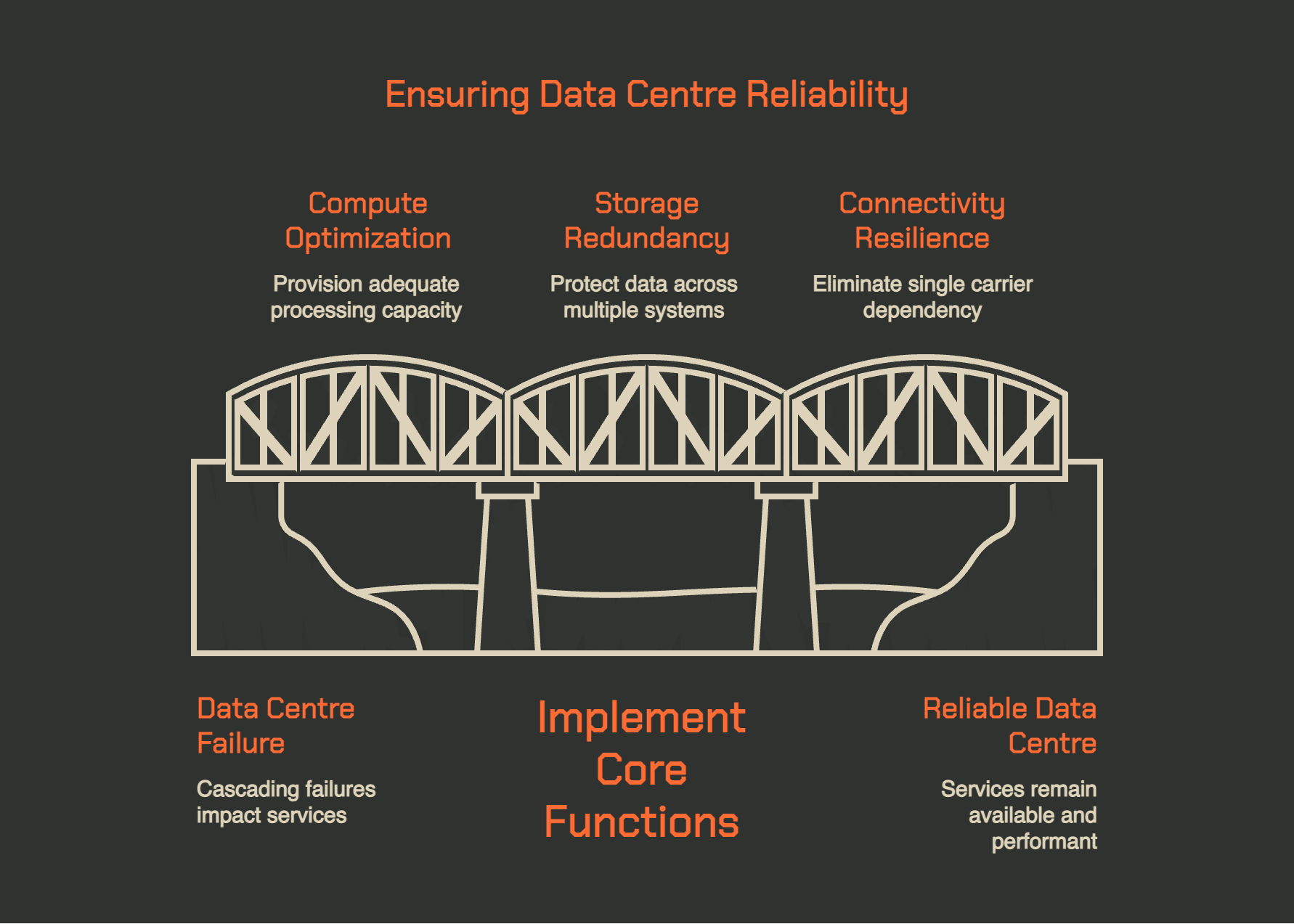
A data centre performs three fundamental jobs, and each one has to work correctly for the others to be worth anything. A failure in any layer does not stay contained; it cascades.
- Compute: The processing layer that runs applications, executes workloads, and handles requests. If compute is undersized or unprotected, applications slow down or fail entirely under load. Getting this right means provisioning the right amount of processing capacity, with power redundancy behind it, so that a hardware failure or a surge in demand does not take services down.
- Storage: The layer that retains, replicates, and protects data. Poor storage design is where organisations lose data permanently, not just temporarily. Done correctly, storage is redundant across drives, replicated across systems, and backed up to a geographically separate location so that a hardware failure or a ransomware event does not result in permanent data loss.
- Connectivity: The network layer that moves data between servers, between users, and between facilities. Connectivity errors are invisible until they are catastrophic. An application can be running perfectly and still be unreachable if the network path fails. Designing connectivity correctly means eliminating single carrier dependency, building in redundant paths, and ensuring that a fibre cut or provider outage does not take the entire environment offline.
These three functions are not independent workstreams. They are interdependent systems that have to be designed, operated, and maintained as a single infrastructure environment.
What Is a Data Centre Used For?
Data centres are not a one-size-fits-all infrastructure. The organisations that rely on them span nearly every industry vertical, but the common thread is that their operations depend on systems that cannot afford to go down, data that cannot be lost, and connectivity that cannot be interrupted. Here are the sectors where data centre infrastructure is not optional.
- Financial Services: Banks, insurers, and capital markets firms run core banking systems, trading platforms, and fraud detection workloads that require sub-millisecond latency and continuous uptime. Regulatory frameworks like OSFI in Canada mandate strict data residency, access control, and audit trail requirements that enterprise-grade colocation facilities are built to satisfy.
- Healthcare: Hospital networks, diagnostic labs, and health information exchanges store and transmit sensitive patient records governed by provincial privacy legislation. These organisations need certified infrastructure with physical access controls, documented audit trails, and geo-diverse backup to meet both compliance and clinical continuity requirements.
- Government and Public Sector: Federal departments, provincial agencies, and municipalities process sensitive citizen data that must remain within Canadian jurisdiction. Sovereign, carrier-neutral facilities with SOC 2 and ISO 27001 certifications are increasingly a baseline procurement requirement for public sector contracts.
- Energy and Resources: Oil and gas operators, utilities, and pipeline companies run industrial control systems, SCADA environments, and real-time monitoring platforms that cannot tolerate outages. Many also face sector-specific cybersecurity frameworks that require documented physical and logical security controls.
- Technology and SaaS: Software companies hosting multi-tenant platforms need reliable, scalable infrastructure that can grow with their customer base. Colocation gives them enterprise-grade facilities without the capital cost of building their own, while high-availability connectivity supports the low-latency performance their end users expect.
- Retail and E-Commerce: High-traffic retail platforms depend on data centre infrastructure during peak demand periods, where even seconds of downtime translate directly into lost revenue. Redundant power, N+1 cooling, and diverse network paths are what keep checkout systems and inventory platforms online when traffic spikes.
- Managed Service Providers (MSPs): MSPs use colocation facilities as the physical foundation for the services they deliver to their own clients. A carrier-neutral facility with strong certifications and available capacity lets an MSP scale its offering without building or owning its own physical infrastructure.
What Equipment Is In a Data Centre?
Most articles about data centre equipment focus on servers, but the hardware that keeps workloads running is only one layer of a much larger system. The infrastructure supporting that hardware is where reliability is actually built.
Servers and Racks
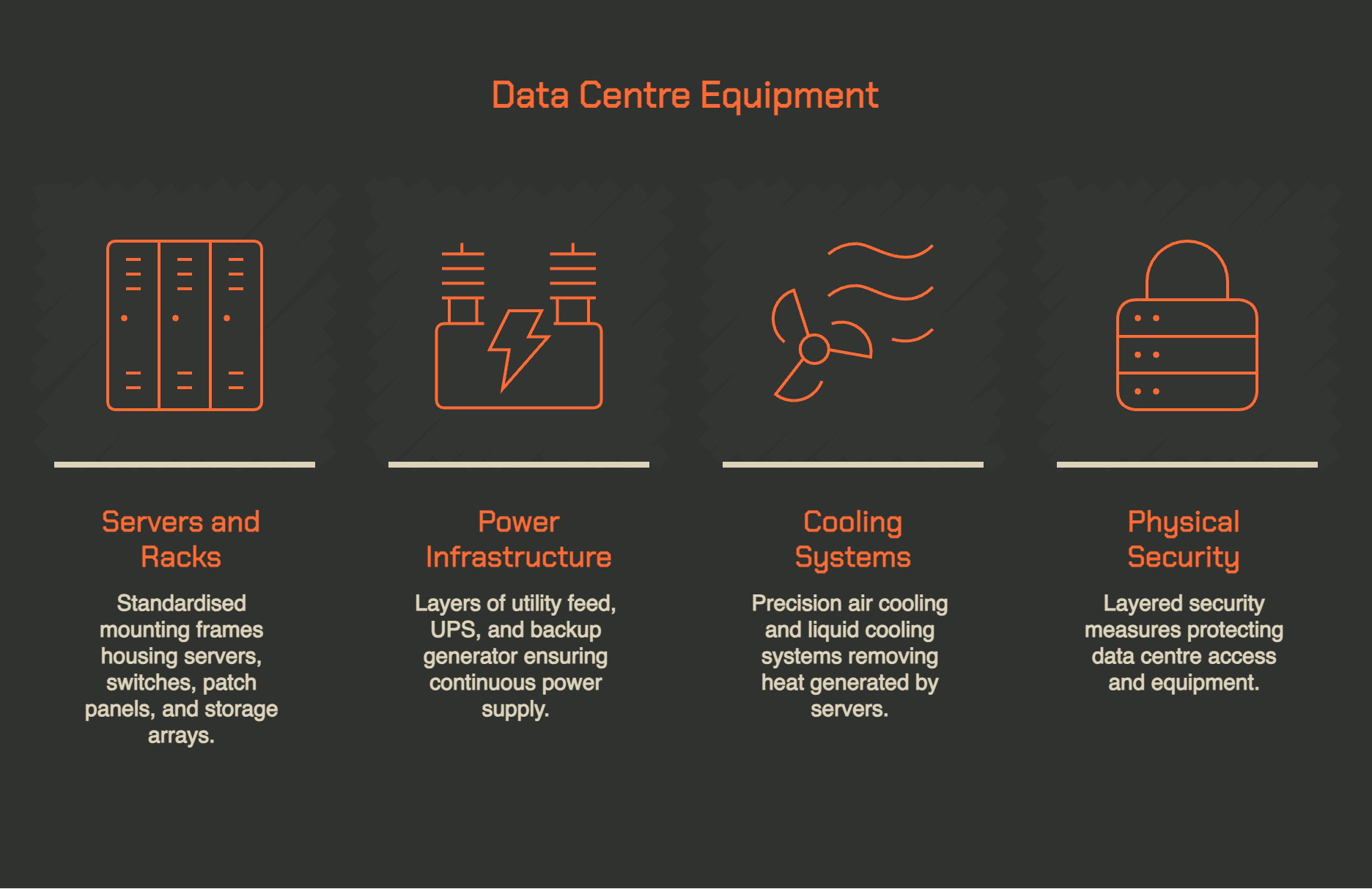
Data centre racks are standardised mounting frames, typically 42U or 48U in height (1U refers to one rack unit), that house servers, switches, patch panels, and storage arrays in a structured column.
Racks are grouped into rows, and rows are arranged into hot aisle and cold aisle configurations to manage airflow. Cold air enters the front of the racks, passes through the equipment, and exits as hot air into the hot aisle, where it is captured and removed by the cooling system.
Power density per rack has changed significantly over the past decade. Traditional enterprise workloads ran at roughly 5-10 kW per rack. High-density AI and GPU workloads are pushing that figure to 30 kW, 50 kW, or higher in some configurations. Not every facility can support that. When evaluating a data centre for modern workloads, per-rack power capacity is one of the first specs worth checking against your actual requirements.
Data Centre Power Infrastructure
Power is where uptime is won or lost. A data centre's power system is typically structured in layers: utility feed, uninterruptible power supply (UPS), and backup generator.
When the utility feed drops, the UPS takes over instantaneously, buying enough time for generators to come online. That handover window, measured in milliseconds, is where most power-related outages happen in poorly designed facilities.
The UPS isn’t just to manage power during outages. It also conditions incoming power, protecting sensitive equipment from voltage fluctuations and surges that would otherwise cause errors or hardware damage. Generator systems are sized to run the full facility load, and onsite fuel storage is rated in hours at full load. Twenty-four hours of fuel on-site is a common minimum standard for enterprise-grade facilities.
Enterprise facilities also implement separate power distribution paths, known as "A" and "B" feeds, so that even if one power path fails entirely, equipment with dual power supply units continues to operate on the surviving path without interruption.
Data Centre Cooling Systems
Cooling is the most underestimated component in a data centre. Servers generate enormous heat as a byproduct of operation, and if that heat is not continuously removed, equipment fails. A modern data centre's cooling load runs around the clock, regardless of how light or heavy the compute activity is at any given moment.
The most common cooling approach in enterprise facilities is precision air cooling, delivered by Computer Room Air Conditioning (CRAC) or Computer Room Air Handler (CRAH) units positioned throughout the floor.
These units work in conjunction with the hot aisle and cold aisle layout to direct conditioned air precisely where it is needed. Some facilities use free-air economisation, drawing in external air during cooler periods to reduce mechanical cooling load and energy consumption.
Liquid cooling is increasingly used for high-density GPU clusters, where air cooling cannot remove heat fast enough from closely packed processors. Direct-to-chip liquid cooling delivers coolant directly to the processor rather than relying on airflow, improving thermal efficiency and reducing the mechanical cooling load compared to traditional evaporative approaches.
Water consumption does vary by facility design and geography, and this is where climate plays a meaningful role. Canada's colder climate gives facilities here a natural advantage: cooler ambient temperatures allow data centres to rely on free-air economisation for a greater portion of the year, reducing both mechanical cooling demand and water usage compared to facilities operating in warmer regions.
Physical Security
Physical access to a data centre is a compliance requirement, not just an operational preference. Regulators and auditors evaluating frameworks like SOC 2, ISO 27001, and PCI DSS specifically review physical access controls as part of their assessments.
Enterprise data centres implement layered physical security that typically includes a single secured entrance, mantraps with two-factor biometric authentication, individually locked cabinets, 24x7 manned monitoring, and CCTV systems with 90-day retention.
Each layer addresses a different risk: the mantrap prevents tailgating, the locked cabinet ensures only authorised personnel access specific equipment, and CCTV retention provides an audit trail if an incident needs to be investigated retroactively.
Data Centre Tiers: Tier I Through Tier IV
The Uptime Institute's Tier Classification System is the global benchmark for data centre reliability. Before evaluating a provider, it is worth knowing what the tiers actually represent, because the difference between them is not incremental. Each step up reflects a fundamentally different approach to infrastructure design.
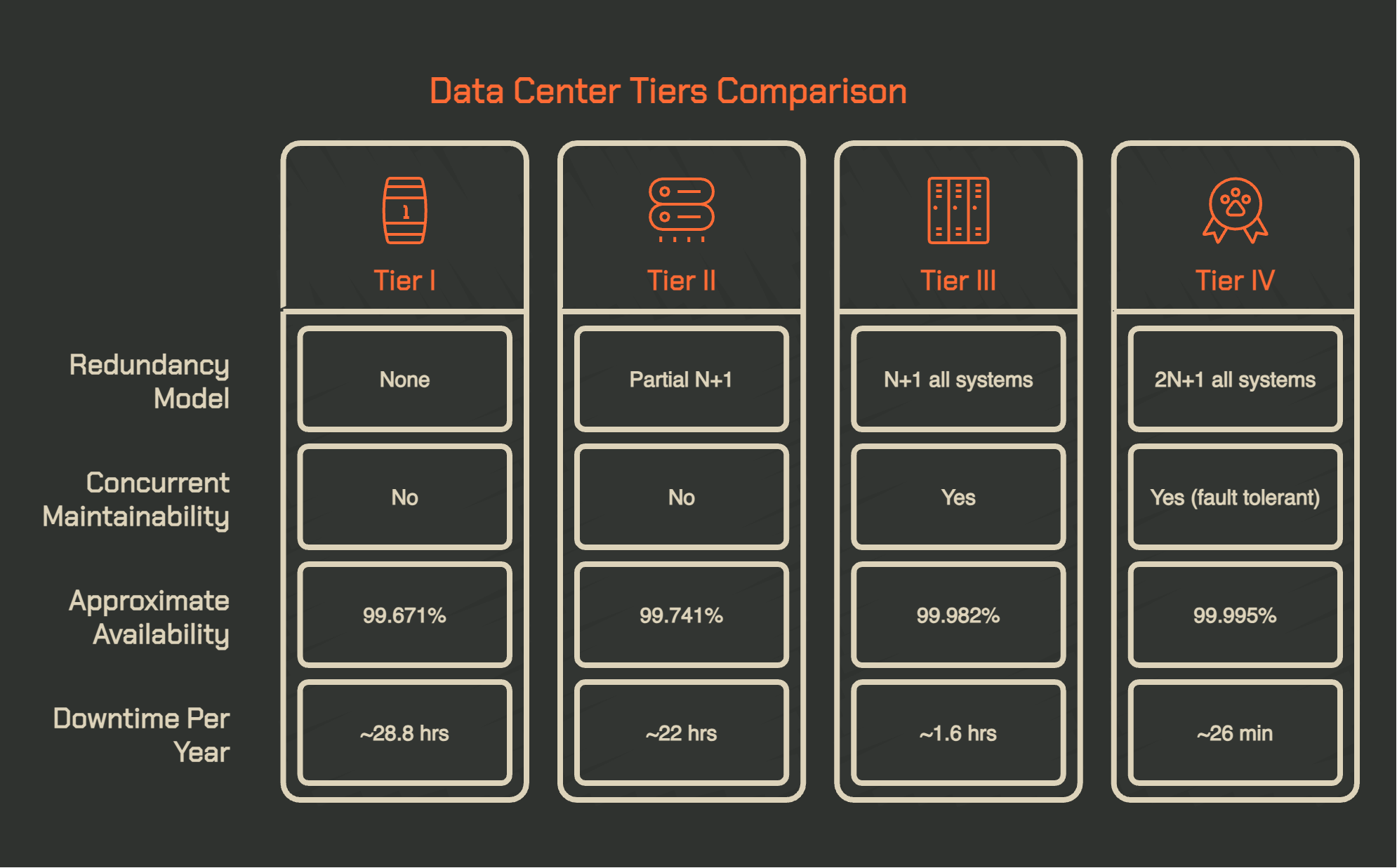
The Uptime Institute defines four tiers based on the facility's redundancy, the number of independent distribution paths, and whether maintenance can be performed without taking systems offline:
- Tier I: Single path for power and cooling, no redundant components. Downtime during any planned maintenance is expected.
- Tier II: Redundant components for power and cooling, but still a single distribution path. Some resilience, but a distribution failure still impacts the environment.
- Tier III: Multiple power and cooling paths with N+1 redundancy across all components. Maintenance can be performed without impacting IT systems. This is the concurrently maintainable standard.
- Tier IV: Full fault tolerance with 2N redundancy. Any single component failure, planned or unplanned, does not affect operations.
Tier III Certification: The Enterprise Reliability Standard
Tier III is the standard most enterprise organisations require, and the reason is a concept called concurrent maintainability. In a Tier III facility, any component in the power or cooling chain can be taken offline for maintenance or replacement without the systems it supports going down. That means a UPS can be serviced, a generator can be tested, and a cooling unit can be swapped, all while customer workloads continue running at full capacity.
According to Uptime Institute, Tier III certification delivers approximately 99.982% availability, which translates to roughly 1.6 hours of potential downtime per year under the standard. For organisations whose revenue depends on always-on systems, that figure matters significantly more than the rough equivalents offered by unrated facilities.
It is also worth noting that Uptime Institute uses Roman numerals only. A provider advertising "Tier 3" with an Arabic numeral has not been officially certified through Uptime's programme, or is being imprecise about their certification status.
N+1 and 2N Redundancy
Redundancy ratings describe how many backup components exist beyond what the facility needs to operate at full capacity. "N" is the baseline, the exact number of components required to run the facility under full load. Every configuration builds from there.
- N+1: One additional component beyond what is required. If four UPS units are needed to run the facility, an N+1 configuration deploys five. If one unit fails, the remaining four carry the load without degradation.
- 2N: Two fully independent systems, each capable of handling the entire load on its own. If one system fails completely, the other takes over 100% of demand with no performance impact.
- 2N+1: Two fully redundant systems plus one additional component. This is the configuration used in Tier IV environments where fault tolerance must be absolute.
N+1 is cost-effective and more than sufficient for most enterprise workloads. 2N is appropriate for environments where the financial or operational cost of any downtime, including from a correlated failure during a maintenance window, is unacceptable. Financial services, healthcare, and critical government infrastructure often sit in this category.
Data Centre Types: On-Premise, Colocation, and Cloud
Not all data centres serve the same function, and the deployment model an organisation chooses has long-term implications for cost structure, control, and compliance posture. The three primary models each represent a different trade-off between ownership, flexibility, and operational overhead.
1. Enterprise Data Centres
An enterprise data centre is owned and operated by a single organisation within its own facility.
The organisation controls every layer of the stack: the building, the power infrastructure, the cooling, the network, and the hardware. This model provides maximum control and direct oversight over where data lives and who can access it.
The cost profile is the challenge. Building and operating an enterprise data centre requires significant capital expenditure in construction, power infrastructure, cooling plant, and ongoing staffing. Maintenance, hardware refresh cycles, and compliance certifications all remain the organisation's responsibility.
For most enterprises, the total cost of ownership over five to ten years is substantially higher than alternative models, and the facility cannot easily be scaled up or down to meet changing demand.
2. Colocation Data Centres
Colocation is the model where an organisation owns and manages its own servers and networking equipment but houses that equipment in a third-party data centre facility. The colocation provider supplies the space, power, cooling, physical security, and network connectivity. The customer supplies the hardware and retains full ownership of it.
This model delivers enterprise-grade infrastructure without the capital cost of building and operating a facility. Organisations gain access to certifications like Tier III, N+1 redundancy, and 24x7 physical security that would be prohibitively expensive to replicate in-house.
The customer also retains the hardware control and data ownership that cloud models do not offer, which matters significantly in regulated industries and data sovereignty contexts. Colocation is available in several configurations, from shared rack space in a common area, to dedicated cages with locked enclosures, to private suites that function as a dedicated room within the facility.
3. Cloud and Hyperscale Data Centres
A hyperscale data centre is a facility, typically 100 MW or larger, built and operated by a major cloud or technology platform to support its global services. These facilities house millions of servers and are optimised for the specific workloads of a single operator, AWS, Microsoft Azure, Google Cloud, or similar. They are not accessible to third parties as colocation; they exist to support the provider's own infrastructure.
What enterprises interact with is the virtualised cloud services running on top of that infrastructure. Cloud deployments offer rapid provisioning, consumption-based pricing, and near-infinite scale on demand. The trade-offs are reduced control over where data physically resides, variable cost structures that can escalate at scale, and reliance on provider compliance certifications rather than independently verified facility certifications.
Choosing the Right Deployment Model for Your Workload
No single model suits every workload. Most organisations run a mix:
- Regulated or performance-sensitive workloads often belong in colocation environments where the organisation retains hardware control and benefits from certified infrastructure.
- Flexible, variable-demand workloads are well-served by cloud.
- Disaster recovery architectures frequently use both, pairing a primary colocation environment with a secondary site or cloud-based failover target.
The decision hinges on three variables: how much control the organisation needs over its hardware and data residency, what compliance frameworks apply, and what the true total cost of ownership looks like over a three-to-five-year horizon.
Why Qu Data Centres is Built for Canadian Enterprise Workloads
The question most CIOs reach eventually is not "what is a data centre" but "which one is right for my organisation." The answer depends on workload requirements, compliance obligations, available capacity, and whether the partner you choose has the depth of experience to support a multi-year infrastructure roadmap rather than just a rack deployment.
Qu Data Centres has operated mission-critical infrastructure for over two decades. Our 130+ Canadian employees, many with 15 to 20 years of tenure at these specific facilities, bring institutional knowledge that cannot be replicated by a new entrant or a U.S.-headquartered operator with a Canadian office.
Our managed services portfolio, which includes backup and disaster recovery, virtual private cloud, and managed firewall, means organisations can deploy into our infrastructure and add services as their requirements evolve without switching providers. Our virtual private cloud platforms are hosted within Tier III certified facilities in Calgary, Toronto, and Ottawa, giving Canadian organisations cloud-like flexibility under Canadian jurisdiction.
Ready to see the infrastructure in person? Book a facility tour and walk through what enterprise-grade looks like in practice.
Frequently Asked Questions About Data Centres
What Is a Colocation Data Centre?
A colocation data centre is a third-party facility where organisations house their own servers and networking equipment. The colocation provider supplies the physical space, power, cooling, security, and network connectivity. The customer owns and manages the hardware. This model gives organisations access to enterprise-grade, certified infrastructure without the capital cost of building and operating a private facility.
What Equipment Is in a Data Centre?
A data centre contains servers and storage arrays mounted in standardised racks, networking equipment including switches, routers, and patch panels, power infrastructure including UPS systems and backup generators, precision cooling units, physical security systems, and fire suppression infrastructure. Enterprise facilities also include meet-me rooms for carrier interconnection and monitoring systems for 24x7 environmental and security oversight.
What Is a Hyperscale Data Centre?
A hyperscale data centre is a very large facility, typically over 100 MW of power capacity, built and operated by a major cloud or technology platform to support its own global services. These facilities house millions of servers and are purpose-built for a single operator's workloads. They are not third-party colocation environments. Enterprises access hyperscale infrastructure indirectly through cloud services, rather than colocating equipment within the facility itself.
How Much Water Does a Data Centre Use?
Water usage varies significantly by facility size and cooling design. According to research published in npj Clean Water, enterprise-scale data centres can consume hundreds of thousands of gallons of water per day, primarily through evaporative cooling. The International Energy Agency estimates global data centres consumed approximately 560 billion litres in 2023, with projections exceeding 1.2 trillion litres by 2030. Cold-climate facilities and those using closed-loop or liquid cooling systems consume substantially less water than those relying on evaporative cooling towers.
What Does Tier III Mean for a Data Centre?
Tier III means the facility has been certified by the Uptime Institute as concurrently maintainable. Every power and cooling component can be taken offline for planned maintenance without shutting down any customer systems. Tier III facilities operate with N+1 redundancy across all critical infrastructure and deliver approximately 99.982% availability, which equates to roughly 1.6 hours of potential downtime per year.
What Is Carrier Neutrality in a Data Centre?
Carrier neutrality means the facility allows customers to connect to multiple telecommunications providers rather than being tied to a single network. Carrier-neutral facilities house access points from competing carriers in a centralised meet-me room, enabling customers to connect to more than one provider simultaneously. This eliminates single-carrier dependency, supports network redundancy, enables direct cloud on-ramps, and creates competitive pricing pressure on connectivity costs.
Sources Used for This Article
- Nature: "Data centre water consumption" - nature.com/articles/s41545-021-00101-w
- Uptime Institute: "Tier Classification System" - uptimeinstitute.com/tiers





Quick Answer: A data centre is a purpose-built facility that houses the servers, networking equipment, power systems, and cooling infrastructure organisations use to store, process, and transmit data. Unlike a basic server room, a data centre is engineered for continuous, mission-critical operation, with redundant power paths, controlled cooling, physical security, and carrier connectivity built in from the ground up.
Key Takeaways
What Is a Data Centre?
Every time a hospital retrieves a patient record, a bank processes a transaction, or a SaaS platform serves a request, a data centre is involved. The term gets used loosely, but there is a meaningful difference between a data centre and a server room that organisations making infrastructure decisions need to understand.
Data Centres vs. Server Rooms: Key Differences
A server room is a space within an office building where an organisation stores its IT equipment. It might have basic cooling, a UPS, and a locked door. A data centre is a purpose-built facility engineered from the ground up to keep that equipment running without interruption, at scale, under any foreseeable condition.
Do they serve the same purpose? Loosely, yes. Does that make them similar? Definitely not.
Data centres are built with dedicated power feeds from the utility grid, multiple layers of backup generation and UPS systems, precision cooling that runs independently of building HVAC, and physical security that includes biometric access, CCTV retention, and mantrap entry systems. Server rooms share building infrastructure. Data centres own theirs.
Three Core Functions: Compute, Storage, and Connectivity
A data centre performs three fundamental jobs, and each one has to work correctly for the others to be worth anything. A failure in any layer does not stay contained; it cascades.
These three functions are not independent workstreams. They are interdependent systems that have to be designed, operated, and maintained as a single infrastructure environment.
What Is a Data Centre Used For?
Data centres are not a one-size-fits-all infrastructure. The organisations that rely on them span nearly every industry vertical, but the common thread is that their operations depend on systems that cannot afford to go down, data that cannot be lost, and connectivity that cannot be interrupted. Here are the sectors where data centre infrastructure is not optional.
What Equipment Is In a Data Centre?
Most articles about data centre equipment focus on servers, but the hardware that keeps workloads running is only one layer of a much larger system. The infrastructure supporting that hardware is where reliability is actually built.
Servers and Racks
Data centre racks are standardised mounting frames, typically 42U or 48U in height (1U refers to one rack unit), that house servers, switches, patch panels, and storage arrays in a structured column.
Racks are grouped into rows, and rows are arranged into hot aisle and cold aisle configurations to manage airflow. Cold air enters the front of the racks, passes through the equipment, and exits as hot air into the hot aisle, where it is captured and removed by the cooling system.
Power density per rack has changed significantly over the past decade. Traditional enterprise workloads ran at roughly 5-10 kW per rack. High-density AI and GPU workloads are pushing that figure to 30 kW, 50 kW, or higher in some configurations. Not every facility can support that. When evaluating a data centre for modern workloads, per-rack power capacity is one of the first specs worth checking against your actual requirements.
Data Centre Power Infrastructure
Power is where uptime is won or lost. A data centre's power system is typically structured in layers: utility feed, uninterruptible power supply (UPS), and backup generator.
When the utility feed drops, the UPS takes over instantaneously, buying enough time for generators to come online. That handover window, measured in milliseconds, is where most power-related outages happen in poorly designed facilities.
The UPS isn’t just to manage power during outages. It also conditions incoming power, protecting sensitive equipment from voltage fluctuations and surges that would otherwise cause errors or hardware damage. Generator systems are sized to run the full facility load, and onsite fuel storage is rated in hours at full load. Twenty-four hours of fuel on-site is a common minimum standard for enterprise-grade facilities.
Enterprise facilities also implement separate power distribution paths, known as "A" and "B" feeds, so that even if one power path fails entirely, equipment with dual power supply units continues to operate on the surviving path without interruption.
Data Centre Cooling Systems
Cooling is the most underestimated component in a data centre. Servers generate enormous heat as a byproduct of operation, and if that heat is not continuously removed, equipment fails. A modern data centre's cooling load runs around the clock, regardless of how light or heavy the compute activity is at any given moment.
The most common cooling approach in enterprise facilities is precision air cooling, delivered by Computer Room Air Conditioning (CRAC) or Computer Room Air Handler (CRAH) units positioned throughout the floor.
These units work in conjunction with the hot aisle and cold aisle layout to direct conditioned air precisely where it is needed. Some facilities use free-air economisation, drawing in external air during cooler periods to reduce mechanical cooling load and energy consumption.
Liquid cooling is increasingly used for high-density GPU clusters, where air cooling cannot remove heat fast enough from closely packed processors. Direct-to-chip liquid cooling delivers coolant directly to the processor rather than relying on airflow, improving thermal efficiency and reducing the mechanical cooling load compared to traditional evaporative approaches.
Water consumption does vary by facility design and geography, and this is where climate plays a meaningful role. Canada's colder climate gives facilities here a natural advantage: cooler ambient temperatures allow data centres to rely on free-air economisation for a greater portion of the year, reducing both mechanical cooling demand and water usage compared to facilities operating in warmer regions.
Physical Security
Physical access to a data centre is a compliance requirement, not just an operational preference. Regulators and auditors evaluating frameworks like SOC 2, ISO 27001, and PCI DSS specifically review physical access controls as part of their assessments.
Enterprise data centres implement layered physical security that typically includes a single secured entrance, mantraps with two-factor biometric authentication, individually locked cabinets, 24x7 manned monitoring, and CCTV systems with 90-day retention.
Each layer addresses a different risk: the mantrap prevents tailgating, the locked cabinet ensures only authorised personnel access specific equipment, and CCTV retention provides an audit trail if an incident needs to be investigated retroactively.
Data Centre Tiers: Tier I Through Tier IV
The Uptime Institute's Tier Classification System is the global benchmark for data centre reliability. Before evaluating a provider, it is worth knowing what the tiers actually represent, because the difference between them is not incremental. Each step up reflects a fundamentally different approach to infrastructure design.
The Uptime Institute defines four tiers based on the facility's redundancy, the number of independent distribution paths, and whether maintenance can be performed without taking systems offline:
Tier III Certification: The Enterprise Reliability Standard
Tier III is the standard most enterprise organisations require, and the reason is a concept called concurrent maintainability. In a Tier III facility, any component in the power or cooling chain can be taken offline for maintenance or replacement without the systems it supports going down. That means a UPS can be serviced, a generator can be tested, and a cooling unit can be swapped, all while customer workloads continue running at full capacity.
According to Uptime Institute, Tier III certification delivers approximately 99.982% availability, which translates to roughly 1.6 hours of potential downtime per year under the standard. For organisations whose revenue depends on always-on systems, that figure matters significantly more than the rough equivalents offered by unrated facilities.
It is also worth noting that Uptime Institute uses Roman numerals only. A provider advertising "Tier 3" with an Arabic numeral has not been officially certified through Uptime's programme, or is being imprecise about their certification status.
N+1 and 2N Redundancy
Redundancy ratings describe how many backup components exist beyond what the facility needs to operate at full capacity. "N" is the baseline, the exact number of components required to run the facility under full load. Every configuration builds from there.
N+1 is cost-effective and more than sufficient for most enterprise workloads. 2N is appropriate for environments where the financial or operational cost of any downtime, including from a correlated failure during a maintenance window, is unacceptable. Financial services, healthcare, and critical government infrastructure often sit in this category.
Data Centre Types: On-Premise, Colocation, and Cloud
Not all data centres serve the same function, and the deployment model an organisation chooses has long-term implications for cost structure, control, and compliance posture. The three primary models each represent a different trade-off between ownership, flexibility, and operational overhead.
1. Enterprise Data Centres
An enterprise data centre is owned and operated by a single organisation within its own facility.
The organisation controls every layer of the stack: the building, the power infrastructure, the cooling, the network, and the hardware. This model provides maximum control and direct oversight over where data lives and who can access it.
The cost profile is the challenge. Building and operating an enterprise data centre requires significant capital expenditure in construction, power infrastructure, cooling plant, and ongoing staffing. Maintenance, hardware refresh cycles, and compliance certifications all remain the organisation's responsibility.
For most enterprises, the total cost of ownership over five to ten years is substantially higher than alternative models, and the facility cannot easily be scaled up or down to meet changing demand.
2. Colocation Data Centres
Colocation is the model where an organisation owns and manages its own servers and networking equipment but houses that equipment in a third-party data centre facility. The colocation provider supplies the space, power, cooling, physical security, and network connectivity. The customer supplies the hardware and retains full ownership of it.
This model delivers enterprise-grade infrastructure without the capital cost of building and operating a facility. Organisations gain access to certifications like Tier III, N+1 redundancy, and 24x7 physical security that would be prohibitively expensive to replicate in-house.
The customer also retains the hardware control and data ownership that cloud models do not offer, which matters significantly in regulated industries and data sovereignty contexts. Colocation is available in several configurations, from shared rack space in a common area, to dedicated cages with locked enclosures, to private suites that function as a dedicated room within the facility.
3. Cloud and Hyperscale Data Centres
A hyperscale data centre is a facility, typically 100 MW or larger, built and operated by a major cloud or technology platform to support its global services. These facilities house millions of servers and are optimised for the specific workloads of a single operator, AWS, Microsoft Azure, Google Cloud, or similar. They are not accessible to third parties as colocation; they exist to support the provider's own infrastructure.
What enterprises interact with is the virtualised cloud services running on top of that infrastructure. Cloud deployments offer rapid provisioning, consumption-based pricing, and near-infinite scale on demand. The trade-offs are reduced control over where data physically resides, variable cost structures that can escalate at scale, and reliance on provider compliance certifications rather than independently verified facility certifications.
Choosing the Right Deployment Model for Your Workload
No single model suits every workload. Most organisations run a mix:
The decision hinges on three variables: how much control the organisation needs over its hardware and data residency, what compliance frameworks apply, and what the true total cost of ownership looks like over a three-to-five-year horizon.
Why Qu Data Centres is Built for Canadian Enterprise Workloads
The question most CIOs reach eventually is not "what is a data centre" but "which one is right for my organisation." The answer depends on workload requirements, compliance obligations, available capacity, and whether the partner you choose has the depth of experience to support a multi-year infrastructure roadmap rather than just a rack deployment.
Qu Data Centres has operated mission-critical infrastructure for over two decades. Our 130+ Canadian employees, many with 15 to 20 years of tenure at these specific facilities, bring institutional knowledge that cannot be replicated by a new entrant or a U.S.-headquartered operator with a Canadian office.
Our managed services portfolio, which includes backup and disaster recovery, virtual private cloud, and managed firewall, means organisations can deploy into our infrastructure and add services as their requirements evolve without switching providers. Our virtual private cloud platforms are hosted within Tier III certified facilities in Calgary, Toronto, and Ottawa, giving Canadian organisations cloud-like flexibility under Canadian jurisdiction.
Ready to see the infrastructure in person? Book a facility tour and walk through what enterprise-grade looks like in practice.
Frequently Asked Questions About Data Centres
What Is a Colocation Data Centre?
A colocation data centre is a third-party facility where organisations house their own servers and networking equipment. The colocation provider supplies the physical space, power, cooling, security, and network connectivity. The customer owns and manages the hardware. This model gives organisations access to enterprise-grade, certified infrastructure without the capital cost of building and operating a private facility.
What Equipment Is in a Data Centre?
A data centre contains servers and storage arrays mounted in standardised racks, networking equipment including switches, routers, and patch panels, power infrastructure including UPS systems and backup generators, precision cooling units, physical security systems, and fire suppression infrastructure. Enterprise facilities also include meet-me rooms for carrier interconnection and monitoring systems for 24x7 environmental and security oversight.
What Is a Hyperscale Data Centre?
A hyperscale data centre is a very large facility, typically over 100 MW of power capacity, built and operated by a major cloud or technology platform to support its own global services. These facilities house millions of servers and are purpose-built for a single operator's workloads. They are not third-party colocation environments. Enterprises access hyperscale infrastructure indirectly through cloud services, rather than colocating equipment within the facility itself.
How Much Water Does a Data Centre Use?
Water usage varies significantly by facility size and cooling design. According to research published in npj Clean Water, enterprise-scale data centres can consume hundreds of thousands of gallons of water per day, primarily through evaporative cooling. The International Energy Agency estimates global data centres consumed approximately 560 billion litres in 2023, with projections exceeding 1.2 trillion litres by 2030. Cold-climate facilities and those using closed-loop or liquid cooling systems consume substantially less water than those relying on evaporative cooling towers.
What Does Tier III Mean for a Data Centre?
Tier III means the facility has been certified by the Uptime Institute as concurrently maintainable. Every power and cooling component can be taken offline for planned maintenance without shutting down any customer systems. Tier III facilities operate with N+1 redundancy across all critical infrastructure and deliver approximately 99.982% availability, which equates to roughly 1.6 hours of potential downtime per year.
What Is Carrier Neutrality in a Data Centre?
Carrier neutrality means the facility allows customers to connect to multiple telecommunications providers rather than being tied to a single network. Carrier-neutral facilities house access points from competing carriers in a centralised meet-me room, enabling customers to connect to more than one provider simultaneously. This eliminates single-carrier dependency, supports network redundancy, enables direct cloud on-ramps, and creates competitive pricing pressure on connectivity costs.
Sources Used for This Article
Paul M
Paul Miedzik is Senior Manager of Marketing at Qu Data Centres, with extensive experience in enterprise cloud and digital infrastructure across the Canadian tech sector.