Quick Answer: A business continuity plan (BCP) and a disaster recovery plan (DRP) are not interchangeable. A BCP defines how your entire organisation keeps functioning during a disruption, covering people, operations, communications, and vendors. A DRP defines how your IT team restores systems and data after a technical failure. Both plans are necessary. Neither replaces the other, and the gap between them is where most incidents escalate from manageable to costly.
Key Takeaways
- A business continuity plan is a broad operational document that governs how your organisation continues working during and after any disruption, spanning every department and function, not just IT.
- A disaster recovery plan is a focused technical document that defines how IT systems, data, and infrastructure get restored after a failure, with specific procedures and measurable targets.
- RTO (Recovery Time Objective) and RPO (Recovery Point Objective) are the connecting metrics between both plans. They set technical targets your DRP must meet and the operational gaps your BCP must bridge.
- The most common preparedness gap in enterprise environments is having a DRP built by IT that gets filed as a full continuity plan. That gap does not surface on a checklist. It surfaces during an incident.
- Qu Data Centres gives Canadian enterprises the backup and disaster recovery infrastructure to make both plans executable, with geo-diverse facilities across five markets and DRaaS powered by Zerto and Veeam. Talk to our team before your next incident makes the conversation urgent.
Most IT leaders have either written a disaster recovery plan or been asked to. Fewer have written a true business continuity plan. And a surprising number have done both, but stored them in separate folders, owned by separate teams, with no clear thread connecting them.
That gap does not appear on any compliance checklist. It appears when something goes wrong.
When a server fails at 2 AM, a DRP tells your IT team what to restore and in what order. When a flood or fire shuts your office building for three days, a BCP tells everyone else in the organisation what to do, who to call, and how critical work continues while the technical recovery runs in the background.
These are two different answers to two different questions, and organisations that treat them as the same document end up with blind spots that become expensive fast.
This article draws a clear line between both plans. It covers what each one contains, how they interact, and where organisations consistently fall short when they treat them as the same thing.
Key Acronyms and Terms
This page is a bit heavy when it comes to acronyms. Here’s a summary of things we’ll go over here:
- BCP: Business Continuity Plan
- DRP: Disaster Recovery Plan
- BCDR: Business Continuity and Disaster Recovery
- BIA: Business Impact Analysis
- RTO: Recovery Time Objective
- RPO: Recovery Point Objective
- DRaaS: Disaster Recovery as a Service
- ERP: Enterprise Resource Planning
- UPS: Uninterruptible Power Supply
- VoIP: Voice over Internet Protocol
Two Plans, One Goal: What Each One Covers
It is easy to see why these two plans get conflated. Both are written in anticipation of disruption, both involve IT to some degree, and both show up on the same regulatory checklists. But they operate at different levels of the organisation and activate under different conditions.
What Is a Business Continuity Plan (BCP)?
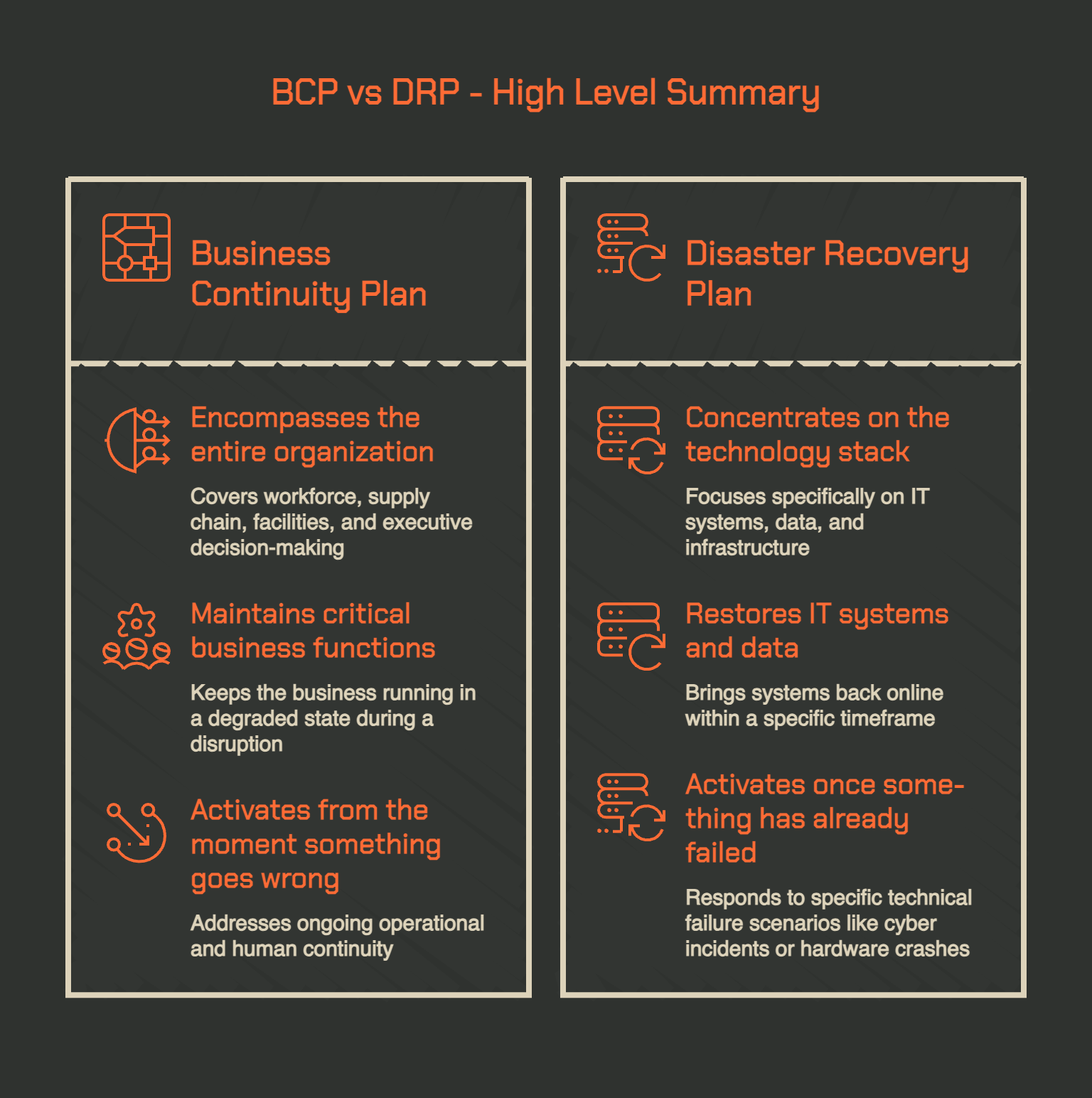
A business continuity plan is an operational document that defines how an organisation maintains its critical functions during and after a disruption. It is broad by design, covering not just technology but also workforce continuity, supply chain dependencies, client communications, facilities management, and executive decision-making authority.
The goal of the BCP is to keep the business running, even in a degraded state, from the moment something goes wrong.
A well-built BCP addresses questions that have nothing to do with servers. Who has authority to make decisions if the executive team is unreachable? Where do staff work if the office is evacuated? Which vendors need to be contacted first, and who holds those relationships? These are operational and human questions, and no IT recovery plan answers them on its own.
What Is a Disaster Recovery Plan (DRP)?
A disaster recovery plan is a technical document that defines how an organisation restores its IT systems, data, and infrastructure after a failure. Where the BCP covers the full organisation, the DRP covers the technology stack. It answers a specific question: how do you bring systems back online, in what priority order, and within what timeframe?
DRPs document recovery procedures for defined failure scenarios:
- Ransomware attacks and targeted cyber incidents
- Hardware failure, server crashes, or storage loss
- Data corruption or accidental deletion
- Extended power outages beyond UPS capacity
- Network connectivity loss or carrier failure
Each scenario maps to recovery steps, assigned parties, and measurable objectives. The DRP activates once something has already failed. It is the technical response, not the organisational one.
How Exactly Are BCP and DRP Different
The differences between a BCP and a DRP are most visible when you put them side by side across scope, timing, and ownership. Treating one as a substitute for the other is where organisations get into trouble, because the gap between them is exactly where incidents tend to escalate from a contained technical problem into an organisation-wide one.
1. Scope: The Whole Organisation Vs. IT Systems and Data
A BCP spans every department.
Finance needs to know how to process payroll if the primary system is inaccessible. Customer service needs alternate communication channels. Facilities management needs contingency workspace arranged well in advance. The BCP pulls all of these threads into a coordinated response that does not depend on IT being back online first.
A DRP operates within a narrower boundary. It is fundamentally an IT document, governing the recovery of specific systems, applications, and data sets. It does not address what your customer service team does while those systems are being restored. That scope is intentional. It is only safe if a BCP is running alongside it simultaneously.
2. Timing: During Vs. After a Disruption
A BCP is built to activate the moment a disruption begins, sometimes before IT even knows there is a problem. If a wildfire forces building evacuation, the BCP should be running before a single server is touched. It covers the full period from the moment of disruption through the restoration of normal operations.
A DRP activates in response to a confirmed technical event. It typically runs once the immediate crisis has been assessed and the scope of the technical damage is known. In most real incidents, the BCP and DRP run simultaneously but address entirely different audiences: the BCP guides the organisation, the DRP guides the IT team.
3. Ownership: Who Runs Each Plan?
A BCP is typically owned at the executive or operations level. It requires input from HR, legal, communications, and department heads, and sign-off from leadership, because it governs decisions that affect the entire organisation. A DRP is owned by the IT director or CIO, with contributions from infrastructure, security, and application teams.
This distinction matters during an actual incident. Both plans need to run independently without waiting on each other. If your IT team is executing a recovery effort, your operations team needs the authority and the procedure to run the BCP simultaneously, without having to pause and wait for a status update.
|
Comparison Area
|
BCP (Business Continuity Plan)
|
DRP (Disaster Recovery Plan)
|
|
Primary Focus
|
Keeps the overall business operating during disruption
|
Restores IT systems, applications, and data
|
|
Scope
|
Covers all departments and critical business functions
|
Focuses mainly on technology and IT infrastructure
|
|
Activation Timing
|
Starts as soon as a disruption occurs
|
Starts after a technical incident is confirmed
|
|
Duration
|
Covers disruption through return to normal operations
|
Covers the technical recovery period
|
|
Ownership
|
Typically led by executives or operations teams
|
Typically led by the CIO, IT director, or IT teams
|
|
Key Participants
|
HR, finance, legal, communications, facilities, and department heads
|
Infrastructure, security, application, and recovery teams
|
|
During an Incident
|
Guides how the organisation continues operating
|
Guides how technology services are recovered
|
RTO and RPO: The Metrics That Drive Both Plans
If you have read any documentation on disaster recovery, you have seen the terms RTO and RPO. Most organisations encounter them inside a DRP and treat them as IT-only metrics. They are not. They are the thread connecting your DRP to your BCP, and setting them without input from both sides produces targets the rest of the business cannot plan around.
Recovery Time Objective (RTO): How Long Can You Be Down?
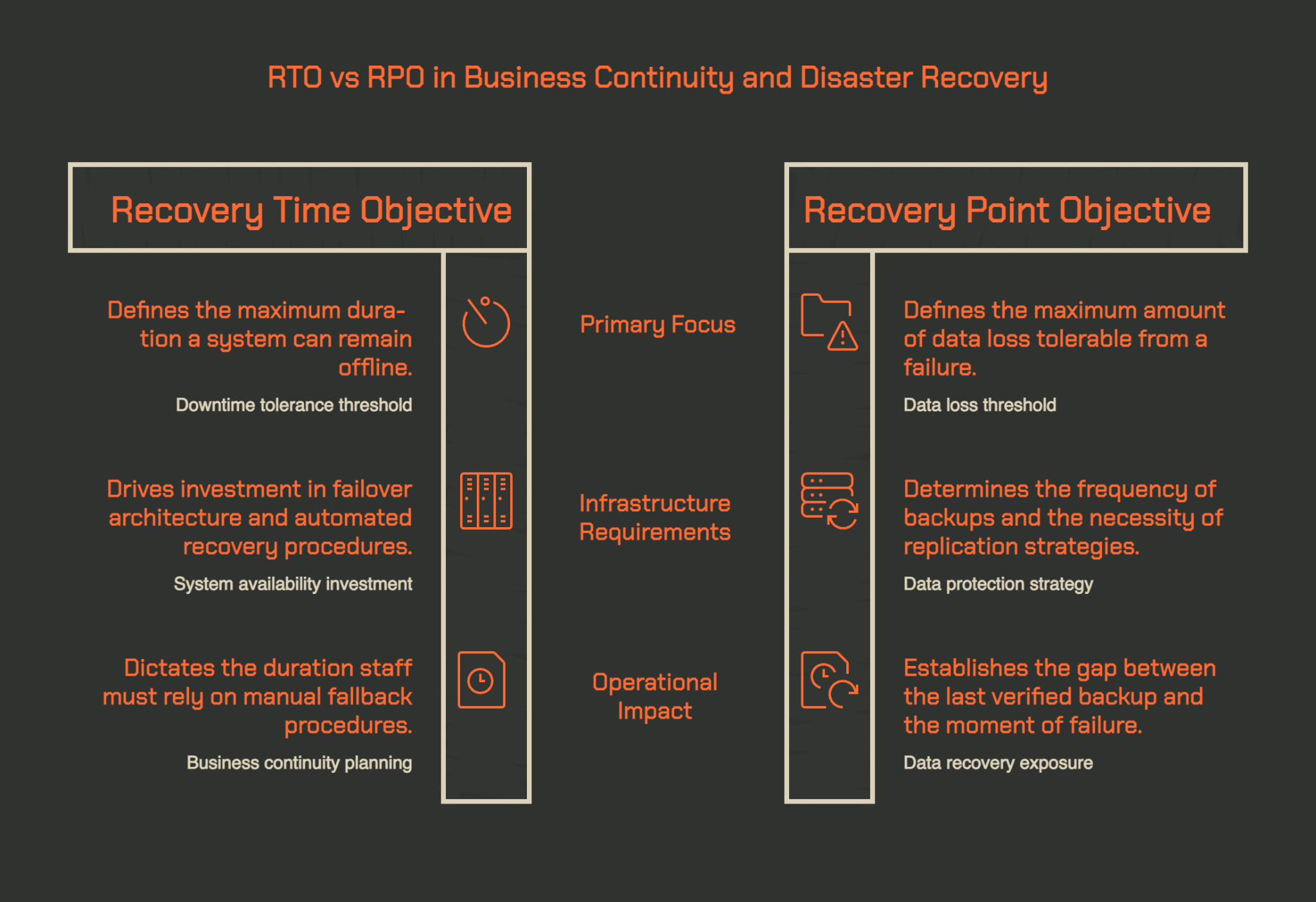
The Recovery Time Objective defines the maximum time a system or business process can be offline before the impact becomes unacceptable. It is expressed in hours or minutes, and it is always set by the business, not the IT team.
A hospital's patient records system might carry an RTO measured in minutes. A marketing team's project management platform might tolerate hours.
RTO drives the infrastructure investment behind your DRP.
A four-hour RTO requires failover architecture, documented restore procedures, and monitoring capable of detecting failure and triggering recovery automatically. A 24-hour RTO offers more flexibility at lower cost. The trade-off is straightforward: the more aggressive your RTO, the more your recovery infrastructure costs to build and maintain.
Recovery Point Objective (RPO): How Much Data Can You Afford to Lose?
The Recovery Point Objective defines the maximum data loss your organisation can tolerate, measured backward in time from the moment of failure. An RPO of one hour means your most recent verified backup must be no older than one hour. An RPO of 24 hours means you are prepared to accept or re-enter up to a full day's worth of transactions.
RPO determines your backup frequency and replication strategy. A one-hour RPO requires near-continuous data replication. A 24-hour RPO can be met with nightly backups. The distance between your stated RPO and your actual backup schedule is your real data loss exposure, and most organisations do not calculate that number until after an incident forces the calculation for them.
How RTO and RPO Connect Your Continuity and Disaster Recovery Plans
Your RTO is not just a technical ceiling for your IT team. It is a commitment your operations team has to plan around.
If your core ERP carries a four-hour RTO, your BCP needs to define what finance, procurement, and logistics staff do during those four hours, not only after them. That means documented manual fallback procedures, alternate communication channels, and decision-making authority that does not depend on the system being available.
RTO and RPO set by IT without a corresponding operational plan are numbers on paper. The BCP is what gives them meaning for everyone outside the server room.
Components of a Business Continuity Plan
A BCP is not a single document. It is a collection of components that together describe how your organisation survives disruption. Most plans that fail in practice were written once, stored on a shared drive, and never tested. The structure matters less than whether the people who need to execute it have seen and practised it before the day it counts.
Business Impact Analysis (BIA)
The Business Impact Analysis is the foundation of any effective BCP. It identifies which business functions are critical, quantifies the operational and financial impact of extended downtime for each, and ranks recovery priorities across the organisation. Without a BIA, a recovery effort restores whatever is easiest to recover, not whatever matters most to the business.
A thorough BIA captures the following for each critical function:
- Maximum acceptable outage window, which becomes the RTO input for the DRP
- Financial and operational impact at each downtime milestone: one hour, four hours, 24 hours
- System, personnel, and vendor dependencies
- Recovery priority order, ranked by business impact rather than technical complexity
The BIA output directly informs the RTO and RPO targets inside your DRP. This is why both plans need shared input, not a sequential handoff where one team completes their document before the other team even starts.
Continuity Strategies for Critical Functions
Once the BIA has ranked priorities, the BCP documents how each critical function continues operating under degraded conditions. For some functions, this is a manual fallback procedure. For others, it is a pre-arranged alternate facility, remote work infrastructure, or contingency agreements with third-party vendors negotiated before the incident.
For organisations with staff distributed across multiple locations, high-availability connectivity and geographically distributed infrastructure become part of the continuity strategy itself. A single-facility dependency is a single point of failure, and it should be visible in the BIA before it becomes visible during an incident.
Communication and Escalation Protocols
A BCP without a clear communication structure stalls when it is needed most. The communication section should define who has authority to declare a continuity event, the notification sequence for internal and external stakeholders, and the channels in use when normal communication infrastructure is unavailable.
This section must account for the scenario where primary communication tools have failed. If your VoIP system runs on the same network segment that just went down, your staff need to know the alternate contact method before the incident begins, not while they are trying to coordinate in the middle of one.
What Goes Into a Disaster Recovery Plan
A DRP is where preparedness becomes a concrete procedure. Every element should be documented to a level where a competent IT professional can execute it without the person who wrote it in the room. It should be tested on a defined schedule and reviewed after any significant change to the infrastructure or the business. A plan that has never been run against a real or simulated failure is not a tested plan.
System and Data Recovery Procedures
The core of any DRP is a documented recovery procedure for each critical system, ranked by the RTO established in the BIA. Each procedure should name the exact recovery steps, the responsible party, the estimated time to restore, and the success criteria that confirm recovery is complete. Vague instructions do not hold up under pressure.
Backup and disaster recovery services that integrate with platforms like Veeam provide centralised management, encryption, and compatibility across virtualised environments. The detail that matters in a DRP is that every recovery procedure is written against the tools the team will use during an actual incident, not a generic description of how recovery theory works.
Failover Architecture and Backup Sites
A DRP must account for scenarios where the primary site is completely unavailable. That requires a documented secondary environment: a secondary colocation facility, a cloud-based failover environment, or a hybrid of both. The failover architecture should be tested regularly, including the network path, access credentials, and confirmation that data at the secondary site falls within the RPO window at the time of the test.
Distributing infrastructure across geographically separate, carrier-neutral facilities is one of the most reliable approaches to building this redundancy. It provides physical separation between production and recovery environments without requiring your team to manage two entirely independent data centres. Carrier-neutral connectivity with diverse routing options eliminates single-provider network dependencies at the infrastructure level. Qu's locations across Canada are specifically designed to support multi-site disaster recovery architectures for this reason.
Testing and Validation Requirements
NIST SP 800-34 identifies three categories of DR testing: tabletop exercises, which validate the logic of the plan; functional drills, which test whether specific systems restore within the stated RTO; and full failover tests, which prove the entire environment can operate from a secondary site. Each type serves a different purpose and surfaces different gaps.
Most organisations run tabletop exercises and consider the plan tested. A full failover test is a different exercise entirely, and it consistently surfaces issues that no tabletop discussion would catch: mismatched credentials, outdated recovery scripts, data at the secondary site that falls outside the RPO window.
Testing cadence should be documented inside the DRP itself, with a named owner and a formal sign-off process for each cycle.
Why Most Organisations Need Both
The most common version of this problem is not that organisations have no plan. It is that they have a DRP built by IT, never shown to operations leadership, and mistakenly filed as a business continuity plan. The second most common version is the reverse: an executive-level BCP that acknowledges IT recovery in two paragraphs but contains no actual technical procedures. Both versions look fine in a compliance audit. Neither version holds up during an actual incident.
The "IT Will Handle It" Assumption
When a DRP is treated as the only plan, the implicit assumption is that once systems are restored, the business resumes normally. That assumption ignores everything happening between the moment of failure and the moment IT says the systems are back online.
Staff do not know where to report. Customer communications do not go out. Vendors do not know capacity is reduced. Decisions requiring executive authority cannot be made because the escalation path was never documented.
According to ITIC's 2024 Hourly Cost of Downtime Survey, a single hour of downtime costs more than $300,000 for over 90% of mid-size and large enterprises. That figure encompasses far more than lost system access. It includes the full operational cascade that follows when people across the organisation do not know what to do next.
What Happens When You Have a DRP but No BCP
An organisation with a DRP but no BCP can restore its systems within the stated RTO and still lose the incident. If a wildfire or flood forces building evacuation, the DRP may successfully protect data at a secondary site. But with no continuity plan, nobody knows whether staff are working remotely, whether clients have been notified, or whether the organisation can meet its contractual obligations during the recovery window.
What Happens When You Have a BCP but No DRP
An organisation with a BCP but no DRP has the inverse problem. Staff know where to report. Leadership has a defined chain of command. Clients are notified on schedule. But the systems do not come back, because no one documented how to restore them, in what order, from which backup, or within what timeframe. The operational layer is functioning. The technical layer is not.
This scenario is less common but not rare, particularly in organisations where the BCP was written to satisfy a compliance requirement and the IT recovery work was assumed to be handled separately. When an incident arrives, that assumption collapses. Both plans need to exist, be owned, and be connected before either one is needed.
Why Qu Data Centres Backs Both Your BCP and DRP
A disaster recovery plan that promises a four-hour RTO but has never been tested against real infrastructure is not a plan. It is a hypothesis. The plan documents the intent. The infrastructure delivers the result.
Qu Data Centres closes that gap by providing the physical and virtual environments that make both plans executable, with nine carrier-neutral facilities across Canada, managed services that reduce the operational burden on IT teams, and virtual private cloud and interconnection options that eliminate single points of failure at the network level.
All Qu facilities are Canadian-owned and operated, which means data sovereignty requirements are met from the ground up, not as an afterthought.
Book a facility tour and see the infrastructure your recovery plan needs to be built on, before you need it.
Frequently Asked Questions About Business Continuity and Disaster Recovery
What Is the Difference Between a BCP and a DRP in Simple Terms?
A BCP tells your organisation how to keep operating during a disruption. A DRP tells your IT team how to restore systems after a failure. The BCP covers people, communications, and operations. The DRP covers technology and data. Both are required for complete preparedness. They are designed to run at the same time during an incident, not one after the other.
Does a Disaster Recovery Plan Need to Be Separate from the BCP?
It depends on the organisation. Larger enterprises typically maintain them as separate documents because different teams own them. Smaller organisations often consolidate them into a single business continuity and disaster recovery (BCDR) framework to reduce complexity. Either approach works as long as each function has documented procedures, a clear owner, and a tested execution path.
What Is ISO 22301 and Why Does It Matter?
ISO 22301: 2019 is the international standard for Business Continuity Management Systems. It defines the requirements for planning, establishing, and maintaining a BCP. Organisations seeking formal certification must demonstrate that their plan includes risk assessment, business impact analysis, recovery strategies, and regular testing. It is particularly relevant to regulated industries and organisations serving government or enterprise clients where continuity documentation is part of procurement requirements.
How Often Should a Disaster Recovery Plan Be Tested?
At minimum, annually through tabletop exercises. Functional failover tests should run at a frequency that matches the criticality of the systems involved. Any significant change to infrastructure, personnel, or business operations should also trigger a plan review. A plan that has not been tested since its last major update should be treated as untested, regardless of how recently it was written.
What Is DRaaS and How Does It Fit a Disaster Recovery Plan?
Disaster Recovery as a Service (DRaaS) is a managed model where a third-party provider hosts and manages your recovery environment. Rather than maintaining a secondary data centre independently, workloads are replicated to the provider's infrastructure and failover is triggered when needed. Platforms like Zerto support Recovery Point Objectives measured in seconds, making them well-suited for critical workloads where even minutes of data loss carry material business or regulatory consequences.
What Should a Business Impact Analysis Include?
A BIA should cover every critical business function, the maximum acceptable downtime for each, the financial and operational impact of extended outage at each milestone, dependencies on systems and vendors, and the recovery priority order ranked by business impact. The BIA output informs both the BCP and the DRP, which is why it should be completed before either document is drafted, not as a step inside one of them.
Sources Used for This Article
- NIST: "Guide to Test, Training, and Exercise Programs for IT Plans and Capabilities" - nvlpubs.nist.gov/nistpubs/legacy/sp/nistspecialpublication800-84.pdf
- ITIC: "ITIC 2024 Hourly Cost of Downtime Report Part 1" - itic-corp.com/itic-2024-hourly-cost-of-downtime-report/






Quick Answer: A business continuity plan (BCP) and a disaster recovery plan (DRP) are not interchangeable. A BCP defines how your entire organisation keeps functioning during a disruption, covering people, operations, communications, and vendors. A DRP defines how your IT team restores systems and data after a technical failure. Both plans are necessary. Neither replaces the other, and the gap between them is where most incidents escalate from manageable to costly.
Key Takeaways
Most IT leaders have either written a disaster recovery plan or been asked to. Fewer have written a true business continuity plan. And a surprising number have done both, but stored them in separate folders, owned by separate teams, with no clear thread connecting them.
That gap does not appear on any compliance checklist. It appears when something goes wrong.
When a server fails at 2 AM, a DRP tells your IT team what to restore and in what order. When a flood or fire shuts your office building for three days, a BCP tells everyone else in the organisation what to do, who to call, and how critical work continues while the technical recovery runs in the background.
These are two different answers to two different questions, and organisations that treat them as the same document end up with blind spots that become expensive fast.
This article draws a clear line between both plans. It covers what each one contains, how they interact, and where organisations consistently fall short when they treat them as the same thing.
Key Acronyms and Terms
This page is a bit heavy when it comes to acronyms. Here’s a summary of things we’ll go over here:
Two Plans, One Goal: What Each One Covers
It is easy to see why these two plans get conflated. Both are written in anticipation of disruption, both involve IT to some degree, and both show up on the same regulatory checklists. But they operate at different levels of the organisation and activate under different conditions.
What Is a Business Continuity Plan (BCP)?
A business continuity plan is an operational document that defines how an organisation maintains its critical functions during and after a disruption. It is broad by design, covering not just technology but also workforce continuity, supply chain dependencies, client communications, facilities management, and executive decision-making authority.
The goal of the BCP is to keep the business running, even in a degraded state, from the moment something goes wrong.
A well-built BCP addresses questions that have nothing to do with servers. Who has authority to make decisions if the executive team is unreachable? Where do staff work if the office is evacuated? Which vendors need to be contacted first, and who holds those relationships? These are operational and human questions, and no IT recovery plan answers them on its own.
What Is a Disaster Recovery Plan (DRP)?
A disaster recovery plan is a technical document that defines how an organisation restores its IT systems, data, and infrastructure after a failure. Where the BCP covers the full organisation, the DRP covers the technology stack. It answers a specific question: how do you bring systems back online, in what priority order, and within what timeframe?
DRPs document recovery procedures for defined failure scenarios:
Each scenario maps to recovery steps, assigned parties, and measurable objectives. The DRP activates once something has already failed. It is the technical response, not the organisational one.
How Exactly Are BCP and DRP Different
The differences between a BCP and a DRP are most visible when you put them side by side across scope, timing, and ownership. Treating one as a substitute for the other is where organisations get into trouble, because the gap between them is exactly where incidents tend to escalate from a contained technical problem into an organisation-wide one.
1. Scope: The Whole Organisation Vs. IT Systems and Data
A BCP spans every department.
Finance needs to know how to process payroll if the primary system is inaccessible. Customer service needs alternate communication channels. Facilities management needs contingency workspace arranged well in advance. The BCP pulls all of these threads into a coordinated response that does not depend on IT being back online first.
A DRP operates within a narrower boundary. It is fundamentally an IT document, governing the recovery of specific systems, applications, and data sets. It does not address what your customer service team does while those systems are being restored. That scope is intentional. It is only safe if a BCP is running alongside it simultaneously.
2. Timing: During Vs. After a Disruption
A BCP is built to activate the moment a disruption begins, sometimes before IT even knows there is a problem. If a wildfire forces building evacuation, the BCP should be running before a single server is touched. It covers the full period from the moment of disruption through the restoration of normal operations.
A DRP activates in response to a confirmed technical event. It typically runs once the immediate crisis has been assessed and the scope of the technical damage is known. In most real incidents, the BCP and DRP run simultaneously but address entirely different audiences: the BCP guides the organisation, the DRP guides the IT team.
3. Ownership: Who Runs Each Plan?
A BCP is typically owned at the executive or operations level. It requires input from HR, legal, communications, and department heads, and sign-off from leadership, because it governs decisions that affect the entire organisation. A DRP is owned by the IT director or CIO, with contributions from infrastructure, security, and application teams.
This distinction matters during an actual incident. Both plans need to run independently without waiting on each other. If your IT team is executing a recovery effort, your operations team needs the authority and the procedure to run the BCP simultaneously, without having to pause and wait for a status update.
Comparison Area
BCP (Business Continuity Plan)
DRP (Disaster Recovery Plan)
Primary Focus
Keeps the overall business operating during disruption
Restores IT systems, applications, and data
Scope
Covers all departments and critical business functions
Focuses mainly on technology and IT infrastructure
Activation Timing
Starts as soon as a disruption occurs
Starts after a technical incident is confirmed
Duration
Covers disruption through return to normal operations
Covers the technical recovery period
Ownership
Typically led by executives or operations teams
Typically led by the CIO, IT director, or IT teams
Key Participants
HR, finance, legal, communications, facilities, and department heads
Infrastructure, security, application, and recovery teams
During an Incident
Guides how the organisation continues operating
Guides how technology services are recovered
RTO and RPO: The Metrics That Drive Both Plans
If you have read any documentation on disaster recovery, you have seen the terms RTO and RPO. Most organisations encounter them inside a DRP and treat them as IT-only metrics. They are not. They are the thread connecting your DRP to your BCP, and setting them without input from both sides produces targets the rest of the business cannot plan around.
Recovery Time Objective (RTO): How Long Can You Be Down?
The Recovery Time Objective defines the maximum time a system or business process can be offline before the impact becomes unacceptable. It is expressed in hours or minutes, and it is always set by the business, not the IT team.
A hospital's patient records system might carry an RTO measured in minutes. A marketing team's project management platform might tolerate hours.
RTO drives the infrastructure investment behind your DRP.
A four-hour RTO requires failover architecture, documented restore procedures, and monitoring capable of detecting failure and triggering recovery automatically. A 24-hour RTO offers more flexibility at lower cost. The trade-off is straightforward: the more aggressive your RTO, the more your recovery infrastructure costs to build and maintain.
Recovery Point Objective (RPO): How Much Data Can You Afford to Lose?
The Recovery Point Objective defines the maximum data loss your organisation can tolerate, measured backward in time from the moment of failure. An RPO of one hour means your most recent verified backup must be no older than one hour. An RPO of 24 hours means you are prepared to accept or re-enter up to a full day's worth of transactions.
RPO determines your backup frequency and replication strategy. A one-hour RPO requires near-continuous data replication. A 24-hour RPO can be met with nightly backups. The distance between your stated RPO and your actual backup schedule is your real data loss exposure, and most organisations do not calculate that number until after an incident forces the calculation for them.
How RTO and RPO Connect Your Continuity and Disaster Recovery Plans
Your RTO is not just a technical ceiling for your IT team. It is a commitment your operations team has to plan around.
If your core ERP carries a four-hour RTO, your BCP needs to define what finance, procurement, and logistics staff do during those four hours, not only after them. That means documented manual fallback procedures, alternate communication channels, and decision-making authority that does not depend on the system being available.
RTO and RPO set by IT without a corresponding operational plan are numbers on paper. The BCP is what gives them meaning for everyone outside the server room.
Components of a Business Continuity Plan
A BCP is not a single document. It is a collection of components that together describe how your organisation survives disruption. Most plans that fail in practice were written once, stored on a shared drive, and never tested. The structure matters less than whether the people who need to execute it have seen and practised it before the day it counts.
Business Impact Analysis (BIA)
The Business Impact Analysis is the foundation of any effective BCP. It identifies which business functions are critical, quantifies the operational and financial impact of extended downtime for each, and ranks recovery priorities across the organisation. Without a BIA, a recovery effort restores whatever is easiest to recover, not whatever matters most to the business.
A thorough BIA captures the following for each critical function:
The BIA output directly informs the RTO and RPO targets inside your DRP. This is why both plans need shared input, not a sequential handoff where one team completes their document before the other team even starts.
Continuity Strategies for Critical Functions
Once the BIA has ranked priorities, the BCP documents how each critical function continues operating under degraded conditions. For some functions, this is a manual fallback procedure. For others, it is a pre-arranged alternate facility, remote work infrastructure, or contingency agreements with third-party vendors negotiated before the incident.
For organisations with staff distributed across multiple locations, high-availability connectivity and geographically distributed infrastructure become part of the continuity strategy itself. A single-facility dependency is a single point of failure, and it should be visible in the BIA before it becomes visible during an incident.
Communication and Escalation Protocols
A BCP without a clear communication structure stalls when it is needed most. The communication section should define who has authority to declare a continuity event, the notification sequence for internal and external stakeholders, and the channels in use when normal communication infrastructure is unavailable.
This section must account for the scenario where primary communication tools have failed. If your VoIP system runs on the same network segment that just went down, your staff need to know the alternate contact method before the incident begins, not while they are trying to coordinate in the middle of one.
What Goes Into a Disaster Recovery Plan
A DRP is where preparedness becomes a concrete procedure. Every element should be documented to a level where a competent IT professional can execute it without the person who wrote it in the room. It should be tested on a defined schedule and reviewed after any significant change to the infrastructure or the business. A plan that has never been run against a real or simulated failure is not a tested plan.
System and Data Recovery Procedures
The core of any DRP is a documented recovery procedure for each critical system, ranked by the RTO established in the BIA. Each procedure should name the exact recovery steps, the responsible party, the estimated time to restore, and the success criteria that confirm recovery is complete. Vague instructions do not hold up under pressure.
Backup and disaster recovery services that integrate with platforms like Veeam provide centralised management, encryption, and compatibility across virtualised environments. The detail that matters in a DRP is that every recovery procedure is written against the tools the team will use during an actual incident, not a generic description of how recovery theory works.
Failover Architecture and Backup Sites
A DRP must account for scenarios where the primary site is completely unavailable. That requires a documented secondary environment: a secondary colocation facility, a cloud-based failover environment, or a hybrid of both. The failover architecture should be tested regularly, including the network path, access credentials, and confirmation that data at the secondary site falls within the RPO window at the time of the test.
Distributing infrastructure across geographically separate, carrier-neutral facilities is one of the most reliable approaches to building this redundancy. It provides physical separation between production and recovery environments without requiring your team to manage two entirely independent data centres. Carrier-neutral connectivity with diverse routing options eliminates single-provider network dependencies at the infrastructure level. Qu's locations across Canada are specifically designed to support multi-site disaster recovery architectures for this reason.
Testing and Validation Requirements
NIST SP 800-34 identifies three categories of DR testing: tabletop exercises, which validate the logic of the plan; functional drills, which test whether specific systems restore within the stated RTO; and full failover tests, which prove the entire environment can operate from a secondary site. Each type serves a different purpose and surfaces different gaps.
Most organisations run tabletop exercises and consider the plan tested. A full failover test is a different exercise entirely, and it consistently surfaces issues that no tabletop discussion would catch: mismatched credentials, outdated recovery scripts, data at the secondary site that falls outside the RPO window.
Testing cadence should be documented inside the DRP itself, with a named owner and a formal sign-off process for each cycle.
Why Most Organisations Need Both
The most common version of this problem is not that organisations have no plan. It is that they have a DRP built by IT, never shown to operations leadership, and mistakenly filed as a business continuity plan. The second most common version is the reverse: an executive-level BCP that acknowledges IT recovery in two paragraphs but contains no actual technical procedures. Both versions look fine in a compliance audit. Neither version holds up during an actual incident.
The "IT Will Handle It" Assumption
When a DRP is treated as the only plan, the implicit assumption is that once systems are restored, the business resumes normally. That assumption ignores everything happening between the moment of failure and the moment IT says the systems are back online.
Staff do not know where to report. Customer communications do not go out. Vendors do not know capacity is reduced. Decisions requiring executive authority cannot be made because the escalation path was never documented.
According to ITIC's 2024 Hourly Cost of Downtime Survey, a single hour of downtime costs more than $300,000 for over 90% of mid-size and large enterprises. That figure encompasses far more than lost system access. It includes the full operational cascade that follows when people across the organisation do not know what to do next.
What Happens When You Have a DRP but No BCP
An organisation with a DRP but no BCP can restore its systems within the stated RTO and still lose the incident. If a wildfire or flood forces building evacuation, the DRP may successfully protect data at a secondary site. But with no continuity plan, nobody knows whether staff are working remotely, whether clients have been notified, or whether the organisation can meet its contractual obligations during the recovery window.
What Happens When You Have a BCP but No DRP
An organisation with a BCP but no DRP has the inverse problem. Staff know where to report. Leadership has a defined chain of command. Clients are notified on schedule. But the systems do not come back, because no one documented how to restore them, in what order, from which backup, or within what timeframe. The operational layer is functioning. The technical layer is not.
This scenario is less common but not rare, particularly in organisations where the BCP was written to satisfy a compliance requirement and the IT recovery work was assumed to be handled separately. When an incident arrives, that assumption collapses. Both plans need to exist, be owned, and be connected before either one is needed.
Why Qu Data Centres Backs Both Your BCP and DRP
A disaster recovery plan that promises a four-hour RTO but has never been tested against real infrastructure is not a plan. It is a hypothesis. The plan documents the intent. The infrastructure delivers the result.
Qu Data Centres closes that gap by providing the physical and virtual environments that make both plans executable, with nine carrier-neutral facilities across Canada, managed services that reduce the operational burden on IT teams, and virtual private cloud and interconnection options that eliminate single points of failure at the network level.
All Qu facilities are Canadian-owned and operated, which means data sovereignty requirements are met from the ground up, not as an afterthought.
Book a facility tour and see the infrastructure your recovery plan needs to be built on, before you need it.
Frequently Asked Questions About Business Continuity and Disaster Recovery
What Is the Difference Between a BCP and a DRP in Simple Terms?
A BCP tells your organisation how to keep operating during a disruption. A DRP tells your IT team how to restore systems after a failure. The BCP covers people, communications, and operations. The DRP covers technology and data. Both are required for complete preparedness. They are designed to run at the same time during an incident, not one after the other.
Does a Disaster Recovery Plan Need to Be Separate from the BCP?
It depends on the organisation. Larger enterprises typically maintain them as separate documents because different teams own them. Smaller organisations often consolidate them into a single business continuity and disaster recovery (BCDR) framework to reduce complexity. Either approach works as long as each function has documented procedures, a clear owner, and a tested execution path.
What Is ISO 22301 and Why Does It Matter?
ISO 22301: 2019 is the international standard for Business Continuity Management Systems. It defines the requirements for planning, establishing, and maintaining a BCP. Organisations seeking formal certification must demonstrate that their plan includes risk assessment, business impact analysis, recovery strategies, and regular testing. It is particularly relevant to regulated industries and organisations serving government or enterprise clients where continuity documentation is part of procurement requirements.
How Often Should a Disaster Recovery Plan Be Tested?
At minimum, annually through tabletop exercises. Functional failover tests should run at a frequency that matches the criticality of the systems involved. Any significant change to infrastructure, personnel, or business operations should also trigger a plan review. A plan that has not been tested since its last major update should be treated as untested, regardless of how recently it was written.
What Is DRaaS and How Does It Fit a Disaster Recovery Plan?
Disaster Recovery as a Service (DRaaS) is a managed model where a third-party provider hosts and manages your recovery environment. Rather than maintaining a secondary data centre independently, workloads are replicated to the provider's infrastructure and failover is triggered when needed. Platforms like Zerto support Recovery Point Objectives measured in seconds, making them well-suited for critical workloads where even minutes of data loss carry material business or regulatory consequences.
What Should a Business Impact Analysis Include?
A BIA should cover every critical business function, the maximum acceptable downtime for each, the financial and operational impact of extended outage at each milestone, dependencies on systems and vendors, and the recovery priority order ranked by business impact. The BIA output informs both the BCP and the DRP, which is why it should be completed before either document is drafted, not as a step inside one of them.
Sources Used for This Article
Paul M
Paul Miedzik is Senior Manager of Marketing at Qu Data Centres, with extensive experience in enterprise cloud and digital infrastructure across the Canadian tech sector.