Qu Data Centres was a sponsor of Data Centre Nation Toronto on June 9, 2026, and took part in three sessions across the day. Together, they told one story: Canada’s digital future depends on who controls the infrastructure, how reliably it runs when lives depend on it, and who’s going to build and operate it. Here’s what we heard, and where we stand.
1. Sovereignty isn't a slogan. It's a control plane.
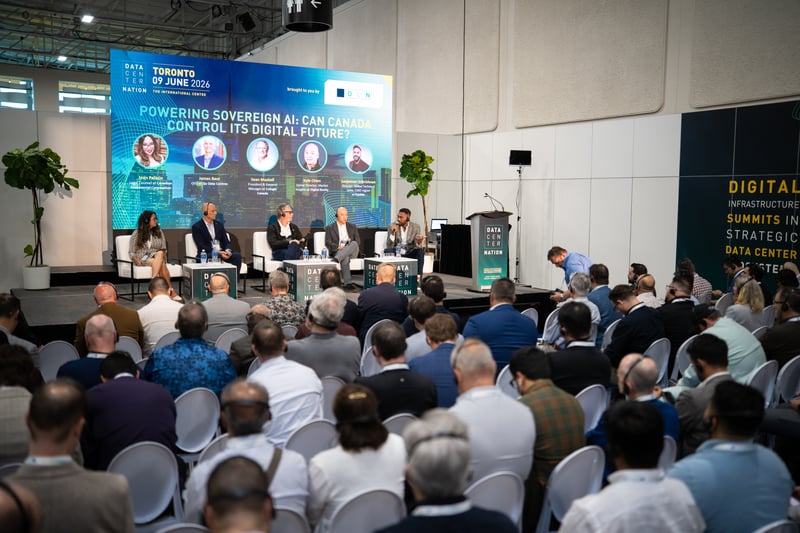
Session: “Powering Sovereign AI: Can Canada control its digital future?” featuring Qu CEO James Beer alongside leaders from global interconnection and colocation platforms.
The most refreshing thing about this panel was its honesty. Nobody on stage pretended Canada can be fully sovereign from chips to applications. The chips aren’t Canadian, most of the models aren’t Canadian, and the global hyperscalers spend at a scale no domestic player can match. Full-stack sovereignty isn’t achievable, and chasing it isn’t even desirable.
So what is achievable? The panel converged on a more useful definition: sovereignty is about the control plane. It means knowing where your data lives, who can access it, and under whose laws. One panelist noted that the majority of Canadian workloads sit in public cloud today, often without CIOs knowing exactly where that data resides or who can compel access to it.
That’s where James drew Qu’s line. As the only 100% Canadian-owned and invested operator on the stage, he made the case that ownership still matters in practice, not just in principle: Canadian leadership, Canadian sites, Canadian networks, Canadian customers. Much of Canada’s real exposure comes through lawful-access requests and foreign legislation like the U.S. CLOUD Act reaching into network traffic. Working with Canadian network providers materially reduces that exposure, and it’s top of mind for nearly every customer we speak with.
James also didn’t sugar-coat the bottleneck: power and permitting. Qu is working with five utilities across the country to secure capacity, and the first-in, first-out interconnection queue is being clogged by speculative ghost projects that will never get built, crowding out legitimate Canadian operators serving enterprises that, in some cases, are literally saving lives. His message to government at every level: the money is available, the talent is available, and it is truly time for Canada to build. The bureaucracy has to come out of the way.
Our takeaway: Sovereignty done right isn’t isolation. It’s choice. Classify your data, know your crown jewels, keep what must stay Canadian on Canadian infrastructure under Canadian control, and stay connected to the global economy for everything else.
2. Uptime isn't measured in nines. Sometimes it's measured in organs.
Session: “No room for downtime: Inside the infrastructure that keeps Canada alive.” In this Qu-sponsored fireside chat, CEO James Beer sat down with Anu Young, Director of Infrastructure at Canadian Blood Services.
This was the session that quieted the room. Most infrastructure conversations are abstract. This one wasn’t.
Anu runs the systems behind Canada’s blood, plasma, organ-matching, stem cell, and neonatal testing operations. When you operate at that level, “uptime” stops being a technical metric and becomes something much more human. A maintenance window in the wrong moment can mean a hospital without supply, or a viable organ without a recipient. As Anu framed it, her team doesn’t measure success in availability percentages. They measure it in patient outcomes.
That mindset is driving the work CBS is doing now: a deliberate, ground-up modernization of its core infrastructure, with sovereignty, security, and tested resilience treated as non-negotiables rather than features to add later.
Two lessons from Anu deserve to be carved into every ops team’s wall:
- Not everything in IT carries the same weight. A broken laptop is a nuisance; broken core infrastructure stops the mission. Know where to lean in.
- Redundancy that you haven’t tested is not redundancy. Make space for testing failover and disaster recovery with the same seriousness as keeping the lights on.
And why does a national blood operator care about sovereignty? Because CBS collects in Canada, for Canadians, and holds deeply sensitive personal health data. As Anu put it, they need partners based in Canada, run in Canada, with Canadian employees. We’re proud that Qu is that partner.
Anu closed with a challenge to the room that we’ll pass along: one in two Canadians is eligible to donate blood. Only one in 76 does. It takes 30 minutes. [Link to blood.ca]
Our takeaway: This is why data centres exist. Behind every “boring” facility is a 911 call, a financial transaction, a transfusion. Resilience isn’t a feature tier. For some customers, it’s the whole point.
3. The talent pipeline is the quiet constraint of it all.
Session: “Developing talent for Canada’s evolving data center industry” featuring Qu CFO Melanie Pump alongside leaders from a major engineering firm and a national general contractor.
You can have the capital, the land, and even the power, and still be stopped by people. The panel laid out the problem plainly:
Nobody graduates into this industry. No Canadian university offers a data centre design program. Engineers leave school believing engineering is engineering, then discover that concurrent maintainability and redundancy make data centre design unlike hospitals, condos, or anything else they’ve trained for. Firms are retraining engineers from other sectors, and internal training takes roughly two years per engineer.
The talent isn’t where the power is. As Melanie noted, new builds are increasingly going where power is available: regions that have never had data centres, and therefore have no local workforce to draw on. The geography problem compounds the skills problem.
It’s not just engineers. Melanie added a layer the industry rarely talks about: go-to-market talent. There’s very little experience in Canada selling complex, high-density data centre services. Qu’s answer is to hire for adaptability over resume keywords, looking for people with a track record of thriving in fast-changing environments, then pairing every newcomer with an experienced mentor and making it safe to ask questions. No growing company can fill every seat with industry veterans.
The industry is shuffling the same deck. Poaching experienced people back and forth doesn’t grow the pool. The fix is deliberately bringing in talent from adjacent industries and building real career pathways so people can see their next two moves inside the company.
One genuinely encouraging note from Melanie: fifteen years ago, telling someone you worked in data centres earned a blank stare. Today it reads as a hot industry, and on the operator side, that’s become a recruiting advantage.
Our takeaway: Bridging the skills gap is a shared responsibility across educators, operators, builders, and government. The companies that invest in pathways, mentorship, and patience will be the ones still building in five years.
One day, one thread.
Pull these three conversations together and the thread is hard to miss. Canada is deciding, right now, how much control it wants over its digital future. That control gets exercised through ownership and the control plane (sovereignty), it gets proven every day in operations where downtime is measured in patient outcomes (resilience), and it gets sustained only if we build the workforce to run it (talent).
That’s the conversation Qu came to Data Centre Nation to have, and it’s the one we have with customers every day.
Want to see it for yourself?
Tour the facilities that Canadian Blood Services relies on every day, or speak with a Qu specialist about what sovereign, resilient infrastructure looks like for your organization.





1. Sovereignty isn't a slogan. It's a control plane.
Session: “Powering Sovereign AI: Can Canada control its digital future?” featuring Qu CEO James Beer alongside leaders from global interconnection and colocation platforms.
The most refreshing thing about this panel was its honesty. Nobody on stage pretended Canada can be fully sovereign from chips to applications. The chips aren’t Canadian, most of the models aren’t Canadian, and the global hyperscalers spend at a scale no domestic player can match. Full-stack sovereignty isn’t achievable, and chasing it isn’t even desirable.
So what is achievable? The panel converged on a more useful definition: sovereignty is about the control plane. It means knowing where your data lives, who can access it, and under whose laws. One panelist noted that the majority of Canadian workloads sit in public cloud today, often without CIOs knowing exactly where that data resides or who can compel access to it.
That’s where James drew Qu’s line. As the only 100% Canadian-owned and invested operator on the stage, he made the case that ownership still matters in practice, not just in principle: Canadian leadership, Canadian sites, Canadian networks, Canadian customers. Much of Canada’s real exposure comes through lawful-access requests and foreign legislation like the U.S. CLOUD Act reaching into network traffic. Working with Canadian network providers materially reduces that exposure, and it’s top of mind for nearly every customer we speak with.
James also didn’t sugar-coat the bottleneck: power and permitting. Qu is working with five utilities across the country to secure capacity, and the first-in, first-out interconnection queue is being clogged by speculative ghost projects that will never get built, crowding out legitimate Canadian operators serving enterprises that, in some cases, are literally saving lives. His message to government at every level: the money is available, the talent is available, and it is truly time for Canada to build. The bureaucracy has to come out of the way.
Our takeaway: Sovereignty done right isn’t isolation. It’s choice. Classify your data, know your crown jewels, keep what must stay Canadian on Canadian infrastructure under Canadian control, and stay connected to the global economy for everything else.
2. Uptime isn't measured in nines. Sometimes it's measured in organs.
Session: “No room for downtime: Inside the infrastructure that keeps Canada alive.” In this Qu-sponsored fireside chat, CEO James Beer sat down with Anu Young, Director of Infrastructure at Canadian Blood Services.
This was the session that quieted the room. Most infrastructure conversations are abstract. This one wasn’t.
Anu runs the systems behind Canada’s blood, plasma, organ-matching, stem cell, and neonatal testing operations. When you operate at that level, “uptime” stops being a technical metric and becomes something much more human. A maintenance window in the wrong moment can mean a hospital without supply, or a viable organ without a recipient. As Anu framed it, her team doesn’t measure success in availability percentages. They measure it in patient outcomes.
That mindset is driving the work CBS is doing now: a deliberate, ground-up modernization of its core infrastructure, with sovereignty, security, and tested resilience treated as non-negotiables rather than features to add later.
Two lessons from Anu deserve to be carved into every ops team’s wall:
And why does a national blood operator care about sovereignty? Because CBS collects in Canada, for Canadians, and holds deeply sensitive personal health data. As Anu put it, they need partners based in Canada, run in Canada, with Canadian employees. We’re proud that Qu is that partner.
Anu closed with a challenge to the room that we’ll pass along: one in two Canadians is eligible to donate blood. Only one in 76 does. It takes 30 minutes. [Link to blood.ca]
Our takeaway: This is why data centres exist. Behind every “boring” facility is a 911 call, a financial transaction, a transfusion. Resilience isn’t a feature tier. For some customers, it’s the whole point.
3. The talent pipeline is the quiet constraint of it all.
Session: “Developing talent for Canada’s evolving data center industry” featuring Qu CFO Melanie Pump alongside leaders from a major engineering firm and a national general contractor.
You can have the capital, the land, and even the power, and still be stopped by people. The panel laid out the problem plainly:
Nobody graduates into this industry. No Canadian university offers a data centre design program. Engineers leave school believing engineering is engineering, then discover that concurrent maintainability and redundancy make data centre design unlike hospitals, condos, or anything else they’ve trained for. Firms are retraining engineers from other sectors, and internal training takes roughly two years per engineer.
The talent isn’t where the power is. As Melanie noted, new builds are increasingly going where power is available: regions that have never had data centres, and therefore have no local workforce to draw on. The geography problem compounds the skills problem.
It’s not just engineers. Melanie added a layer the industry rarely talks about: go-to-market talent. There’s very little experience in Canada selling complex, high-density data centre services. Qu’s answer is to hire for adaptability over resume keywords, looking for people with a track record of thriving in fast-changing environments, then pairing every newcomer with an experienced mentor and making it safe to ask questions. No growing company can fill every seat with industry veterans.
The industry is shuffling the same deck. Poaching experienced people back and forth doesn’t grow the pool. The fix is deliberately bringing in talent from adjacent industries and building real career pathways so people can see their next two moves inside the company.
One genuinely encouraging note from Melanie: fifteen years ago, telling someone you worked in data centres earned a blank stare. Today it reads as a hot industry, and on the operator side, that’s become a recruiting advantage.
Our takeaway: Bridging the skills gap is a shared responsibility across educators, operators, builders, and government. The companies that invest in pathways, mentorship, and patience will be the ones still building in five years.
One day, one thread.
Pull these three conversations together and the thread is hard to miss. Canada is deciding, right now, how much control it wants over its digital future. That control gets exercised through ownership and the control plane (sovereignty), it gets proven every day in operations where downtime is measured in patient outcomes (resilience), and it gets sustained only if we build the workforce to run it (talent).
That’s the conversation Qu came to Data Centre Nation to have, and it’s the one we have with customers every day.
Want to see it for yourself?
Tour the facilities that Canadian Blood Services relies on every day, or speak with a Qu specialist about what sovereign, resilient infrastructure looks like for your organization.
Paul M
Paul Miedzik is Senior Manager of Marketing at Qu Data Centres, with extensive experience in enterprise cloud and digital infrastructure across the Canadian tech sector.