Quick Answer: NVIDIA's H200, B200 and B300 ship as 8-GPU servers that draw between 10.2 kW and 14.5 kW each and run on air cooling. GB200, GB300 and Vera Rubin ship as 72-GPU racks that are liquid-cooled and are provisioned for well over 100 kW each. The exact system on your purchase order, not the GPU name alone, sets the power, cooling, floor loading and networking your colocation facility must provide.
The purchase order says B200, the vendor quote says GB200, and a blog post you found last week claims the B300 needs liquid cooling. Your facilities team asks a simple question: how many kilowatts per rack, and how is it cooled? Nobody on the thread can answer with confidence, because the same GPU family name covers products that differ by a factor of ten in power density.
That confusion is expensive. Hardware that arrives before the space is ready sits on a loading dock, and a rack that lands in a hall built for 10 kW can trip breakers or throttle itself once the load ramps. Most online guides compare chips on teraflops and memory, which says nothing about what the building has to deliver.
This article lines up the H200, B200, GB200, B300, GB300 and Vera Rubin by what each one asks of a data centre. It separates the 8-GPU servers from the 72-GPU racks, shows where air cooling stops working, and covers the weight, power cords and cabling that spec sheets bury. By the end, you can match any NVIDIA system to the kind of facility that can host it.
Key Takeaways
- The exact system configuration, rather than the graphics processing unit (GPU) name alone, determines facility power, cooling, floor loading and networking requirements.
- Eight-GPU DGX H200, B200 and B300 servers use air cooling, with maximum power draws of 10.2, 14.3 and 14.5 kW respectively.
- GB200 and GB300 NVL72 systems integrate 72 GPUs into liquid-cooled racks; one Supermicro GB200 configuration provisions 132 kW, with requirements varying by build.
- Vera Rubin NVL72 uses liquid cooling with a 45°C coolant supply; third-party estimates place rack power at 190–230 kW, pending vendor confirmation.
- Cabinet planning must account for total equipment load, redundant feeds and outlet counts; the DGX B300 requires twelve power cords versus the B200’s six.
- Floor capacity, delivery routes, network cabling and infrastructure lead times also determine deployment readiness; confirm available capacity before hardware ships.
- Speak to a specialist at Qu Data Centres and bring your exact system quote to map cabinet space, power feeds and cooling before hardware ships.
What Is NVIDIA GPU Infrastructure?
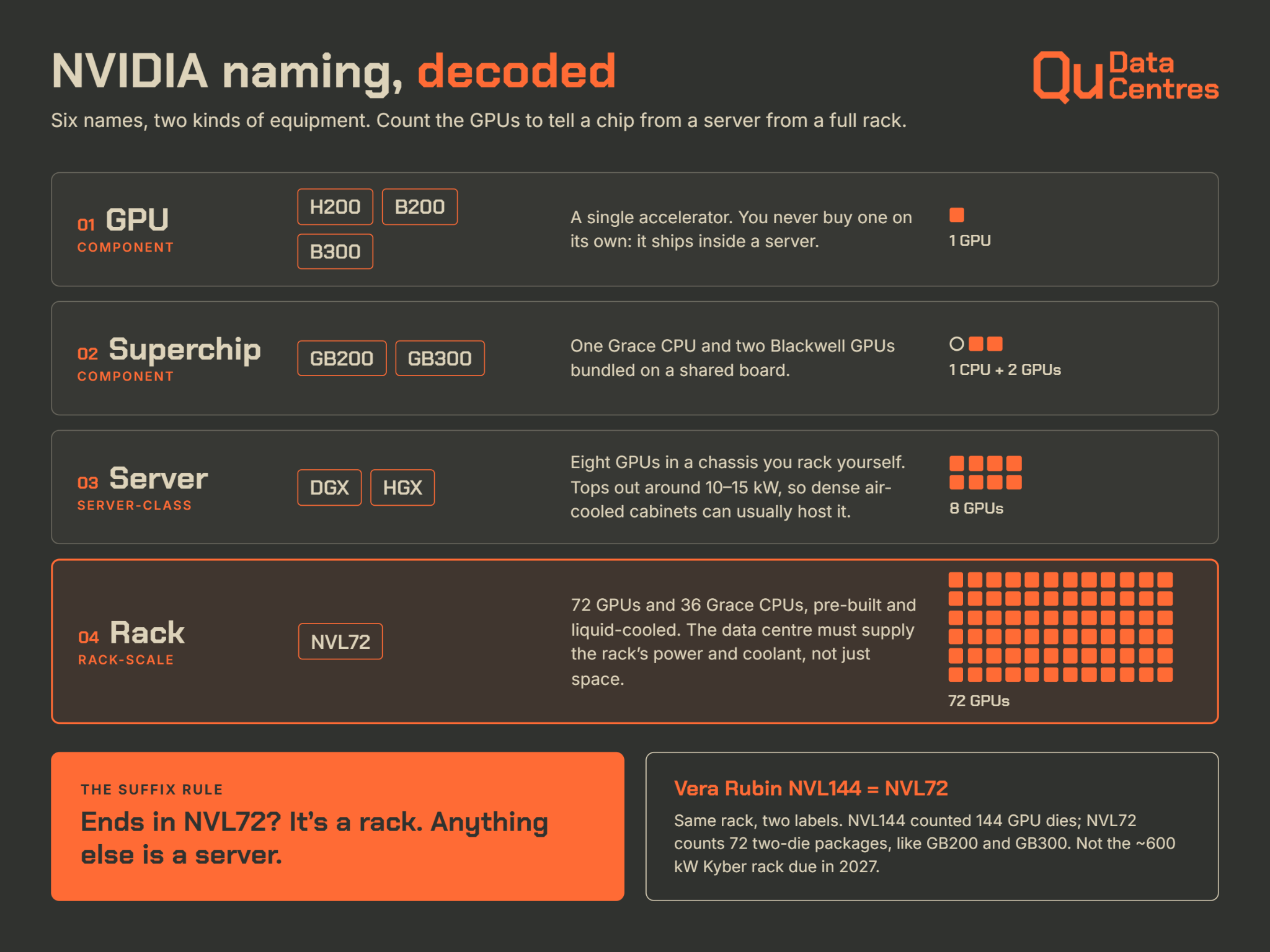
NVIDIA sells six names that sound like one product line, but they describe two very different kinds of equipment. Sorting out which name is a chip, which is a server and which is a rack is the fastest way to read a vendor quote without getting lost. This section sets the vocabulary that the rest of the article relies on.
How NVIDIA Names Its GPUs, Superchips, Servers and Racks
NVIDIA stacks its names in layers. A B200 or an H200 is a single GPU, while a GB200 is a superchip that pairs one Grace CPU with two Blackwell GPUs. NVIDIA describes the GB200 NVL72 as 36 Grace CPUs and 72 Blackwell GPUs connected in one liquid-cooled rack.
- GPU: H200, B200 and B300 are individual accelerators, sold inside servers.
- Superchip: GB200 and GB300 bundle Grace CPUs and GPUs on a shared board.
- Server: DGX systems and HGX-based partner servers pack eight GPUs into a chassis that slides into a standard rack.
- Rack: NVL72 systems arrive as a complete rack with 72 GPUs, pre-built by the vendor.
The suffix tells you the form. Anything ending in NVL72 is a rack, and everything else in this article is a server.
Server-Class vs Rack-Scale NVIDIA Systems (HGX, DGX and NVL72)
Server-class systems follow the familiar model. You buy a box, rack it beside others, and connect power and network, much as you would in any colocation deployment. Per-box draw has climbed, but a DGX H200 tops out at 10.2 kW and a DGX B300 at 14.5 kW, so a facility with dense air-cooled cabinets can usually host them.
Rack-scale systems break that model. NVIDIA calls the Blackwell NVL72 the first rack-scale architecture, one that makes the rack the primary unit of integration. Compute trays, NVLink switch trays, power shelves and liquid manifolds arrive together, so the data centre must supply the rack's power and coolant connections, not just space and an outlet.
Both families serve inference workloads well, so the choice rarely rests on the model you run. It rests on what the building can deliver.
Why Vera Rubin Went From NVL144 to NVL72
Early announcements called the rack Vera Rubin NVL144, a figure that counted GPU dies. Each Rubin GPU package holds two dies, so the same rack contains 72 packages, and the official NVL72 name counts packages in the same way GB200 and GB300 do.
You will still see both labels in vendor documents and older articles. Treat them as one system, and confirm that any power figure you are quoted belongs to the 72-package rack rather than the roughly 600 kW Kyber design that sits on NVIDIA's 2027 roadmap.
The naming conventions are fairly complex. This visual should explain things a little better.
How NVIDIA H200, B200, GB200, B300, GB300 and Vera Rubin Compare
With the vocabulary settled, the comparison becomes simple to read. Four pairings cover almost every question buyers ask, from the jump between Hopper and Blackwell servers to the gap between a server and a rack. Each pairing focuses on what changes for the facility, not on benchmark scores.
NVIDIA H200 Vs B200 Vs B300 in 8-GPU Servers
All three ship as eight-GPU servers on 200 to 240 V AC power, and all three are specified for air cooling. The DGX H200 draws up to 10.2 kW in an 8U chassis weighing up to 130.45 kg. The DGX B200 rises to 14.3 kW in a 10U chassis of up to 142.4 kg, and the DGX B300 reaches 14.5 kW in 10U at up to 168 kg.
The headline gap between B200 and B300 is only 0.2 kW, which hides two bigger changes.
The B300 uses twelve power supplies and twelve cords where the B200 uses six, and its eight network ports run at 800 Gb/s instead of 400 Gb/s. Your PDU outlet count and cable plan change more than your kilowatt budget does.
NVIDIA H200 Vs GB200 and B200 Vs GB200
The GB200 is where the facility conversation changes. NVIDIA describes the GB200 NVL72 as 36 Grace CPUs and 72 Blackwell GPUs in a rack-scale, liquid-cooled design. Supermicro's build of it carries 132 kW of power shelves in a 48U enclosure paired with a 250 kW coolant distribution unit, and third-party estimates of typical draw run from 120 to 130 kW.
The math here tells us a lot. A GB200 rack holds nine times the GPUs of a DGX B200, and its 132 kW of provisioned power is about nine times the 14.3 kW of one server, so power per GPU is roughly similar. What changes is concentration, because that power now sits in one footprint and leaves through water instead of air.
NVIDIA B300 Vs GB300 and GB200 Vs GB300
The B300 and GB300 use the same Blackwell Ultra GPU in two different packages. The DGX B300 is a 14.5 kW air-cooled server, while NVIDIA lists the GB300 NVL72 as a fully liquid-cooled rack with 72 Blackwell Ultra GPUs and 36 Grace CPUs.
Between GB200 and GB300, the rack format stays the same, with 72 GPUs, 36 CPUs and liquid cooling. Plan for GB300 at or above the GB200 power envelope, and ask the vendor for the configured rack figure instead of relying on a generic number. A facility that already hosts GB200 has done most of the work, provided its feeds and coolant loops have headroom.
NVIDIA GB300 Vs Vera Rubin
Vera Rubin keeps the 72-GPU rack and removes the options. NVIDIA's technical documentation describes the Vera Rubin NVL72 as fully liquid-cooled, using warm-water direct liquid cooling at a 45°C supply temperature.
Third-party estimates put rack power at roughly 190 to 230 kW, and the same source notes that Blackwell offered a lower-density NVL36x2 option while Vera Rubin ships as a single rack SKU. These are estimates rather than NVIDIA-published figures, so treat them as planning ranges until a vendor confirms a configuration.
|
System
|
Form factor
|
Maximum power
|
Cooling
|
|
DGX H200
|
8-GPU server, 8U
|
10.2 kW per server
|
Air
|
|
DGX B200
|
8-GPU server, 10U
|
14.3 kW per server
|
Air
|
|
DGX B300
|
8-GPU server, 10U
|
14.5 kW per server
|
Air
|
|
GB200 NVL72
|
72-GPU rack
|
132 kW provisioned (Supermicro build)
|
Liquid
|
|
GB300 NVL72
|
72-GPU rack
|
At or above GB200, confirm per build
|
Liquid
|
|
Vera Rubin NVL72
|
72-GPU rack
|
About 190 to 230 kW (third-party estimate)
|
Liquid, 45°C supply
|
NVIDIA GPU Power Requirements and Rack Density
Spec sheets quote watts per GPU, but a colocation contract is written in kilowatts per cabinet. The gap between those two numbers is where deployments stall. The next three subsections translate GPU specifications into the figures your facility team actually signs.
Server Power vs Rack Power for NVIDIA GPUs
Server power is the maximum draw of one chassis, and rack power is what a cabinet must sustain across everything inside it. System maximums are ceilings, and real draw depends on the workload, but colocation contracts are sized to the ceiling.
A DGX B300 at 14.5 kW uses the entire allocation of a 15 kW cabinet before you add a network switch or a management node, and every kilowatt drawn becomes a kilowatt of heat that must leave the room.
NVIDIA's documentation shows how seriously it treats redundancy at this level. The DGX B200 uses six 3.3 kW supplies in a 5+1 arrangement, while the DGX B300 uses twelve supplies configured as N+N, an arrangement that suits A+B power feeds.
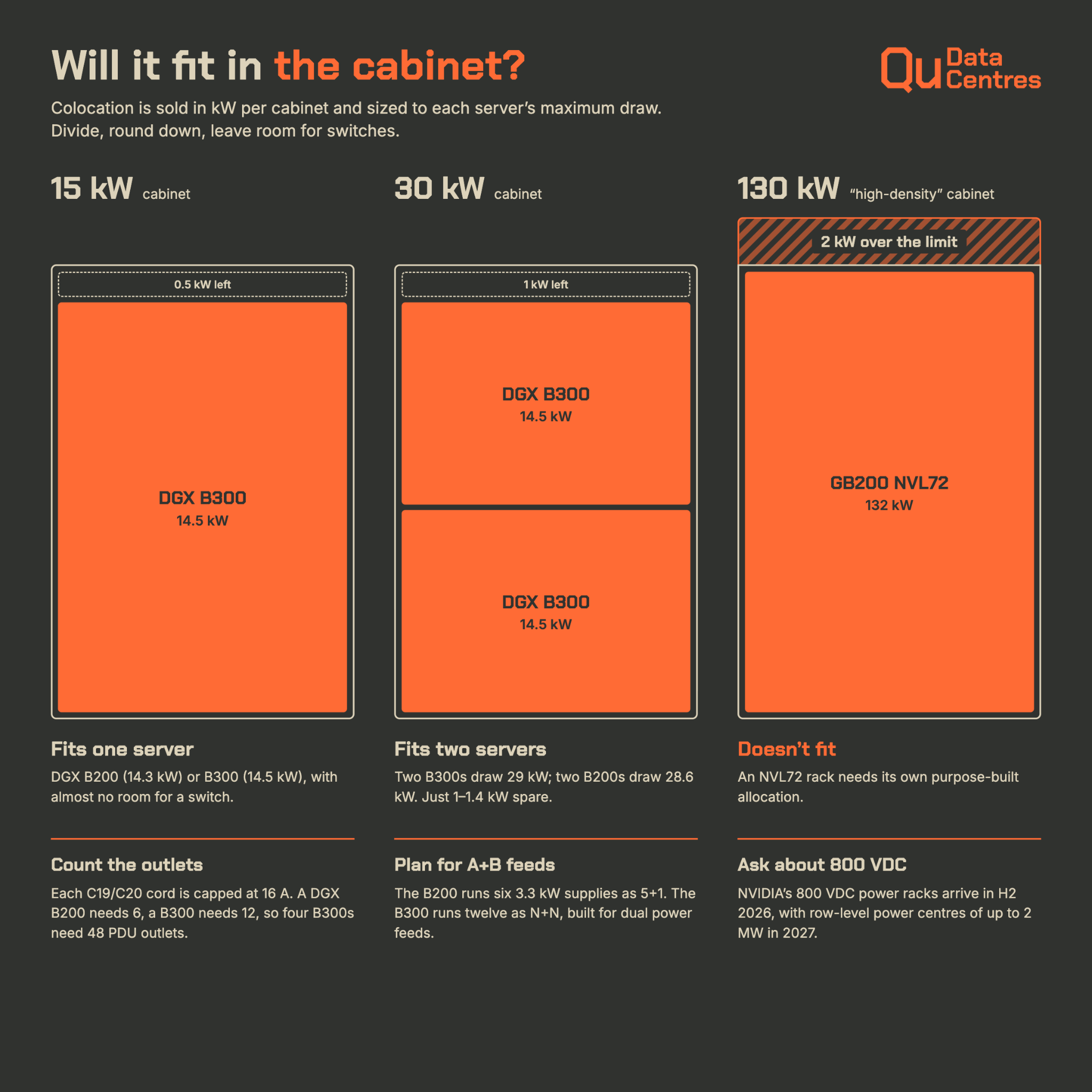
How Many GPU Servers Fit in One Rack at 15 kW, 30 kW and 130 kW
Rack math is simple once you know the server draw. Divide the cabinet's usable kilowatts by the system maximum, round down, and leave room for switches and cabling.
- 15 kW Cabinet: One DGX B200 (14.3 kW) or DGX B300 (14.5 kW) fits, with almost nothing left for a top-of-rack switch.
- 30 kW Cabinet: Two DGX B200 servers total 28.6 kW and two DGX B300 servers total 29 kW, which leaves between 1 and 1.4 kW of headroom.
- 130 kW Cabinet: This still falls short of a 132 kW GB200 NVL72 build, so the rack needs its own purpose-built allocation.
The last line surprises many buyers. A hall advertised as high density at 130 kW per cabinet cannot host a rack provisioned for 132 kW, and the shortfall appears only when someone reads the vendor's power shelf specification. Ask for the rack power figure in writing before you ask any facility for a quote.
Voltage, Phases, PDUs and the Move to 800 VDC
Every DGX server in this article takes 200 to 240 V AC, and each power cord is a locking C19/C20 connection limited to 16 A per outlet. That makes outlet count a real constraint, because a DGX B200 needs six, a DGX B300 needs twelve, and a cabinet with four B300 servers needs 48 PDU outlets before you count switches.
Rack feeds at these loads are normally three-phase, and PDUs should be chosen by outlet count and amperage together. The DGX B300 also ships in a busbar version that takes 54 VDC from in-rack power shelves, which signals where the industry is heading.
That direction continues with NVIDIA's 800 VDC architecture. NVIDIA says an MGX-compatible 800 VDC power rack arrives in the second half of 2026 and slots into existing AC facilities, while row-level power centres supporting up to 2 MW per row are expected in 2027. Ask any provider whether its electrical design can accept 800 VDC equipment, because denser racks will start asking.
NVIDIA GPU Cooling Requirements
Power gets the attention, yet cooling decides which of these systems a building can actually run. Air handles the servers, liquid handles the racks, and the middle ground is narrower than most vendor pages suggest. The basic mechanics of data centre cooling still apply, but the heat loads here stretch them.
Air Cooling for HGX and DGX Servers
NVIDIA specifies its DGX servers for ambient air. The DGX B200 operates in 10°C to 35°C air and moves 1,550 CFM through its chassis, and the DGX B300 lists the same 10°C to 35°C inlet range with 1,500 CFM at 70% fan speed.
Several online articles claim the B300 requires direct liquid cooling, yet NVIDIA's own DGX B300 guide specifies inlet air temperatures and fan airflow. Partner builds of the same GPU can differ, so confirm the exact chassis and cooling option on the quote before you assume either answer.
- Inlet Temperature: Hold cold-aisle air between 10°C and 35°C at the server face.
- Airflow: Budget roughly 1,500 CFM per server, moving front to back.
- Containment: Seal the hot aisle so exhaust cannot recirculate into neighbouring intakes.
Rear-Door Heat Exchangers for High-Density GPU Racks
A rear-door heat exchanger is a water-cooled coil mounted on the back of a standard rack. Hot exhaust from air-cooled servers passes through it and leaves the rack close to room temperature, which lets a cabinet carry heat loads that room air alone could not remove.
This is the practical bridge for dense DGX deployments, such as several B200 or B300 servers sharing one cabinet.
It works only because those servers still pull in air, so it is not a substitute for direct liquid cooling on GB200, GB300 or Vera Rubin.
Direct Liquid Cooling for GB200, GB300 and Vera Rubin
Direct liquid cooling sends coolant through cold plates mounted on the GPUs and CPUs, so heat leaves the rack as warm water instead of hot air. NVIDIA's GB200 NVL72 page describes liquid-cooled rack-scale designs for both GB200 and GB300, and the Vera Rubin NVL72 is fully liquid-cooled.
The coolant has to come from somewhere. Supermicro's GB200 NVL72 lists an in-rack 250 kW coolant distribution unit, a 1.3 MW in-row unit, and 180 kW or 240 kW liquid-to-air options for facilities with no cooling tower or water supply.
Those liquid-to-air units matter in colocation, because they let a rack run in a hall without facility water, at the cost of pushing the heat back into the room's air handling.
Coolant Distribution Units and Inlet Water Temperatures
A coolant distribution unit, or CDU, is the heat exchanger that separates the rack's closed coolant loop from the building's water. It delivers coolant at a stable temperature and flow, and its capacity must match the rack it serves.
Inlet temperature changes how much cooling plant the building needs. Vera Rubin NVL72 uses a 45°C supply temperature, which lets a data centre cool the water with ambient air instead of relying on designs that need 35°C liquid and more mechanical cooling.
A cold climate helps here, since outdoor air in most Canadian markets sits well below 45°C for nearly the whole year. Water treatment, leak detection and loop servicing still need an operator who has done it before, and water use depends on the heat-rejection design, which is covered in detail in this breakdown of how data centres use water.
GPU Colocation Requirements Beyond Power and Cooling
Two buildings can offer the same kilowatts per cabinet and still differ in whether a GPU deployment succeeds. The remaining requirements sit in places a power and cooling checklist rarely reaches, such as the floor, the fibre and the construction schedule. These three catch buyers late, when changing course costs the most.
Floor Loading and Rack Weight
GPU servers are heavy. The DGX H200 weighs up to 130.45 kg, the DGX B200 up to 142.4 kg, and the DGX B300 up to 168 kg in its AC power version. A cabinet holding four B300 servers carries 672 kg of equipment before the rack itself is counted.
Raised floors, slab floors and loading paths all carry ratings, and those ratings differ by hall. Ask each provider for the floor load rating at the exact position you would occupy, and for the route a loaded rack takes from the dock. Rack-scale systems add more weight and the coolant that fills them, so request the vendor's loaded rack weight early.
400G and 800G Networking and Cable Density
GPU clusters are networks first and computers second. The DGX B200 carries eight ConnectX-7 cards at up to 400 Gb/s each, the DGX B300 moves to eight ConnectX-8 cards at 800 Gb/s each, and NVIDIA lists 1.6 Tb/s per GPU for Vera Rubin's ConnectX-9 adapters.
Every step up multiplies fibre runs, optics and patching, and it punishes any facility that cannot terminate that bandwidth cleanly. A carrier-neutral provider with strong interconnection options can place your cluster close to the networks and clouds it has to reach.
Power and Cooling Lead Times
Hardware often ships faster than a facility can change. Adding a power feed, a CDU or a liquid loop to an occupied hall involves design, procurement, permitting and a maintenance window, and none of it moves on the vendor's delivery date.
NVIDIA's own roadmap shows the pace buyers are chasing, with 800 VDC power racks arriving in the second half of 2026 and row-level 800 VDC busways expected in 2027. A provider that can show a staged power roadmap, with capacity already energized instead of merely promised, lowers your schedule risk more than any single specification does.

How Qu Data Centres Supports NVIDIA GPU Deployments
Qu Data Centres is a pure-play Canadian data centre provider, and its facilities are operated by the team that built them. Nine carrier-neutral facilities across five markets let you place air-cooled NVIDIA servers close to the networks, clouds and users they serve. Ownership is Canadian with no foreign parent, operations run from Canada, and 24/7 managed services are available.
Tier III certified halls in Ottawa, Toronto, Edmonton and Calgary give regulated enterprises the resilience and sovereignty their auditors expect. High-availability connectivity across multiple carriers and interconnection options connect your cluster to clouds and partners directly. Review the full list of locations and solutions to match a facility to your hardware.
Bring us the exact system quote, and we will map it to a cabinet, a power feed and a cooling plan. Speak to a specialist to learn more today.
Frequently Asked Questions About NVIDIA GPU Infrastructure
How Much Power Does an NVIDIA DGX B200 Draw?
NVIDIA lists a maximum system power of about 14.3 kW for the DGX B200, delivered through six 3.3 kW power supplies in a 5+1 arrangement on 200 to 240 V AC. That figure is a ceiling, and real draw varies with workload. Colocation contracts are normally sized to the maximum, so plan a full 15 kW cabinet per server.
Does the NVIDIA B300 Require Liquid Cooling?
Not in every form. NVIDIA's DGX B300 is specified for air cooling, with a 10°C to 35°C inlet range and a maximum of 14.5 kW. The GB300 NVL72 rack, which uses the same Blackwell Ultra GPU, is fully liquid-cooled. Confirm the exact chassis and cooling option on your quote, because partner builds can differ.
What Is the Difference Between NVIDIA B200 and GB200?
The B200 is a single GPU sold inside eight-GPU servers such as the DGX B200. The GB200 is a superchip that pairs one Grace CPU with two Blackwell GPUs, and 36 of them make up a GB200 NVL72 rack. The server draws about 14.3 kW on air cooling, while the rack is liquid-cooled and draws roughly nine times as much.
How Many kW Does an NVIDIA GB200 NVL72 Rack Need?
Plan for at least the vendor's provisioned figure. One Supermicro GB200 NVL72 build carries 132 kW of power shelves, while third-party estimates of typical draw run from 120 to 130 kW. Rack power varies by vendor and configuration, so request the exact figure in writing and size feeds, cooling and contract capacity to it.
Can You Air-Cool NVIDIA Vera Rubin?
No. NVIDIA designs the Vera Rubin NVL72 as a fully liquid-cooled rack that uses warm-water direct liquid cooling at a 45°C supply temperature. That temperature lets many facilities reject heat with ambient air instead of chillers, but the rack still needs a coolant loop, a coolant distribution unit and compatible plumbing at the cabinet.
What Is the Difference Between Vera Rubin NVL144 and NVL72?
They are the same system. NVL144 was the original name and counted GPU dies, while NVL72 is the current name and counts the 72 GPU packages, each holding two dies. The rack contains 72 Rubin GPU packages and 36 Vera CPUs. Older articles may still use NVL144, so check the rack contents rather than the label.
Can NVIDIA GPU Servers Be Hosted in a Standard Colocation Facility?
Often yes, for the servers. A DGX H200, B200 or B300 runs on 200 to 240 V AC and air cooling, so a hall that supplies 15 kW per cabinet can host one per rack. Racks such as the GB200, GB300 and Vera Rubin need liquid cooling and far higher power, which standard enterprise halls usually do not provide.
Sources Used for This Article




Quick Answer: NVIDIA's H200, B200 and B300 ship as 8-GPU servers that draw between 10.2 kW and 14.5 kW each and run on air cooling. GB200, GB300 and Vera Rubin ship as 72-GPU racks that are liquid-cooled and are provisioned for well over 100 kW each. The exact system on your purchase order, not the GPU name alone, sets the power, cooling, floor loading and networking your colocation facility must provide.
The purchase order says B200, the vendor quote says GB200, and a blog post you found last week claims the B300 needs liquid cooling. Your facilities team asks a simple question: how many kilowatts per rack, and how is it cooled? Nobody on the thread can answer with confidence, because the same GPU family name covers products that differ by a factor of ten in power density.
That confusion is expensive. Hardware that arrives before the space is ready sits on a loading dock, and a rack that lands in a hall built for 10 kW can trip breakers or throttle itself once the load ramps. Most online guides compare chips on teraflops and memory, which says nothing about what the building has to deliver.
This article lines up the H200, B200, GB200, B300, GB300 and Vera Rubin by what each one asks of a data centre. It separates the 8-GPU servers from the 72-GPU racks, shows where air cooling stops working, and covers the weight, power cords and cabling that spec sheets bury. By the end, you can match any NVIDIA system to the kind of facility that can host it.
Key Takeaways
What Is NVIDIA GPU Infrastructure?
NVIDIA sells six names that sound like one product line, but they describe two very different kinds of equipment. Sorting out which name is a chip, which is a server and which is a rack is the fastest way to read a vendor quote without getting lost. This section sets the vocabulary that the rest of the article relies on.
How NVIDIA Names Its GPUs, Superchips, Servers and Racks
NVIDIA stacks its names in layers. A B200 or an H200 is a single GPU, while a GB200 is a superchip that pairs one Grace CPU with two Blackwell GPUs. NVIDIA describes the GB200 NVL72 as 36 Grace CPUs and 72 Blackwell GPUs connected in one liquid-cooled rack.
The suffix tells you the form. Anything ending in NVL72 is a rack, and everything else in this article is a server.
Server-Class vs Rack-Scale NVIDIA Systems (HGX, DGX and NVL72)
Server-class systems follow the familiar model. You buy a box, rack it beside others, and connect power and network, much as you would in any colocation deployment. Per-box draw has climbed, but a DGX H200 tops out at 10.2 kW and a DGX B300 at 14.5 kW, so a facility with dense air-cooled cabinets can usually host them.
Rack-scale systems break that model. NVIDIA calls the Blackwell NVL72 the first rack-scale architecture, one that makes the rack the primary unit of integration. Compute trays, NVLink switch trays, power shelves and liquid manifolds arrive together, so the data centre must supply the rack's power and coolant connections, not just space and an outlet.
Both families serve inference workloads well, so the choice rarely rests on the model you run. It rests on what the building can deliver.
Why Vera Rubin Went From NVL144 to NVL72
Early announcements called the rack Vera Rubin NVL144, a figure that counted GPU dies. Each Rubin GPU package holds two dies, so the same rack contains 72 packages, and the official NVL72 name counts packages in the same way GB200 and GB300 do.
You will still see both labels in vendor documents and older articles. Treat them as one system, and confirm that any power figure you are quoted belongs to the 72-package rack rather than the roughly 600 kW Kyber design that sits on NVIDIA's 2027 roadmap.
The naming conventions are fairly complex. This visual should explain things a little better.
How NVIDIA H200, B200, GB200, B300, GB300 and Vera Rubin Compare
With the vocabulary settled, the comparison becomes simple to read. Four pairings cover almost every question buyers ask, from the jump between Hopper and Blackwell servers to the gap between a server and a rack. Each pairing focuses on what changes for the facility, not on benchmark scores.
NVIDIA H200 Vs B200 Vs B300 in 8-GPU Servers
All three ship as eight-GPU servers on 200 to 240 V AC power, and all three are specified for air cooling. The DGX H200 draws up to 10.2 kW in an 8U chassis weighing up to 130.45 kg. The DGX B200 rises to 14.3 kW in a 10U chassis of up to 142.4 kg, and the DGX B300 reaches 14.5 kW in 10U at up to 168 kg.
The headline gap between B200 and B300 is only 0.2 kW, which hides two bigger changes.
The B300 uses twelve power supplies and twelve cords where the B200 uses six, and its eight network ports run at 800 Gb/s instead of 400 Gb/s. Your PDU outlet count and cable plan change more than your kilowatt budget does.
NVIDIA H200 Vs GB200 and B200 Vs GB200
The GB200 is where the facility conversation changes. NVIDIA describes the GB200 NVL72 as 36 Grace CPUs and 72 Blackwell GPUs in a rack-scale, liquid-cooled design. Supermicro's build of it carries 132 kW of power shelves in a 48U enclosure paired with a 250 kW coolant distribution unit, and third-party estimates of typical draw run from 120 to 130 kW.
The math here tells us a lot. A GB200 rack holds nine times the GPUs of a DGX B200, and its 132 kW of provisioned power is about nine times the 14.3 kW of one server, so power per GPU is roughly similar. What changes is concentration, because that power now sits in one footprint and leaves through water instead of air.
NVIDIA B300 Vs GB300 and GB200 Vs GB300
The B300 and GB300 use the same Blackwell Ultra GPU in two different packages. The DGX B300 is a 14.5 kW air-cooled server, while NVIDIA lists the GB300 NVL72 as a fully liquid-cooled rack with 72 Blackwell Ultra GPUs and 36 Grace CPUs.
Between GB200 and GB300, the rack format stays the same, with 72 GPUs, 36 CPUs and liquid cooling. Plan for GB300 at or above the GB200 power envelope, and ask the vendor for the configured rack figure instead of relying on a generic number. A facility that already hosts GB200 has done most of the work, provided its feeds and coolant loops have headroom.
NVIDIA GB300 Vs Vera Rubin
Vera Rubin keeps the 72-GPU rack and removes the options. NVIDIA's technical documentation describes the Vera Rubin NVL72 as fully liquid-cooled, using warm-water direct liquid cooling at a 45°C supply temperature.
Third-party estimates put rack power at roughly 190 to 230 kW, and the same source notes that Blackwell offered a lower-density NVL36x2 option while Vera Rubin ships as a single rack SKU. These are estimates rather than NVIDIA-published figures, so treat them as planning ranges until a vendor confirms a configuration.
System
Form factor
Maximum power
Cooling
DGX H200
8-GPU server, 8U
10.2 kW per server
Air
DGX B200
8-GPU server, 10U
14.3 kW per server
Air
DGX B300
8-GPU server, 10U
14.5 kW per server
Air
GB200 NVL72
72-GPU rack
132 kW provisioned (Supermicro build)
Liquid
GB300 NVL72
72-GPU rack
At or above GB200, confirm per build
Liquid
Vera Rubin NVL72
72-GPU rack
About 190 to 230 kW (third-party estimate)
Liquid, 45°C supply
NVIDIA GPU Power Requirements and Rack Density
Spec sheets quote watts per GPU, but a colocation contract is written in kilowatts per cabinet. The gap between those two numbers is where deployments stall. The next three subsections translate GPU specifications into the figures your facility team actually signs.
Server Power vs Rack Power for NVIDIA GPUs
Server power is the maximum draw of one chassis, and rack power is what a cabinet must sustain across everything inside it. System maximums are ceilings, and real draw depends on the workload, but colocation contracts are sized to the ceiling.
A DGX B300 at 14.5 kW uses the entire allocation of a 15 kW cabinet before you add a network switch or a management node, and every kilowatt drawn becomes a kilowatt of heat that must leave the room.
NVIDIA's documentation shows how seriously it treats redundancy at this level. The DGX B200 uses six 3.3 kW supplies in a 5+1 arrangement, while the DGX B300 uses twelve supplies configured as N+N, an arrangement that suits A+B power feeds.
How Many GPU Servers Fit in One Rack at 15 kW, 30 kW and 130 kW
Rack math is simple once you know the server draw. Divide the cabinet's usable kilowatts by the system maximum, round down, and leave room for switches and cabling.
The last line surprises many buyers. A hall advertised as high density at 130 kW per cabinet cannot host a rack provisioned for 132 kW, and the shortfall appears only when someone reads the vendor's power shelf specification. Ask for the rack power figure in writing before you ask any facility for a quote.
Voltage, Phases, PDUs and the Move to 800 VDC
Every DGX server in this article takes 200 to 240 V AC, and each power cord is a locking C19/C20 connection limited to 16 A per outlet. That makes outlet count a real constraint, because a DGX B200 needs six, a DGX B300 needs twelve, and a cabinet with four B300 servers needs 48 PDU outlets before you count switches.
Rack feeds at these loads are normally three-phase, and PDUs should be chosen by outlet count and amperage together. The DGX B300 also ships in a busbar version that takes 54 VDC from in-rack power shelves, which signals where the industry is heading.
That direction continues with NVIDIA's 800 VDC architecture. NVIDIA says an MGX-compatible 800 VDC power rack arrives in the second half of 2026 and slots into existing AC facilities, while row-level power centres supporting up to 2 MW per row are expected in 2027. Ask any provider whether its electrical design can accept 800 VDC equipment, because denser racks will start asking.
NVIDIA GPU Cooling Requirements
Power gets the attention, yet cooling decides which of these systems a building can actually run. Air handles the servers, liquid handles the racks, and the middle ground is narrower than most vendor pages suggest. The basic mechanics of data centre cooling still apply, but the heat loads here stretch them.
Air Cooling for HGX and DGX Servers
NVIDIA specifies its DGX servers for ambient air. The DGX B200 operates in 10°C to 35°C air and moves 1,550 CFM through its chassis, and the DGX B300 lists the same 10°C to 35°C inlet range with 1,500 CFM at 70% fan speed.
Several online articles claim the B300 requires direct liquid cooling, yet NVIDIA's own DGX B300 guide specifies inlet air temperatures and fan airflow. Partner builds of the same GPU can differ, so confirm the exact chassis and cooling option on the quote before you assume either answer.
Rear-Door Heat Exchangers for High-Density GPU Racks
A rear-door heat exchanger is a water-cooled coil mounted on the back of a standard rack. Hot exhaust from air-cooled servers passes through it and leaves the rack close to room temperature, which lets a cabinet carry heat loads that room air alone could not remove.
This is the practical bridge for dense DGX deployments, such as several B200 or B300 servers sharing one cabinet.
It works only because those servers still pull in air, so it is not a substitute for direct liquid cooling on GB200, GB300 or Vera Rubin.
Direct Liquid Cooling for GB200, GB300 and Vera Rubin
Direct liquid cooling sends coolant through cold plates mounted on the GPUs and CPUs, so heat leaves the rack as warm water instead of hot air. NVIDIA's GB200 NVL72 page describes liquid-cooled rack-scale designs for both GB200 and GB300, and the Vera Rubin NVL72 is fully liquid-cooled.
The coolant has to come from somewhere. Supermicro's GB200 NVL72 lists an in-rack 250 kW coolant distribution unit, a 1.3 MW in-row unit, and 180 kW or 240 kW liquid-to-air options for facilities with no cooling tower or water supply.
Those liquid-to-air units matter in colocation, because they let a rack run in a hall without facility water, at the cost of pushing the heat back into the room's air handling.
Coolant Distribution Units and Inlet Water Temperatures
A coolant distribution unit, or CDU, is the heat exchanger that separates the rack's closed coolant loop from the building's water. It delivers coolant at a stable temperature and flow, and its capacity must match the rack it serves.
Inlet temperature changes how much cooling plant the building needs. Vera Rubin NVL72 uses a 45°C supply temperature, which lets a data centre cool the water with ambient air instead of relying on designs that need 35°C liquid and more mechanical cooling.
A cold climate helps here, since outdoor air in most Canadian markets sits well below 45°C for nearly the whole year. Water treatment, leak detection and loop servicing still need an operator who has done it before, and water use depends on the heat-rejection design, which is covered in detail in this breakdown of how data centres use water.
GPU Colocation Requirements Beyond Power and Cooling
Two buildings can offer the same kilowatts per cabinet and still differ in whether a GPU deployment succeeds. The remaining requirements sit in places a power and cooling checklist rarely reaches, such as the floor, the fibre and the construction schedule. These three catch buyers late, when changing course costs the most.
Floor Loading and Rack Weight
GPU servers are heavy. The DGX H200 weighs up to 130.45 kg, the DGX B200 up to 142.4 kg, and the DGX B300 up to 168 kg in its AC power version. A cabinet holding four B300 servers carries 672 kg of equipment before the rack itself is counted.
Raised floors, slab floors and loading paths all carry ratings, and those ratings differ by hall. Ask each provider for the floor load rating at the exact position you would occupy, and for the route a loaded rack takes from the dock. Rack-scale systems add more weight and the coolant that fills them, so request the vendor's loaded rack weight early.
400G and 800G Networking and Cable Density
GPU clusters are networks first and computers second. The DGX B200 carries eight ConnectX-7 cards at up to 400 Gb/s each, the DGX B300 moves to eight ConnectX-8 cards at 800 Gb/s each, and NVIDIA lists 1.6 Tb/s per GPU for Vera Rubin's ConnectX-9 adapters.
Every step up multiplies fibre runs, optics and patching, and it punishes any facility that cannot terminate that bandwidth cleanly. A carrier-neutral provider with strong interconnection options can place your cluster close to the networks and clouds it has to reach.
Power and Cooling Lead Times
Hardware often ships faster than a facility can change. Adding a power feed, a CDU or a liquid loop to an occupied hall involves design, procurement, permitting and a maintenance window, and none of it moves on the vendor's delivery date.
NVIDIA's own roadmap shows the pace buyers are chasing, with 800 VDC power racks arriving in the second half of 2026 and row-level 800 VDC busways expected in 2027. A provider that can show a staged power roadmap, with capacity already energized instead of merely promised, lowers your schedule risk more than any single specification does.
How Qu Data Centres Supports NVIDIA GPU Deployments
Qu Data Centres is a pure-play Canadian data centre provider, and its facilities are operated by the team that built them. Nine carrier-neutral facilities across five markets let you place air-cooled NVIDIA servers close to the networks, clouds and users they serve. Ownership is Canadian with no foreign parent, operations run from Canada, and 24/7 managed services are available.
Tier III certified halls in Ottawa, Toronto, Edmonton and Calgary give regulated enterprises the resilience and sovereignty their auditors expect. High-availability connectivity across multiple carriers and interconnection options connect your cluster to clouds and partners directly. Review the full list of locations and solutions to match a facility to your hardware.
Bring us the exact system quote, and we will map it to a cabinet, a power feed and a cooling plan. Speak to a specialist to learn more today.
Frequently Asked Questions About NVIDIA GPU Infrastructure
How Much Power Does an NVIDIA DGX B200 Draw?
NVIDIA lists a maximum system power of about 14.3 kW for the DGX B200, delivered through six 3.3 kW power supplies in a 5+1 arrangement on 200 to 240 V AC. That figure is a ceiling, and real draw varies with workload. Colocation contracts are normally sized to the maximum, so plan a full 15 kW cabinet per server.
Does the NVIDIA B300 Require Liquid Cooling?
Not in every form. NVIDIA's DGX B300 is specified for air cooling, with a 10°C to 35°C inlet range and a maximum of 14.5 kW. The GB300 NVL72 rack, which uses the same Blackwell Ultra GPU, is fully liquid-cooled. Confirm the exact chassis and cooling option on your quote, because partner builds can differ.
What Is the Difference Between NVIDIA B200 and GB200?
The B200 is a single GPU sold inside eight-GPU servers such as the DGX B200. The GB200 is a superchip that pairs one Grace CPU with two Blackwell GPUs, and 36 of them make up a GB200 NVL72 rack. The server draws about 14.3 kW on air cooling, while the rack is liquid-cooled and draws roughly nine times as much.
How Many kW Does an NVIDIA GB200 NVL72 Rack Need?
Plan for at least the vendor's provisioned figure. One Supermicro GB200 NVL72 build carries 132 kW of power shelves, while third-party estimates of typical draw run from 120 to 130 kW. Rack power varies by vendor and configuration, so request the exact figure in writing and size feeds, cooling and contract capacity to it.
Can You Air-Cool NVIDIA Vera Rubin?
No. NVIDIA designs the Vera Rubin NVL72 as a fully liquid-cooled rack that uses warm-water direct liquid cooling at a 45°C supply temperature. That temperature lets many facilities reject heat with ambient air instead of chillers, but the rack still needs a coolant loop, a coolant distribution unit and compatible plumbing at the cabinet.
What Is the Difference Between Vera Rubin NVL144 and NVL72?
They are the same system. NVL144 was the original name and counted GPU dies, while NVL72 is the current name and counts the 72 GPU packages, each holding two dies. The rack contains 72 Rubin GPU packages and 36 Vera CPUs. Older articles may still use NVL144, so check the rack contents rather than the label.
Can NVIDIA GPU Servers Be Hosted in a Standard Colocation Facility?
Often yes, for the servers. A DGX H200, B200 or B300 runs on 200 to 240 V AC and air cooling, so a hall that supplies 15 kW per cabinet can host one per rack. Racks such as the GB200, GB300 and Vera Rubin need liquid cooling and far higher power, which standard enterprise halls usually do not provide.
Sources Used for This Article
Paul Miedzik
Paul Miedzik is Senior Manager of Marketing at Qu Data Centres, with extensive experience in enterprise cloud and digital infrastructure across the Canadian tech sector.