Quick Answer: Yes, AI data centres exist in Canada and the sector is expanding at a significant pace. An April 2026 investigation by The Logic mapped 309 data centres operating across the country, with purpose-built AI infrastructure concentrated in markets like Calgary, Edmonton, Toronto, and Ottawa. Billions of dollars in new investment are being committed across the country. However, not all data centres are built equally, and the gap between a facility that supports AI workloads and one that is genuinely purpose-built for them is wider than most people realise.
Key Takeaways
- Canada currently has AI-capable data centre infrastructure, with approximately 309 facilities nationwide, but purpose-built AI-ready environments represent only a smaller subset.
- The most active AI infrastructure markets are Alberta, Ontario, and Quebec, with major activity concentrated around Calgary, Edmonton, Toronto, Ottawa, and Montreal.
- New Canadian AI capacity is increasingly being reserved by hyperscalers and government-backed initiatives, creating limited availability for enterprise organisations seeking colocation infrastructure.
- Enterprise AI deployments typically require 15–30+ kW per rack, advanced cooling systems, strong redundancy, and carrier-neutral connectivity rather than hyperscale-level GPU training infrastructure.
- Canadian infrastructure offers structural advantages including colder climates that reduce cooling costs, strong AI research ecosystems, and jurisdictional benefits for organisations with data sovereignty requirements.
- Data residency and data sovereignty are different issues. Data stored in Canada may still be subject to foreign access laws if the provider is owned by a foreign entity.
- If you need AI-ready colocation with available capacity now, Qu Data Centres operates nine facilities across five Canadian markets built to support enterprise AI workloads.
AI Data Centre Capacity in Canada: Where Things Stand Today
Canada does have AI data centre infrastructure, and it is growing faster than most people outside the industry expect. That said, the picture is more nuanced than a simple yes. Depending on who is building, where they are building, and who they are building for, the availability and quality of AI-grade colocation in Canada varies considerably by market.
Where AI Infrastructure Exists Right Now
The most active markets for AI-capable data centre infrastructure in Canada are Alberta, Ontario, and Quebec. Alberta launched an aggressive data centre strategy in December 2024 targeting $100 billion in private investment, specifically positioning the province for AI workloads by emphasising its cold climate, natural gas supply, and deregulated electricity market.
Ontario, led by the Greater Toronto Area, remains the most mature enterprise colocation market in the country with established carrier density and the tightest vacancy rates on record. Quebec, particularly Montreal, has long attracted AI investment due to its lower power costs and proximity to university research clusters, though regulatory constraints under Bill 69 have effectively frozen new supply in that market as of mid-2025.
Nationally, Canada has approximately 309 data centres in operation. The number of facilities genuinely equipped for AI-grade workloads is a much smaller subset. That distinction matters, and it is one that gets glossed over in most coverage of the sector.
The Hyperscaler Problem: Built for Them, Not You
Much of the new capacity being announced and built in Canada is hyperscale infrastructure.
Projects like Cohere's Bell AI Fabric, projected to deliver 500 MW at completion, and the federal government's sovereign supercomputing initiative are built to serve researchers, cloud providers, and AI model developers at a scale that most Canadian enterprises will never need or access directly.
This creates a real problem for the VP of Infrastructure or CIO at a mid-market or enterprise organisation. The headline numbers around Canadian AI investment are real, but the capacity being built is mostly pre-sold to hyperscalers or reserved for public compute programmes. The federal 2024 budget committed $2.4 billion toward new computing infrastructure, and that money is flowing toward institutional and hyperscale build-outs, not the enterprise colocation market.
Why Canadian Enterprises Are Getting Left Behind
The colocation market in Canada is tightening fast. The Greater Toronto Area saw vacancy drop to 7.6% in H1 2025 while 223 MW of the 236 MW under construction was already pre-committed, according to CBRE's Toronto market profile. That means the pipeline is effectively spoken for before it comes online.
According to CBRE's North America Data Center Trends H1 2025 report, 74.3% of all capacity under construction across North America was already committed, driven by cloud and AI providers locking in infrastructure ahead of delivery.
The result is a market where Canadian enterprises need AI-ready infrastructure now but are competing against hyperscaler demand for what little capacity exists. The organisations that get left behind are typically the ones that waited too long to evaluate their options, assuming capacity would be readily available when they needed it.
What Makes a Data Centre AI-Ready?
Not every data centre that claims AI capabilities has the infrastructure to back it up. The gap between a standard colocation facility and one that can genuinely support enterprise AI workloads comes down to three variables: power, cooling, and connectivity.
It is also worth being precise about what "AI-ready" actually means in the context of Canadian enterprise deployments, because the goalposts are often set against hyperscale GPU training clusters that most organisations will never need or operate.
Power Density Requirements for AI Workloads
Power density is the biggest difference between traditional and AI-capable infrastructure.
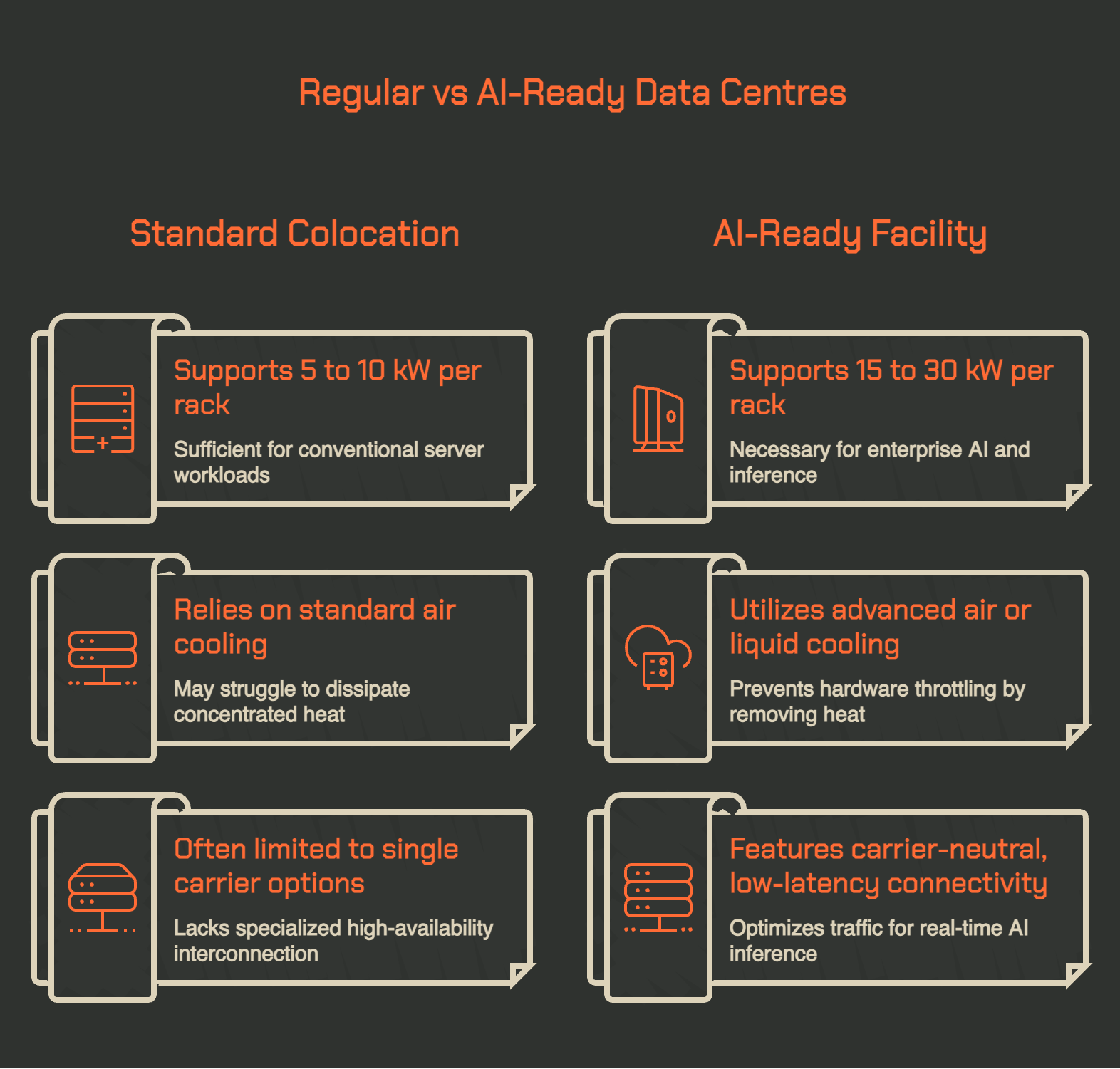
Standard colocation facilities were built around 5 to 10 kW per rack, which was sufficient for conventional server workloads for roughly two decades. Enterprise AI workloads, including inference environments, AI-integrated applications, and high-performance analytics, operate comfortably in the 15 to 30 kW per rack range. That is the relevant threshold for the vast majority of Canadian enterprises deploying AI today.
The upper end of the power density conversation is driven by dedicated GPU training clusters used by hyperscalers and AI model developers. Systems like NVIDIA's GB200 NVL72 draw around 120 kW per rack, and future generations are projected to push even further.
Those are real numbers, but they describe infrastructure built for training frontier AI models at scale, not for running AI workloads across a Canadian enterprise environment. Conflating the two leads organisations to evaluate facilities against requirements they do not actually have.
The key specs to verify when evaluating a facility include:
- Per-Rack Power Capacity: Does the facility support the density your specific workloads require?
- Power Redundancy Configuration: Is power delivered in an N+1 or 2N configuration?
- Utility Capacity and Expandability: Can the facility scale its available power as workloads grow?
- UPS Infrastructure: Are multiple UPS banks in place to protect against supply interruptions?
Cooling Requirements
Cooling is the variable most people underestimate when evaluating AI infrastructure. High-density workloads generate concentrated heat that underpowered cooling environments cannot dissipate efficiently.
When a facility cannot remove heat fast enough, servers throttle their performance to protect hardware, meaning the computing power you are paying for is not fully available.
For enterprise AI density ranges, advanced air cooling with free-air economisation is a proven and effective approach, particularly in Canadian climates where cold ambient temperatures reduce mechanical cooling load for significant portions of the year.
Liquid cooling architectures become more relevant as rack densities climb toward 40 kW and beyond, and facilities planning for those workloads should have a credible path to liquid cooling support. The question to ask any provider is not just what cooling technology they use today, but what their infrastructure can support as hardware generations advance.
Network Latency and Interconnection for AI Inference
AI training workloads are compute-intensive but relatively tolerant of latency. AI inference is not. Serving AI-powered applications to end users requires low-latency connectivity from the data centre to the users it is serving, which means the network architecture of a facility matters as much as its compute environment.
Carrier-neutral facilities that maintain physically isolated interconnect rooms and support connections to multiple network providers give operators the flexibility to route traffic optimally without locking into a single carrier's pricing or performance. For AI inference use cases, the combination of high availability connectivity and direct interconnection between facilities is what separates a high-performance deployment from one that underdelivers at the application layer.
Canada's Structural Advantages for AI Infrastructure
Beyond the current state of the market, Canada has a set of structural characteristics that make it a rational long-term location for AI infrastructure.
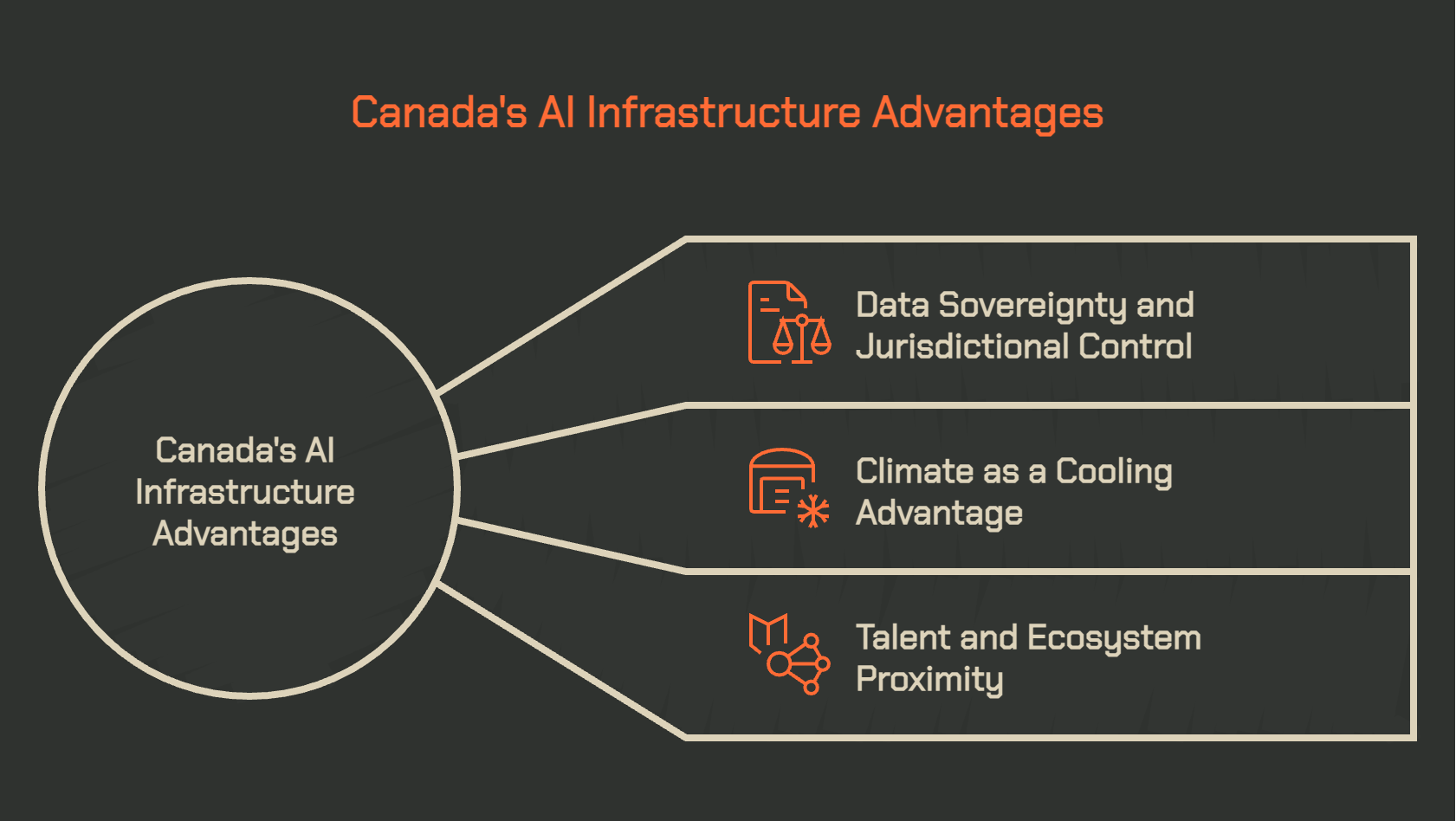
Data Sovereignty and Jurisdictional Control
Storing data in Canada is not the same as having Canadian sovereignty over that data. As the Government of Canada's own white paper on the subject states, as long as a cloud or infrastructure provider operating in Canada is subject to the laws of a foreign country, Canada cannot claim full sovereignty over the data held there.
This is the CLOUD Act problem in plain language. The U.S. Clarifying Lawful Overseas Use of Data Act empowers American authorities to compel U.S.-incorporated companies to provide access to data they control, regardless of where that data is physically stored.
When a senior Microsoft executive was asked under oath before the French Senate in June 2025 whether he could guarantee that data stored in French infrastructure would not be transmitted to American authorities, the answer was no. The same legal reality applies to Canadian data held on U.S.-owned infrastructure.
For Canadian enterprises in financial services, healthcare, and government, this is not a theoretical risk. It is a procurement constraint that is becoming harder to route around as regulatory expectations tighten.
Climate as a Cooling Advantage
Canada's geography means that a significant portion of the country operates in ambient temperatures that allow data centre cooling systems to run in free-air or economiser mode for extended portions of the year.
In Alberta, where much of the AI-specific infrastructure investment is concentrated, the provincial government has explicitly cited the cold climate as a competitive asset for data centre operations.
This does not eliminate cooling costs for AI workloads, which generate heat densities well beyond what ambient air alone can address. It does reduce the mechanical cooling burden during a meaningful portion of the operating year, which has a real impact on total operating cost and infrastructure efficiency at scale.
Talent and Ecosystem Proximity
Canada has one of the strongest AI research ecosystems in the world, anchored by institutions in Toronto, Montreal, Edmonton, and Vancouver. The Vector Institute, Mila, and the Alberta Machine Intelligence Institute represent genuine world-class concentrations of AI talent.
For organisations that need technical expertise close to their infrastructure, particularly for applied AI workloads and model fine-tuning, proximity to this research base is a practical advantage rather than a geographic footnote.
What to Look For in a Canadian AI Data Centre
Assuming you are evaluating facilities and want a practical framework for comparing options, the following criteria separate facilities that are genuinely AI-capable from those that have updated their website copy without upgrading their infrastructure.
Power and Cooling Specs That Matter
The first question to ask any prospective provider is maximum per-rack power density, not average.
Averages obscure the constraint that will limit your deployment. For enterprise AI workloads, including inference, analytics pipelines, and AI-integrated applications, a facility that supports 15 to 30 kW per rack covers the density range that most Canadian enterprise deployments actually require.
Facilities that can push toward 30 kW and beyond give you room to grow as workloads change without needing to re-evaluate your infrastructure partner.
You also want clarity on how the facility handles cooling at the density ranges you are deploying. Advanced air cooling with free-air economisation is effective and proven for enterprise AI density, particularly in Canadian climates where ambient temperatures reduce mechanical cooling load for meaningful portions of the year.
The follow-up question worth asking is whether the facility has a credible path to support higher densities over time, since hardware generations are moving faster than most procurement cycles.
Certifications That Signal Operational Readiness
Certifications are not just compliance paperwork. They are evidence that a facility has been independently verified against specific operational standards. The most meaningful ones to look for when evaluating AI infrastructure include:
- Uptime Institute Tier III Certification: Validates concurrent maintainability, meaning the facility can perform maintenance without taking systems offline. This is the standard that mission-critical AI workloads require.
- SOC 2 Type II: Confirms that security controls have been independently audited over a sustained period, not just at a point in time.
- ISO 27001: The international standard for information security management, relevant for any regulated workload.
- PCI DSS: Required if payment data or financial workloads are part of the deployment.
Facilities that hold multiple independent certifications have been through rigorous third-party evaluation. Ones that list certifications they are "working toward" have not.
Flexibility to Scale Without Starting Over
AI infrastructure requirements do not stay static. Model sizes grow, inference demand scales with adoption, and hardware generations change faster than most procurement cycles. A facility that locks you into a fixed configuration without a credible path to expansion is a constraint that becomes more expensive with every year.
The right question is not just what the facility can deliver on day one, but whether power, cooling, and floor space can grow in parallel with your workloads. Managed services that include capacity planning, OS-level management, and backup and disaster recovery become particularly valuable as deployments grow in complexity, since the operational burden of maintaining AI environments at scale is substantial.
Why Qu Data Centres Supports Canadian AI Workloads
For Canadian enterprises navigating a market where new capacity is being snapped up before it is built and hyperscaler projects dominate the investment headlines, finding an infrastructure partner with available space, purpose-built facilities, and full Canadian sovereignty is harder than it should be. Qu Data Centres is built specifically to fill that gap.
Qu's facilities across Calgary, Edmonton, Ottawa, Toronto, and London, Ontario give organisations the geographic flexibility to run multi-site architectures, support regional latency requirements, and maintain disaster recovery posture across distinct markets.
No other Canadian-owned operator covers all five. Qu's colocation services are backed by 750+ enterprise customers across financial services, healthcare, energy, and government, many of whom have trusted these facilities for over a decade. That operational track record means your AI workloads are running on infrastructure that has been proven under real enterprise loads, not just spec-sheet promises.
Ready to put your AI workloads on infrastructure that is available, sovereign, and purpose-built for enterprise? Schedule a tour of the Qu Data Centres premises today.
Frequently Asked Questions About AI Data Centres in Canada
Does AI Need Data Centres to Function?
Yes. AI models, whether being trained or serving inferences, require substantial compute power that runs on physical hardware housed in data centres. Training large models requires GPU clusters drawing tens of megawatts over weeks or months. Serving those models at scale requires persistent, low-latency infrastructure that simply cannot run on a laptop or a small server room. The compute intensity of AI workloads is what is driving the global data centre build-out.
How Do AI Data Centres Use Water?
Many AI data centres use water as part of their cooling systems, particularly in evaporative cooling towers or direct liquid cooling loops. Water consumption varies significantly by cooling architecture and climate. Facilities in cooler climates can reduce water usage by relying on ambient air for cooling during colder months. Some newer facilities are moving toward closed-loop liquid cooling systems that recirculate water rather than consuming it, reducing total water draw compared to older evaporative designs.
What Does an AI Data Centre Look Like?
Physically, an AI data centre looks similar to a conventional facility but with denser cabling, larger cooling units, and more robust power distribution equipment. The most visible differences are the cooling systems, including liquid cooling infrastructure, rear-door heat exchangers, and in some cases, immersion tanks where servers sit submerged in dielectric fluid. Floor loading is also a consideration, since high-density GPU racks are substantially heavier than standard server racks.
Where Are AI Data Centres Located in Canada?
The primary concentrations of AI-capable data centre infrastructure in Canada are in the Greater Toronto Area, the Greater Calgary Area, Edmonton, Ottawa/Kanata, and Montreal. Alberta has attracted the most new investment announcements due to its AI-specific provincial strategy, while Ontario remains the most mature enterprise market by vacancy rate and carrier density.
How Many AI Data Centres Are There in the World?
There is no single authoritative count, because the definition of an AI data centre varies widely. Canada alone has roughly 309 data centres in operation, of which a smaller subset are genuinely equipped for AI-grade workloads. Globally, thousands of data centres host some level of AI infrastructure, but dedicated, purpose-built AI facilities designed specifically for GPU-intensive workloads represent a much smaller and rapidly growing category.
What Is the Difference Between a Regular Data Centre and an AI Data Centre?
The core difference is power density and cooling architecture. A conventional data centre is designed around 5 to 10 kW per rack. An AI data centre is built to support 40 to 120+ kW per rack, which requires fundamentally different power distribution, cooling, and structural engineering. Beyond hardware specs, AI facilities often require high-speed interconnect fabrics between GPU nodes and low-latency network connectivity to serve inference workloads efficiently.
Is Canadian Data Centre Infrastructure Subject to U.S. Law?
It depends on who owns and operates the facility. Data stored in Canadian facilities owned and operated by U.S.-incorporated companies remains subject to U.S. legal jurisdiction through the CLOUD Act, regardless of physical location. Data held in facilities that are Canadian-owned, Canadian-operated, and have no foreign entity in the ownership chain is governed exclusively by Canadian law. This distinction is the basis of meaningful data sovereignty, as opposed to data residency, which only addresses where data is stored, not who can access it.
Sources Used for This Article
- BetaKit: "Danielle Smith expands ministerial team leading Alberta's $100-billion AI data centre push" - betakit.com/danielle-smith-expands-ministerial-team-leading-albertas-100-billion-ai-data-centre-push/
- Data Center Knowledge: "Canadian Telecom BCE to Build Large Network of AI Data Centers" - datacenterknowledge.com/data-center-construction/canadian-telecom-bce-to-build-large-network-of-ai-data-centers
- Data Center Knowledge: "Canada Emerges as Global Data Center Powerhouse" - datacenterknowledge.com/data-center-site-selection/canada-emerges-as-global-data-center-powerhouse
- CBRE: "North America Data Center Trends H1 2025" - cbre.ca/insights/reports/north-america-data-center-trends-h1-2025
- NVIDIA: "Hardware" - docs.nvidia.com/dgx/dgxgb200-user-guide/hardware.html
- Government of Canada: "Government of Canada White Paper: Data Sovereignty and Public Cloud" - canada.ca/en/government/system/digital-government/digital-government-innovations/cloud-services/gc-white-paper-data-sovereignty-public-cloud.html
- Osler: "Data sovereignty in light of the CLOUD Act: back to the future?" - osler.com/en/insights/updates/data-sovereignty-in-light-of-the-cloud-act-back-to-the-future/
- Forbes: "Microsoft Can't Keep EU Data Safe From US Authorities" - forbes.com/sites/emmawoollacott/2025/07/22/microsoft-cant-keep-eu-data-safe-from-us-authorities/





Quick Answer: Yes, AI data centres exist in Canada and the sector is expanding at a significant pace. An April 2026 investigation by The Logic mapped 309 data centres operating across the country, with purpose-built AI infrastructure concentrated in markets like Calgary, Edmonton, Toronto, and Ottawa. Billions of dollars in new investment are being committed across the country. However, not all data centres are built equally, and the gap between a facility that supports AI workloads and one that is genuinely purpose-built for them is wider than most people realise.
Key Takeaways
AI Data Centre Capacity in Canada: Where Things Stand Today
Canada does have AI data centre infrastructure, and it is growing faster than most people outside the industry expect. That said, the picture is more nuanced than a simple yes. Depending on who is building, where they are building, and who they are building for, the availability and quality of AI-grade colocation in Canada varies considerably by market.
Where AI Infrastructure Exists Right Now
The most active markets for AI-capable data centre infrastructure in Canada are Alberta, Ontario, and Quebec. Alberta launched an aggressive data centre strategy in December 2024 targeting $100 billion in private investment, specifically positioning the province for AI workloads by emphasising its cold climate, natural gas supply, and deregulated electricity market.
Ontario, led by the Greater Toronto Area, remains the most mature enterprise colocation market in the country with established carrier density and the tightest vacancy rates on record. Quebec, particularly Montreal, has long attracted AI investment due to its lower power costs and proximity to university research clusters, though regulatory constraints under Bill 69 have effectively frozen new supply in that market as of mid-2025.
Nationally, Canada has approximately 309 data centres in operation. The number of facilities genuinely equipped for AI-grade workloads is a much smaller subset. That distinction matters, and it is one that gets glossed over in most coverage of the sector.
The Hyperscaler Problem: Built for Them, Not You
Much of the new capacity being announced and built in Canada is hyperscale infrastructure.
Projects like Cohere's Bell AI Fabric, projected to deliver 500 MW at completion, and the federal government's sovereign supercomputing initiative are built to serve researchers, cloud providers, and AI model developers at a scale that most Canadian enterprises will never need or access directly.
This creates a real problem for the VP of Infrastructure or CIO at a mid-market or enterprise organisation. The headline numbers around Canadian AI investment are real, but the capacity being built is mostly pre-sold to hyperscalers or reserved for public compute programmes. The federal 2024 budget committed $2.4 billion toward new computing infrastructure, and that money is flowing toward institutional and hyperscale build-outs, not the enterprise colocation market.
Why Canadian Enterprises Are Getting Left Behind
The colocation market in Canada is tightening fast. The Greater Toronto Area saw vacancy drop to 7.6% in H1 2025 while 223 MW of the 236 MW under construction was already pre-committed, according to CBRE's Toronto market profile. That means the pipeline is effectively spoken for before it comes online.
According to CBRE's North America Data Center Trends H1 2025 report, 74.3% of all capacity under construction across North America was already committed, driven by cloud and AI providers locking in infrastructure ahead of delivery.
The result is a market where Canadian enterprises need AI-ready infrastructure now but are competing against hyperscaler demand for what little capacity exists. The organisations that get left behind are typically the ones that waited too long to evaluate their options, assuming capacity would be readily available when they needed it.
What Makes a Data Centre AI-Ready?
Not every data centre that claims AI capabilities has the infrastructure to back it up. The gap between a standard colocation facility and one that can genuinely support enterprise AI workloads comes down to three variables: power, cooling, and connectivity.
It is also worth being precise about what "AI-ready" actually means in the context of Canadian enterprise deployments, because the goalposts are often set against hyperscale GPU training clusters that most organisations will never need or operate.
Power Density Requirements for AI Workloads
Power density is the biggest difference between traditional and AI-capable infrastructure.
Standard colocation facilities were built around 5 to 10 kW per rack, which was sufficient for conventional server workloads for roughly two decades. Enterprise AI workloads, including inference environments, AI-integrated applications, and high-performance analytics, operate comfortably in the 15 to 30 kW per rack range. That is the relevant threshold for the vast majority of Canadian enterprises deploying AI today.
The upper end of the power density conversation is driven by dedicated GPU training clusters used by hyperscalers and AI model developers. Systems like NVIDIA's GB200 NVL72 draw around 120 kW per rack, and future generations are projected to push even further.
Those are real numbers, but they describe infrastructure built for training frontier AI models at scale, not for running AI workloads across a Canadian enterprise environment. Conflating the two leads organisations to evaluate facilities against requirements they do not actually have.
The key specs to verify when evaluating a facility include:
Cooling Requirements
Cooling is the variable most people underestimate when evaluating AI infrastructure. High-density workloads generate concentrated heat that underpowered cooling environments cannot dissipate efficiently.
When a facility cannot remove heat fast enough, servers throttle their performance to protect hardware, meaning the computing power you are paying for is not fully available.
For enterprise AI density ranges, advanced air cooling with free-air economisation is a proven and effective approach, particularly in Canadian climates where cold ambient temperatures reduce mechanical cooling load for significant portions of the year.
Liquid cooling architectures become more relevant as rack densities climb toward 40 kW and beyond, and facilities planning for those workloads should have a credible path to liquid cooling support. The question to ask any provider is not just what cooling technology they use today, but what their infrastructure can support as hardware generations advance.
Network Latency and Interconnection for AI Inference
AI training workloads are compute-intensive but relatively tolerant of latency. AI inference is not. Serving AI-powered applications to end users requires low-latency connectivity from the data centre to the users it is serving, which means the network architecture of a facility matters as much as its compute environment.
Carrier-neutral facilities that maintain physically isolated interconnect rooms and support connections to multiple network providers give operators the flexibility to route traffic optimally without locking into a single carrier's pricing or performance. For AI inference use cases, the combination of high availability connectivity and direct interconnection between facilities is what separates a high-performance deployment from one that underdelivers at the application layer.
Canada's Structural Advantages for AI Infrastructure
Beyond the current state of the market, Canada has a set of structural characteristics that make it a rational long-term location for AI infrastructure.
Data Sovereignty and Jurisdictional Control
Storing data in Canada is not the same as having Canadian sovereignty over that data. As the Government of Canada's own white paper on the subject states, as long as a cloud or infrastructure provider operating in Canada is subject to the laws of a foreign country, Canada cannot claim full sovereignty over the data held there.
This is the CLOUD Act problem in plain language. The U.S. Clarifying Lawful Overseas Use of Data Act empowers American authorities to compel U.S.-incorporated companies to provide access to data they control, regardless of where that data is physically stored.
When a senior Microsoft executive was asked under oath before the French Senate in June 2025 whether he could guarantee that data stored in French infrastructure would not be transmitted to American authorities, the answer was no. The same legal reality applies to Canadian data held on U.S.-owned infrastructure.
For Canadian enterprises in financial services, healthcare, and government, this is not a theoretical risk. It is a procurement constraint that is becoming harder to route around as regulatory expectations tighten.
Climate as a Cooling Advantage
Canada's geography means that a significant portion of the country operates in ambient temperatures that allow data centre cooling systems to run in free-air or economiser mode for extended portions of the year.
In Alberta, where much of the AI-specific infrastructure investment is concentrated, the provincial government has explicitly cited the cold climate as a competitive asset for data centre operations.
This does not eliminate cooling costs for AI workloads, which generate heat densities well beyond what ambient air alone can address. It does reduce the mechanical cooling burden during a meaningful portion of the operating year, which has a real impact on total operating cost and infrastructure efficiency at scale.
Talent and Ecosystem Proximity
Canada has one of the strongest AI research ecosystems in the world, anchored by institutions in Toronto, Montreal, Edmonton, and Vancouver. The Vector Institute, Mila, and the Alberta Machine Intelligence Institute represent genuine world-class concentrations of AI talent.
For organisations that need technical expertise close to their infrastructure, particularly for applied AI workloads and model fine-tuning, proximity to this research base is a practical advantage rather than a geographic footnote.
What to Look For in a Canadian AI Data Centre
Assuming you are evaluating facilities and want a practical framework for comparing options, the following criteria separate facilities that are genuinely AI-capable from those that have updated their website copy without upgrading their infrastructure.
Power and Cooling Specs That Matter
The first question to ask any prospective provider is maximum per-rack power density, not average.
Averages obscure the constraint that will limit your deployment. For enterprise AI workloads, including inference, analytics pipelines, and AI-integrated applications, a facility that supports 15 to 30 kW per rack covers the density range that most Canadian enterprise deployments actually require.
Facilities that can push toward 30 kW and beyond give you room to grow as workloads change without needing to re-evaluate your infrastructure partner.
You also want clarity on how the facility handles cooling at the density ranges you are deploying. Advanced air cooling with free-air economisation is effective and proven for enterprise AI density, particularly in Canadian climates where ambient temperatures reduce mechanical cooling load for meaningful portions of the year.
The follow-up question worth asking is whether the facility has a credible path to support higher densities over time, since hardware generations are moving faster than most procurement cycles.
Certifications That Signal Operational Readiness
Certifications are not just compliance paperwork. They are evidence that a facility has been independently verified against specific operational standards. The most meaningful ones to look for when evaluating AI infrastructure include:
Facilities that hold multiple independent certifications have been through rigorous third-party evaluation. Ones that list certifications they are "working toward" have not.
Flexibility to Scale Without Starting Over
AI infrastructure requirements do not stay static. Model sizes grow, inference demand scales with adoption, and hardware generations change faster than most procurement cycles. A facility that locks you into a fixed configuration without a credible path to expansion is a constraint that becomes more expensive with every year.
The right question is not just what the facility can deliver on day one, but whether power, cooling, and floor space can grow in parallel with your workloads. Managed services that include capacity planning, OS-level management, and backup and disaster recovery become particularly valuable as deployments grow in complexity, since the operational burden of maintaining AI environments at scale is substantial.
Why Qu Data Centres Supports Canadian AI Workloads
For Canadian enterprises navigating a market where new capacity is being snapped up before it is built and hyperscaler projects dominate the investment headlines, finding an infrastructure partner with available space, purpose-built facilities, and full Canadian sovereignty is harder than it should be. Qu Data Centres is built specifically to fill that gap.
Qu's facilities across Calgary, Edmonton, Ottawa, Toronto, and London, Ontario give organisations the geographic flexibility to run multi-site architectures, support regional latency requirements, and maintain disaster recovery posture across distinct markets.
No other Canadian-owned operator covers all five. Qu's colocation services are backed by 750+ enterprise customers across financial services, healthcare, energy, and government, many of whom have trusted these facilities for over a decade. That operational track record means your AI workloads are running on infrastructure that has been proven under real enterprise loads, not just spec-sheet promises.
Ready to put your AI workloads on infrastructure that is available, sovereign, and purpose-built for enterprise? Schedule a tour of the Qu Data Centres premises today.
Frequently Asked Questions About AI Data Centres in Canada
Does AI Need Data Centres to Function?
Yes. AI models, whether being trained or serving inferences, require substantial compute power that runs on physical hardware housed in data centres. Training large models requires GPU clusters drawing tens of megawatts over weeks or months. Serving those models at scale requires persistent, low-latency infrastructure that simply cannot run on a laptop or a small server room. The compute intensity of AI workloads is what is driving the global data centre build-out.
How Do AI Data Centres Use Water?
Many AI data centres use water as part of their cooling systems, particularly in evaporative cooling towers or direct liquid cooling loops. Water consumption varies significantly by cooling architecture and climate. Facilities in cooler climates can reduce water usage by relying on ambient air for cooling during colder months. Some newer facilities are moving toward closed-loop liquid cooling systems that recirculate water rather than consuming it, reducing total water draw compared to older evaporative designs.
What Does an AI Data Centre Look Like?
Physically, an AI data centre looks similar to a conventional facility but with denser cabling, larger cooling units, and more robust power distribution equipment. The most visible differences are the cooling systems, including liquid cooling infrastructure, rear-door heat exchangers, and in some cases, immersion tanks where servers sit submerged in dielectric fluid. Floor loading is also a consideration, since high-density GPU racks are substantially heavier than standard server racks.
Where Are AI Data Centres Located in Canada?
The primary concentrations of AI-capable data centre infrastructure in Canada are in the Greater Toronto Area, the Greater Calgary Area, Edmonton, Ottawa/Kanata, and Montreal. Alberta has attracted the most new investment announcements due to its AI-specific provincial strategy, while Ontario remains the most mature enterprise market by vacancy rate and carrier density.
How Many AI Data Centres Are There in the World?
There is no single authoritative count, because the definition of an AI data centre varies widely. Canada alone has roughly 309 data centres in operation, of which a smaller subset are genuinely equipped for AI-grade workloads. Globally, thousands of data centres host some level of AI infrastructure, but dedicated, purpose-built AI facilities designed specifically for GPU-intensive workloads represent a much smaller and rapidly growing category.
What Is the Difference Between a Regular Data Centre and an AI Data Centre?
The core difference is power density and cooling architecture. A conventional data centre is designed around 5 to 10 kW per rack. An AI data centre is built to support 40 to 120+ kW per rack, which requires fundamentally different power distribution, cooling, and structural engineering. Beyond hardware specs, AI facilities often require high-speed interconnect fabrics between GPU nodes and low-latency network connectivity to serve inference workloads efficiently.
Is Canadian Data Centre Infrastructure Subject to U.S. Law?
It depends on who owns and operates the facility. Data stored in Canadian facilities owned and operated by U.S.-incorporated companies remains subject to U.S. legal jurisdiction through the CLOUD Act, regardless of physical location. Data held in facilities that are Canadian-owned, Canadian-operated, and have no foreign entity in the ownership chain is governed exclusively by Canadian law. This distinction is the basis of meaningful data sovereignty, as opposed to data residency, which only addresses where data is stored, not who can access it.
Sources Used for This Article
Paul M
Paul Miedzik is Senior Manager of Marketing at Qu Data Centres, with extensive experience in enterprise cloud and digital infrastructure across the Canadian tech sector.