Quick Answer: RTO (Recovery Time Objective) is the maximum time your organisation can afford to be offline after a failure. RPO (Recovery Point Objective) is the maximum amount of data you can afford to lose, expressed as a window of time. Together, these two metrics define the foundation of any disaster recovery strategy. Setting realistic targets depends as much on your infrastructure and regulatory environment as it does on your tolerance for risk.
Key Takeaways
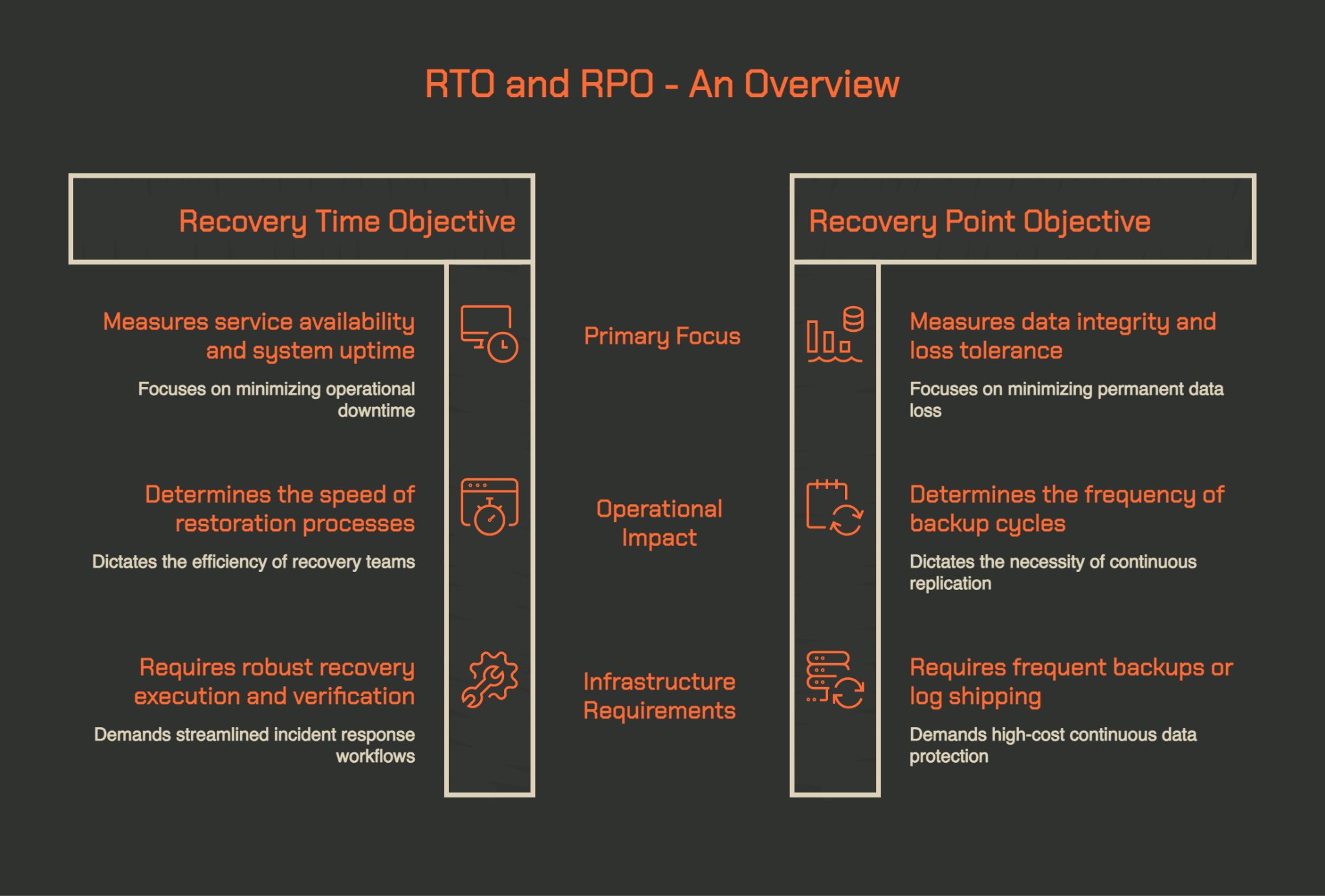
- RTO measures forward from a failure, how quickly systems must be restored. RPO measures backward, how much data you can afford to lose before the last valid backup.
- The difference between RTO and RPO goes beyond definitions: they require separate infrastructure decisions and they don't always scale together or in the same direction.
- Canadian regulations including OSFI B-13 for financial institutions and PHIPA for Ontario healthcare providers set minimum recovery expectations that aren't optional for regulated organisations.
- Tightening recovery targets is not a linear cost exercise. Moving from a four-hour RTO to 30 minutes can cost five to ten times more in infrastructure, which is why tiering workloads by criticality is essential.
- Qu Data Centres provides Canadian enterprises with the colocation, DRaaS, and backup infrastructure to meet recovery targets entirely within Canadian jurisdiction. Book a facility tour to learn more today.
When a system goes down, two numbers tell you how prepared you actually are. The first is how long you can stay offline before the damage becomes unacceptable. The second is how much data you can lose before recovery stops being practical. Most organisations have both of those numbers written down somewhere. Far fewer have stress-tested them against a realistic incident.
Documented recovery target and a tested recovery capability are not the same thing. It's not that organisations lack targets. It's that the targets were set optimistically, documented once, and never validated against the infrastructure that's supposed to meet them. When a ransomware attack or a regional outage actually hits, the plan and reality tend to diverge fast.
The numbers themselves aren't the hard part. Setting them correctly requires a clear view of your workloads, your regulatory obligations, and, most critically, the infrastructure behind them. This article covers both metrics in full: what they measure, how they interact, what your industry's benchmarks look like, and what it takes to build recovery architecture that doesn't fall apart when you need it most.
What RTO and RPO Mean in Disaster Recovery
RTO and RPO are the two core metrics for every disaster recovery plan. They're often listed together, sometimes treated as if they're variations of the same idea, but they measure entirely different things. Getting both right starts with being precise about what each one actually asks.
Recovery Time Objective: How Long Can You Afford to Be Down?
RTO is the maximum acceptable time between a failure and the moment your systems are fully operational again. The clock starts at the moment of failure. Not when it's detected, not when it's escalated, but when the incident actually occurs. An RTO of four hours means your disaster recovery architecture must restore full functionality within four hours, covering detection, diagnosis, recovery execution, and verification.
That's a more demanding window than it sounds.
A real recovery event involves multiple steps that don't run in a clean sequence: assembling a response team, diagnosing the root cause, executing restore procedures, re-establishing network connectivity, and confirming that applications are actually functioning correctly.
Each of those steps takes real time, and most teams run them slowly the first time they operate under genuine pressure.
Recovery Point Objective: How Much Data Loss Can You Accept?
RPO is the maximum amount of data your organisation can afford to lose, expressed as a window of time. It measures backward from the point of failure to the last valid recovery state.
If your RPO is two hours, your backup or replication system must capture data frequently enough that no more than two hours of changes are at risk at any given moment.
This directly shapes your backup architecture. A 24-hour RPO means nightly backups are technically sufficient. A one-hour RPO requires at least hourly backups or continuous log shipping.
A near-zero RPO requires continuous data replication. This is a materially different and significantly more expensive infrastructure decision. RPO isn't just a target; it's a specification that tells you how often your data protection systems need to run, and at what cost.
How RTO and RPO Differ and How They Work Together
The definitions are straightforward, but the relationship between RTO and RPO is a bit more technical than what you might think. They're not always aligned, and treating them as a matched pair leads to better recovery decisions than managing them in isolation.
Two Metrics, Two Different Questions
RTO is a service availability metric. RPO is a data integrity metric. One measures downtime; the other measures data loss. An organisation can meet its RTO, restore systems on schedule, and still fail its RPO if the data that loads into those restored systems is hours out of date. These two outcomes require separate infrastructure and separate validation to prevent.
That difference is fairly important here. Downtime is a temporary state you recover from; data loss can be permanent. A system that comes back online quickly but with stale or incomplete data has technically restored but may not be operationally usable.
When RTO and RPO Pull in Opposite Directions
A corporate intranet may need a short RTO, staff can't work without it, but can tolerate a generous RPO, because the content changes slowly and a day of lost documentation edits is recoverable.
A payment processing platform needs both targets tight: a long RTO means revenue stops, and a loose RPO means transactions are permanently lost.
This is why targets can't be set in the abstract. Every workload has its own cost-of-failure profile, and that profile determines what combination of RTO and RPO is actually appropriate.
Most disaster recovery frameworks also reference a third threshold, the Maximum Tolerable Downtime (MTD), which defines the absolute outer limit beyond which the business cannot survive the disruption at all. RTO must always sit well below that ceiling, which is another reason the business impact analysis comes before the target-setting.
RTO and RPO Benchmarks by Industry
Different industries carry different recovery expectations: some shaped by business model, others by regulation. Here are some realistic working targets based on what the sectors most relevant to Canadian enterprise IT buyers, including the regulatory floors that apply.
Financial Services and Regulated Banking
Canada's federally regulated financial institutions operate under OSFI Guideline B-13, which sets expectations for technology resilience and operational continuity. B-13 doesn't prescribe specific RTO or RPO numbers, but it holds institutions accountable for demonstrating recovery capability through testing and audit evidence. A documented target that has never been drilled is not a defensible target under OSFI scrutiny.
Trading platforms and payment systems in this sector typically target an RTO of 15 to 30 minutes and an RPO approaching zero.
Back-office and reporting systems can generally tolerate longer windows — RTO of four to eight hours, RPO of one to four hours — without triggering immediate regulatory concern. The key compliance distinction is that all targets must be supported by evidence of regular, documented testing.
Healthcare and Patient Records
Ontario's Personal Health Information Protection Act (PHIPA) requires health information custodians to take reasonable steps against the loss or unauthorised access of personal health information. In an active clinical environment, downtime directly affects care delivery, which raises the urgency of both RTO and RPO well above what pure business impact would suggest.
Core clinical systems carry targets of one to two hours for RTO and one to four hours for RPO. Administrative and billing systems can tolerate an RTO of four to eight hours without direct patient impact.
When an RPO target is missed and data is lost, PHIPA also creates notification obligations to affected individuals which adds a compliance and reputational dimension to every data loss event extending well beyond the technical recovery.
For high-volume transactional platforms, downtime carries a direct and calculable cost. According to ITIC's 2024 Hourly Cost of Downtime survey, over 90% of mid-size and large enterprises report that a single hour of downtime now costs more than $300,000. For checkout systems and subscription platforms, that figure makes the business case for tighter recovery targets sharper than most other arguments.
Transaction databases and checkout flows typically target an RTO of 15 to 30 minutes and an RPO of five minutes or less. Product catalogues and content management systems can usually tolerate longer windows. RTO of one to two hours, RPO of four to eight hours, since those systems change more slowly and their loss is recoverable without direct transaction impact.
Government and Public Sector
Citizen-facing services and public portals carry a trust dimension that goes beyond internal SLAs. PIPEDA requires breach notification when personal information is lost or accessed without authorisation, giving public sector RPO failures a mandatory reporting dimension on top of the operational consequences.
Citizen-facing platforms generally target an RTO of two to four hours and an RPO of one to four hours. Internal administrative systems can operate with longer windows, an RTO of eight to 24 hours, without direct public impact. Public sector organisations in Canada also face the expectation that recovery infrastructure remains within Canadian borders, both for data sovereignty reasons and to meet the requirements of applicable provincial privacy legislation.
|
Sector
|
Mission-Critical RTO
|
Mission-Critical RPO
|
Key Regulatory Driver
|
|
Financial Services
|
15–30 min
|
Near-zero (seconds)
|
OSFI B-13
|
|
Healthcare (Clinical)
|
1–2 hours
|
1–4 hours
|
PHIPA
|
|
E-Commerce / SaaS
|
15–30 min
|
5 minutes
|
Revenue / SLA exposure
|
|
Government / Public Sector
|
2–4 hours
|
1–4 hours
|
PIPEDA, provincial law
|
|
Back-Office / Admin
|
4–8 hours
|
4–8 hours
|
Internal SLA
|
|
Archival / Dev / Test
|
24–72 hours
|
24–48 hours
|
Internal SLA
|
How to Set RTO and RPO for Your Organisation
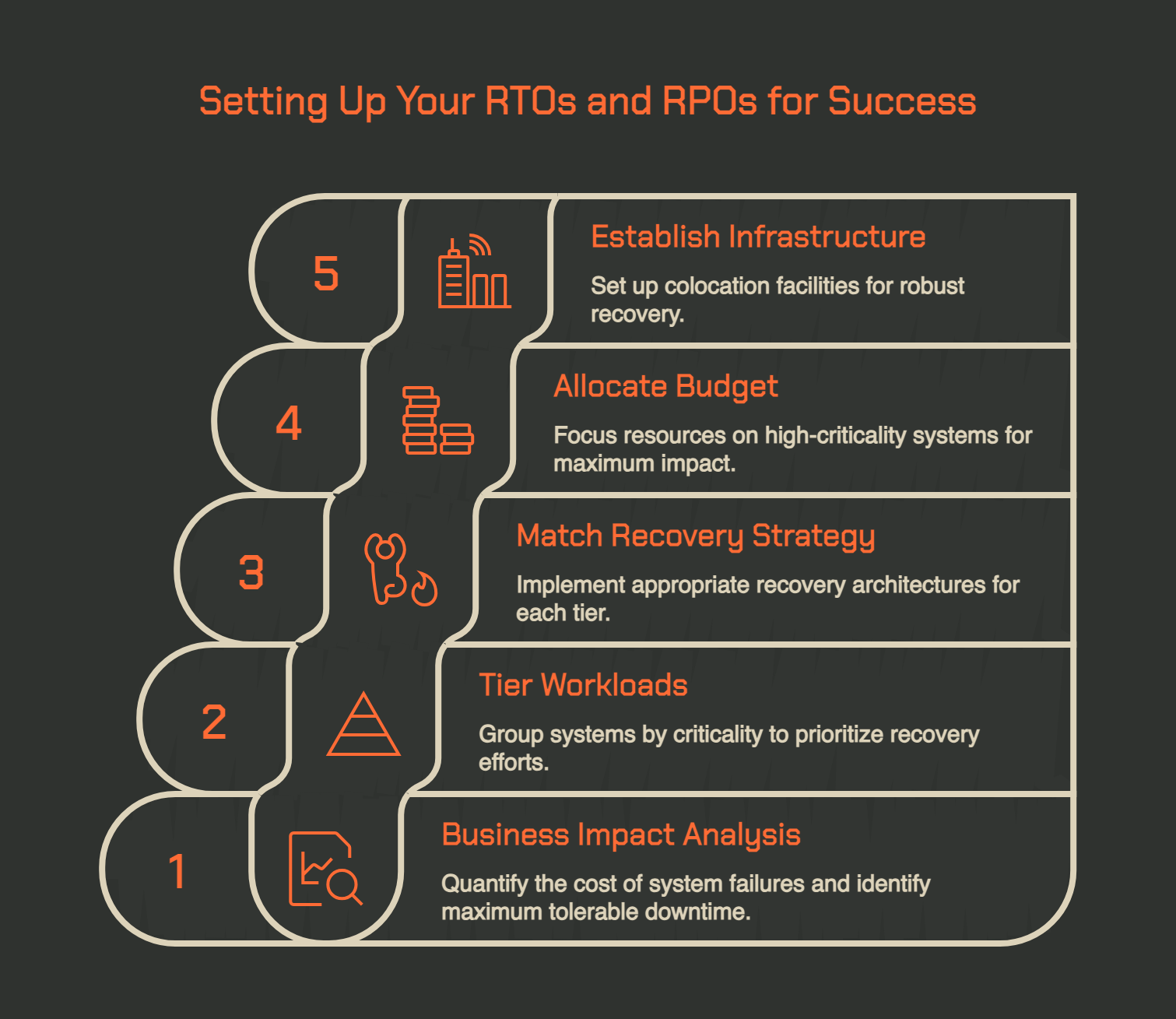
Most disaster recovery documentation begins with picking numbers, which is the wrong starting point. The right approach begins with a business question: what does a failure actually cost, and how long can the business survive it?
The same way a business continuity plan requires buy-in from operations leadership, RTO and RPO targets need to be grounded in real financial and operational impact before they become technical specifications that IT is held to.
Start with a Business Impact Analysis
A Business Impact Analysis (BIA) quantifies the cost of a system failure per unit of time for each workload. That means calculating lost revenue, idle staff costs, SLA penalties, regulatory exposure, and reputational damage in a way that's specific to the workload and not estimated at the organisation level.
A BIA also identifies the Maximum Tolerable Downtime for each system, which sets the hard ceiling that any RTO must fall below.
Business units tend to express urgency in non-technical terms: "we can't be down" or "we can't lose any data." The BIA translates those priorities into time-bounded targets that IT can design to and finance can approve against a real cost model.
Without it, recovery targets are guesses dressed up as specifications and guesses don’t hold up to regulatory scrutiny or an actual incident debrief.
Tier Your Workloads by Criticality
Once BIA data exists for each workload, the next step is grouping systems into tiers that share similar recovery requirements.
Applying the same target to every workload wastes budget on low-criticality systems and under-invests in the ones where recovery speed actually matters. A practical four-tier model for most Canadian enterprises looks like this:
- Tier 1 (Mission-Critical): Revenue-generating, patient-safety, or regulatory-mandated systems. RTO under one hour, RPO under 15 minutes.
- Tier 2 (Business-Essential): Operational systems with indirect revenue or compliance impact. RTO four to eight hours, RPO one to four hours.
- Tier 3 (Internal/Support): Administrative systems, internal tools, analytics platforms. RTO eight to 24 hours, RPO four to 24 hours.
- Tier 4 (Non-Critical): Development environments, test systems, archives. RTO 48 to 72 hours, RPO 24 to 48 hours.
Match Each Tier to a Recovery Strategy
Tiers without matching infrastructure are just labels. Each tier needs a recovery architecture calibrated to the target it's committed to.
- Tier 1 workloads require synchronous or near-synchronous replication, automated failover, and pre-provisioned standby capacity ready to accept traffic within minutes of a failure.
- Tier 2 can be served by DRaaS with asynchronous replication and warm standby.
- Tiers 3 and 4 rely on scheduled backups and cold or offline restore, which is appropriate given how rarely and how slowly those environments change.
The cost profile drops significantly from Tier 1 to Tier 4, which is the financial justification for the whole exercise. Most organisations find that 10 to 15% of their workloads are genuinely Tier 1, and that's where the majority of the DR budget belongs.
Housing those workloads in colocation facilities with dedicated carrier-neutral interconnects and geographic separation from the primary site gives them the physical infrastructure foundation to meet tight targets, without the variable latency and cost structure of cloud-only recovery architectures.
You can see the full range of Qu's locations across Canada to understand how geographic redundancy factors into DR design.
How Qu Data Centres Helps Canadian Enterprises Meet Recovery Targets
Recovery targets are only as strong as the infrastructure designed to meet them. For Canadian enterprises with regulatory obligations under OSFI B-13, PHIPA, or PIPEDA, that infrastructure must remain within Canadian borders, which limits some cloud-based recovery options offered by U.S.-parented providers and fundamentally shapes the architecture decisions from the ground up.
Qu Data Centres operates nine carrier-neutral facilities across Toronto, Ottawa, Calgary, Edmonton, and London, Ontario, giving organisations the geographic redundancy to run Tier 1 and Tier 2 recovery architectures entirely within Canadian jurisdiction. With Zerto-powered DRaaS delivering RTOs in minutes and RPOs in seconds, alongside backup and disaster recovery services built for regulated environments, Qu gives IT leaders a path from documented targets to tested, auditable recovery performance. Backed by 99.999% uptime standards, 15+ carrier networks, and 130+ Canadian employees who have operated these facilities for over two decades, Qu is a partner — not a ticket queue — for organisations that can't afford to find out their DR plan doesn't work during an actual incident.
Book a facility tour and see what Canadian-owned, sovereignty-first infrastructure looks like in practice.
Frequently Asked Questions About RTO and RPO
What Does RTO Stand For?
RTO stands for Recovery Time Objective. It defines the maximum amount of time a system can be offline after a failure before the impact on the business becomes unacceptable. RTO is measured forward from the moment of failure through full system restoration, and it covers detection, response, recovery execution, and verification — not just the technical restore time.
What Does RPO Stand For?
RPO stands for Recovery Point Objective. It defines the maximum amount of data loss an organisation can tolerate, expressed as a time window. RPO is measured backward from the point of failure to the last valid backup or replication snapshot. An RPO of two hours means no more than two hours of data changes should be at risk at any given moment in time.
How Do You Calculate Recovery Time Objective?
Start by running a Business Impact Analysis to quantify the cost of downtime per hour for each workload. Set the maximum loss threshold the business can sustain, in revenue, compliance, and operations, and translate that into a time window. Then conduct a timed end-to-end recovery test, measure actual recovery time against the documented target, and treat the gap as the priority investment area.
What Are the RTO and RPO Requirements for Canadian Regulated Industries?
Canadian regulated industries face mandatory recovery expectations under sector-specific guidance. OSFI B-13 requires federally regulated financial institutions to demonstrate operational resilience and tested recovery capability. PHIPA requires Ontario health information custodians to protect personal health information against loss, with breach notification obligations when data is accessed without authorisation. PIPEDA creates equivalent safeguard requirements for federal private-sector organisations collecting personal information commercially.
Can RTO Be Zero?
Technically yes. A zero RTO means no detectable downtime, requiring active-active infrastructure where traffic shifts to a secondary environment with no interruption and no manual intervention. In practice, this level of architecture is reserved for the highest-criticality workloads, like payment processing or emergency services platforms, where any downtime carries immediate revenue or safety consequences. For most workloads, the infrastructure cost of a near-zero RTO isn't justified by the risk profile.
Sources Used for This Article
OSFI: "Technology and Cyber Risk Management" - osfi-bsif.gc.ca/en/risks/technology-cyber-risk-management
Information and Privacy Commissioner of Ontario: "Your Health Privacy Rights in Ontario" - ipc.on.ca/en/health-individuals/file-a-health-privacy-complaint/your-health-privacy-rights-in-ontario
Office of the Privacy Commissioner of Canada: "PIPEDA Requirements in Brief" - priv.gc.ca/en/privacy-topics/privacy-laws-in-canada/the-personal-information-protection-and-electronic-documents-act-pipeda/pipeda_brief/
ITIC: "ITIC 2024 Hourly Cost of Downtime Report" - itic-corp.com/itic-2024-hourly-cost-of-downtime-report/






Quick Answer: RTO (Recovery Time Objective) is the maximum time your organisation can afford to be offline after a failure. RPO (Recovery Point Objective) is the maximum amount of data you can afford to lose, expressed as a window of time. Together, these two metrics define the foundation of any disaster recovery strategy. Setting realistic targets depends as much on your infrastructure and regulatory environment as it does on your tolerance for risk.
Key Takeaways
When a system goes down, two numbers tell you how prepared you actually are. The first is how long you can stay offline before the damage becomes unacceptable. The second is how much data you can lose before recovery stops being practical. Most organisations have both of those numbers written down somewhere. Far fewer have stress-tested them against a realistic incident.
Documented recovery target and a tested recovery capability are not the same thing. It's not that organisations lack targets. It's that the targets were set optimistically, documented once, and never validated against the infrastructure that's supposed to meet them. When a ransomware attack or a regional outage actually hits, the plan and reality tend to diverge fast.
The numbers themselves aren't the hard part. Setting them correctly requires a clear view of your workloads, your regulatory obligations, and, most critically, the infrastructure behind them. This article covers both metrics in full: what they measure, how they interact, what your industry's benchmarks look like, and what it takes to build recovery architecture that doesn't fall apart when you need it most.
What RTO and RPO Mean in Disaster Recovery
RTO and RPO are the two core metrics for every disaster recovery plan. They're often listed together, sometimes treated as if they're variations of the same idea, but they measure entirely different things. Getting both right starts with being precise about what each one actually asks.
Recovery Time Objective: How Long Can You Afford to Be Down?
RTO is the maximum acceptable time between a failure and the moment your systems are fully operational again. The clock starts at the moment of failure. Not when it's detected, not when it's escalated, but when the incident actually occurs. An RTO of four hours means your disaster recovery architecture must restore full functionality within four hours, covering detection, diagnosis, recovery execution, and verification.
That's a more demanding window than it sounds.
A real recovery event involves multiple steps that don't run in a clean sequence: assembling a response team, diagnosing the root cause, executing restore procedures, re-establishing network connectivity, and confirming that applications are actually functioning correctly.
Each of those steps takes real time, and most teams run them slowly the first time they operate under genuine pressure.
Recovery Point Objective: How Much Data Loss Can You Accept?
RPO is the maximum amount of data your organisation can afford to lose, expressed as a window of time. It measures backward from the point of failure to the last valid recovery state.
If your RPO is two hours, your backup or replication system must capture data frequently enough that no more than two hours of changes are at risk at any given moment.
This directly shapes your backup architecture. A 24-hour RPO means nightly backups are technically sufficient. A one-hour RPO requires at least hourly backups or continuous log shipping.
A near-zero RPO requires continuous data replication. This is a materially different and significantly more expensive infrastructure decision. RPO isn't just a target; it's a specification that tells you how often your data protection systems need to run, and at what cost.
How RTO and RPO Differ and How They Work Together
The definitions are straightforward, but the relationship between RTO and RPO is a bit more technical than what you might think. They're not always aligned, and treating them as a matched pair leads to better recovery decisions than managing them in isolation.
Two Metrics, Two Different Questions
RTO is a service availability metric. RPO is a data integrity metric. One measures downtime; the other measures data loss. An organisation can meet its RTO, restore systems on schedule, and still fail its RPO if the data that loads into those restored systems is hours out of date. These two outcomes require separate infrastructure and separate validation to prevent.
That difference is fairly important here. Downtime is a temporary state you recover from; data loss can be permanent. A system that comes back online quickly but with stale or incomplete data has technically restored but may not be operationally usable.
When RTO and RPO Pull in Opposite Directions
A corporate intranet may need a short RTO, staff can't work without it, but can tolerate a generous RPO, because the content changes slowly and a day of lost documentation edits is recoverable.
A payment processing platform needs both targets tight: a long RTO means revenue stops, and a loose RPO means transactions are permanently lost.
This is why targets can't be set in the abstract. Every workload has its own cost-of-failure profile, and that profile determines what combination of RTO and RPO is actually appropriate.
Most disaster recovery frameworks also reference a third threshold, the Maximum Tolerable Downtime (MTD), which defines the absolute outer limit beyond which the business cannot survive the disruption at all. RTO must always sit well below that ceiling, which is another reason the business impact analysis comes before the target-setting.
RTO and RPO Benchmarks by Industry
Different industries carry different recovery expectations: some shaped by business model, others by regulation. Here are some realistic working targets based on what the sectors most relevant to Canadian enterprise IT buyers, including the regulatory floors that apply.
Financial Services and Regulated Banking
Canada's federally regulated financial institutions operate under OSFI Guideline B-13, which sets expectations for technology resilience and operational continuity. B-13 doesn't prescribe specific RTO or RPO numbers, but it holds institutions accountable for demonstrating recovery capability through testing and audit evidence. A documented target that has never been drilled is not a defensible target under OSFI scrutiny.
Trading platforms and payment systems in this sector typically target an RTO of 15 to 30 minutes and an RPO approaching zero.
Back-office and reporting systems can generally tolerate longer windows — RTO of four to eight hours, RPO of one to four hours — without triggering immediate regulatory concern. The key compliance distinction is that all targets must be supported by evidence of regular, documented testing.
Healthcare and Patient Records
Ontario's Personal Health Information Protection Act (PHIPA) requires health information custodians to take reasonable steps against the loss or unauthorised access of personal health information. In an active clinical environment, downtime directly affects care delivery, which raises the urgency of both RTO and RPO well above what pure business impact would suggest.
Core clinical systems carry targets of one to two hours for RTO and one to four hours for RPO. Administrative and billing systems can tolerate an RTO of four to eight hours without direct patient impact.
When an RPO target is missed and data is lost, PHIPA also creates notification obligations to affected individuals which adds a compliance and reputational dimension to every data loss event extending well beyond the technical recovery.
E-Commerce and SaaS Platforms
For high-volume transactional platforms, downtime carries a direct and calculable cost. According to ITIC's 2024 Hourly Cost of Downtime survey, over 90% of mid-size and large enterprises report that a single hour of downtime now costs more than $300,000. For checkout systems and subscription platforms, that figure makes the business case for tighter recovery targets sharper than most other arguments.
Transaction databases and checkout flows typically target an RTO of 15 to 30 minutes and an RPO of five minutes or less. Product catalogues and content management systems can usually tolerate longer windows. RTO of one to two hours, RPO of four to eight hours, since those systems change more slowly and their loss is recoverable without direct transaction impact.
Government and Public Sector
Citizen-facing services and public portals carry a trust dimension that goes beyond internal SLAs. PIPEDA requires breach notification when personal information is lost or accessed without authorisation, giving public sector RPO failures a mandatory reporting dimension on top of the operational consequences.
Citizen-facing platforms generally target an RTO of two to four hours and an RPO of one to four hours. Internal administrative systems can operate with longer windows, an RTO of eight to 24 hours, without direct public impact. Public sector organisations in Canada also face the expectation that recovery infrastructure remains within Canadian borders, both for data sovereignty reasons and to meet the requirements of applicable provincial privacy legislation.
Sector
Mission-Critical RTO
Mission-Critical RPO
Key Regulatory Driver
Financial Services
15–30 min
Near-zero (seconds)
OSFI B-13
Healthcare (Clinical)
1–2 hours
1–4 hours
PHIPA
E-Commerce / SaaS
15–30 min
5 minutes
Revenue / SLA exposure
Government / Public Sector
2–4 hours
1–4 hours
PIPEDA, provincial law
Back-Office / Admin
4–8 hours
4–8 hours
Internal SLA
Archival / Dev / Test
24–72 hours
24–48 hours
Internal SLA
How to Set RTO and RPO for Your Organisation
Most disaster recovery documentation begins with picking numbers, which is the wrong starting point. The right approach begins with a business question: what does a failure actually cost, and how long can the business survive it?
The same way a business continuity plan requires buy-in from operations leadership, RTO and RPO targets need to be grounded in real financial and operational impact before they become technical specifications that IT is held to.
Start with a Business Impact Analysis
A Business Impact Analysis (BIA) quantifies the cost of a system failure per unit of time for each workload. That means calculating lost revenue, idle staff costs, SLA penalties, regulatory exposure, and reputational damage in a way that's specific to the workload and not estimated at the organisation level.
A BIA also identifies the Maximum Tolerable Downtime for each system, which sets the hard ceiling that any RTO must fall below.
Business units tend to express urgency in non-technical terms: "we can't be down" or "we can't lose any data." The BIA translates those priorities into time-bounded targets that IT can design to and finance can approve against a real cost model.
Without it, recovery targets are guesses dressed up as specifications and guesses don’t hold up to regulatory scrutiny or an actual incident debrief.
Tier Your Workloads by Criticality
Once BIA data exists for each workload, the next step is grouping systems into tiers that share similar recovery requirements.
Applying the same target to every workload wastes budget on low-criticality systems and under-invests in the ones where recovery speed actually matters. A practical four-tier model for most Canadian enterprises looks like this:
Match Each Tier to a Recovery Strategy
Tiers without matching infrastructure are just labels. Each tier needs a recovery architecture calibrated to the target it's committed to.
The cost profile drops significantly from Tier 1 to Tier 4, which is the financial justification for the whole exercise. Most organisations find that 10 to 15% of their workloads are genuinely Tier 1, and that's where the majority of the DR budget belongs.
Housing those workloads in colocation facilities with dedicated carrier-neutral interconnects and geographic separation from the primary site gives them the physical infrastructure foundation to meet tight targets, without the variable latency and cost structure of cloud-only recovery architectures.
You can see the full range of Qu's locations across Canada to understand how geographic redundancy factors into DR design.
How Qu Data Centres Helps Canadian Enterprises Meet Recovery Targets
Recovery targets are only as strong as the infrastructure designed to meet them. For Canadian enterprises with regulatory obligations under OSFI B-13, PHIPA, or PIPEDA, that infrastructure must remain within Canadian borders, which limits some cloud-based recovery options offered by U.S.-parented providers and fundamentally shapes the architecture decisions from the ground up.
Qu Data Centres operates nine carrier-neutral facilities across Toronto, Ottawa, Calgary, Edmonton, and London, Ontario, giving organisations the geographic redundancy to run Tier 1 and Tier 2 recovery architectures entirely within Canadian jurisdiction. With Zerto-powered DRaaS delivering RTOs in minutes and RPOs in seconds, alongside backup and disaster recovery services built for regulated environments, Qu gives IT leaders a path from documented targets to tested, auditable recovery performance. Backed by 99.999% uptime standards, 15+ carrier networks, and 130+ Canadian employees who have operated these facilities for over two decades, Qu is a partner — not a ticket queue — for organisations that can't afford to find out their DR plan doesn't work during an actual incident.
Book a facility tour and see what Canadian-owned, sovereignty-first infrastructure looks like in practice.
Frequently Asked Questions About RTO and RPO
What Does RTO Stand For?
RTO stands for Recovery Time Objective. It defines the maximum amount of time a system can be offline after a failure before the impact on the business becomes unacceptable. RTO is measured forward from the moment of failure through full system restoration, and it covers detection, response, recovery execution, and verification — not just the technical restore time.
What Does RPO Stand For?
RPO stands for Recovery Point Objective. It defines the maximum amount of data loss an organisation can tolerate, expressed as a time window. RPO is measured backward from the point of failure to the last valid backup or replication snapshot. An RPO of two hours means no more than two hours of data changes should be at risk at any given moment in time.
How Do You Calculate Recovery Time Objective?
Start by running a Business Impact Analysis to quantify the cost of downtime per hour for each workload. Set the maximum loss threshold the business can sustain, in revenue, compliance, and operations, and translate that into a time window. Then conduct a timed end-to-end recovery test, measure actual recovery time against the documented target, and treat the gap as the priority investment area.
What Are the RTO and RPO Requirements for Canadian Regulated Industries?
Canadian regulated industries face mandatory recovery expectations under sector-specific guidance. OSFI B-13 requires federally regulated financial institutions to demonstrate operational resilience and tested recovery capability. PHIPA requires Ontario health information custodians to protect personal health information against loss, with breach notification obligations when data is accessed without authorisation. PIPEDA creates equivalent safeguard requirements for federal private-sector organisations collecting personal information commercially.
Can RTO Be Zero?
Technically yes. A zero RTO means no detectable downtime, requiring active-active infrastructure where traffic shifts to a secondary environment with no interruption and no manual intervention. In practice, this level of architecture is reserved for the highest-criticality workloads, like payment processing or emergency services platforms, where any downtime carries immediate revenue or safety consequences. For most workloads, the infrastructure cost of a near-zero RTO isn't justified by the risk profile.
Sources Used for This Article
OSFI: "Technology and Cyber Risk Management" - osfi-bsif.gc.ca/en/risks/technology-cyber-risk-management
Information and Privacy Commissioner of Ontario: "Your Health Privacy Rights in Ontario" - ipc.on.ca/en/health-individuals/file-a-health-privacy-complaint/your-health-privacy-rights-in-ontario
Office of the Privacy Commissioner of Canada: "PIPEDA Requirements in Brief" - priv.gc.ca/en/privacy-topics/privacy-laws-in-canada/the-personal-information-protection-and-electronic-documents-act-pipeda/pipeda_brief/
ITIC: "ITIC 2024 Hourly Cost of Downtime Report" - itic-corp.com/itic-2024-hourly-cost-of-downtime-report/
Paul M
Paul Miedzik is Senior Manager of Marketing at Qu Data Centres, with extensive experience in enterprise cloud and digital infrastructure across the Canadian tech sector.