Quick Answer: A wildfire disaster recovery checklist is a phase-based framework that guides IT teams through pre-season preparation, alert-stage readiness verification, active crisis response, and post-containment restoration. Unlike a cyberattack or hardware failure, wildfires unfold in stages over days or weeks, threatening power continuity, physical access, and regional connectivity at different points in time. An effective checklist treats each phase as a distinct operational scenario with its own triggers and actions.
Key Takeaways
- A wildfire disaster recovery checklist should cover pre-season preparation, fire alert readiness, evacuation response, and post-containment restoration.
- Wildfires differ from standard IT disasters because they unfold over days or weeks, threatening power, access, connectivity, and staffing in phases.
- Pre-season planning should audit RTO and RPO targets, DR site geography, generator fuel autonomy, fire suppression, remote access, and escalation authority.
- During fire alerts, IT teams should verify backups, replication, remote access, DR team availability, provider communications, and critical system baselines.
- Evacuation orders or Public Safety Power Shutoffs should trigger disaster declaration, failover activation, incident logging, vendor communication, and non-essential IT suspension.
- Wildfire-specific risks include smoke contamination, prolonged utility shutoffs, staff displacement, regional correlation risk, and post-event hardware supply chain delays.
- Book a tour to see how Qu Data Centres supports wildfire resilience with cross-regional facilities, redundant power, clean agent suppression, and 24/7 remote hands.
According to Public Safety Canada, the 2023 wildfire season was the worst in Canadian history, burning over 15 million hectares, more than double the previous record. The 2024 season followed with 5,374 wildfires and 5.3 million hectares burned, with Alberta, British Columbia, Saskatchewan, and the Northwest Territories accounting for 70% of the total area. Then 2025 arrived as the second-worst wildfire season nationally on record, displacing more than 85,000 people across the country.
For businesses in Canada, the question is no longer whether wildfires represent a credible operational threat. It is whether your disaster recovery planning treats them like one. Most DR frameworks are designed around ransomware, hardware failure, and flooding. Each of those scenarios has a clear trigger: something fails, you activate a plan, and you begin recovery.
Wildfires do not work that way. Your building may never burn. Your facility may stay completely operational. And yet your team might be unreachable, your utility might cut power proactively, and your on-premises hardware might be quietly accumulating internal smoke damage that does not show up until months later. If your DR plan was not written with those scenarios in mind, it’s another disaster just waiting to happen.
Why Wildfires Are a Different Category of IT Disaster
Most DR frameworks treat disaster as a moment: the point at which something breaks. Wildfires are more accurately described as an extended condition, one that evolves across multiple phases, each with a different risk profile for IT infrastructure. Treating wildfire the same way you would treat a server failure or a ransomware event is commonly overlooked in wildfire preparedness.
The Phased Timeline No Standard DR Plan Accounts For
A wildfire crisis begins well before any structure is threatened. It starts with a fire watch, which escalates to an evacuation alert, then a potential evacuation order, then an active fire, and eventually a post-containment recovery period that can last weeks. At each phase, the IT risk is different.
During a fire watch, your team should be confirming replication currency and verifying remote access. During an evacuation order, you may need to activate failover before any damage has occurred at all. Post-containment, the concern shifts to latent hardware contamination and supply chain delays.
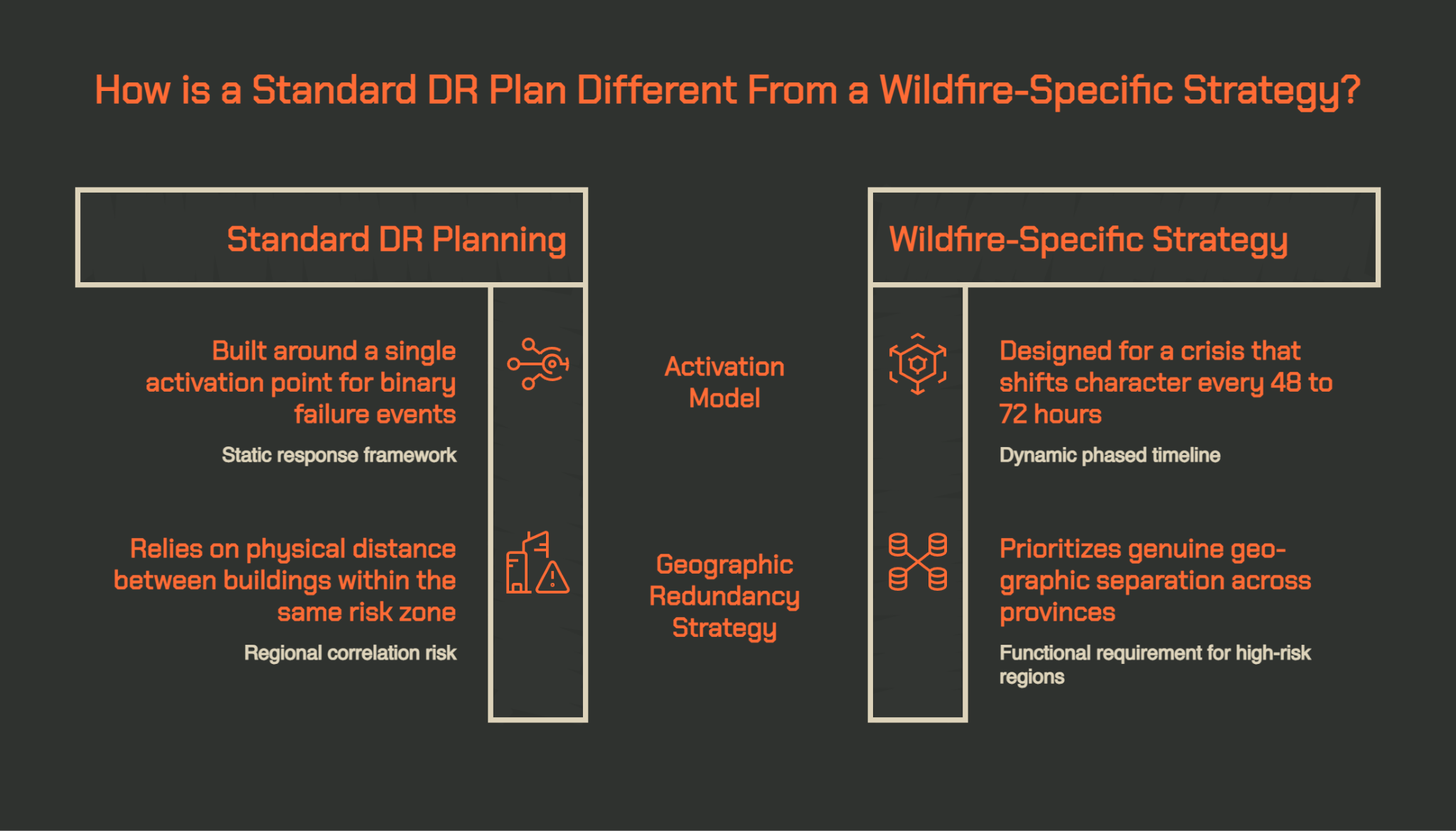
Standard disaster recovery planning is built around a single activation point, which makes sense for binary failure events. For wildfire, that model breaks down because the hazard shape keeps changing. A plan that activates once and then waits for resolution is not equipped for a crisis that shifts character every 48 to 72 hours over a period of weeks.
Regional Correlation Risk and Why Your DR Site's Province Matters
When IT teams talk about geographic redundancy, the conversation usually stops at physical distance between two buildings. What it rarely addresses is whether those two buildings sit in the same risk zone.
If your primary site is in Calgary and your disaster recovery site is in Edmonton, both facilities are in Alberta during a wildfire season that has twice now ranked among the worst in provincial history.
This is what is sometimes called regional correlation risk: the probability that a single large-scale event can affect both your primary and your recovery environment simultaneously.
For wildfires, that risk is not hypothetical.
Western Canada as a region accounted for 70% of the total area burned in 2024, which means in-province redundancy offered little meaningful protection for organisations that relied on it. Choosing a data centre in Canada with genuine geographic separation across provinces is not a premium consideration for high-risk regions. It is a functional requirement.
The Wildfire Disaster Recovery Checklist
This checklist is structured by crisis phase rather than by IT domain. That structure matters because the actions you need to take before a fire watch are categorically different from what you need during an evacuation, and both are different from what follows containment. Wildfire disaster recovery data centre best practices follow the event in sequence.
1. Before Fire Season Begins
Annual pre-season review is the only phase in which you have the time to identify and fix gaps before pressure removes that option. It is also the phase most organisations treat as administrative rather than operational. The actions below form the foundation of effective disaster recovery planning for fire-prone environments.
- RTO and RPO Audit: Re-evaluate your Recovery Time and Recovery Point Objectives against wildfire-specific scenarios. A 24-hour RTO that is acceptable for a ransomware recovery may not be viable if your IT team is displaced under an evacuation order for days at a time.
- DR Site Geography Review: Confirm that your secondary site is outside your primary wildfire risk zone. In-province failover does not constitute genuine geographic separation during a regional fire season.
- Generator and Fuel Autonomy Verification: Confirm that your on-premises generators have sufficient fuel autonomy if the grid is interrupted for several consecutive days via a proactive utility shutoff. Enterprise colocation facilities typically carry 24-plus hours of onsite fuel with priority refuelling agreements in place.
- Data Centre Fire Suppression Systems Review: Verify that any on-premises server infrastructure is protected by a current clean agent suppression system. Professional facilities use gas-based systems such as Novec 1230 or FM-200 that suppress fire without damaging equipment. If your server room relies solely on sprinklers, that is a benchmark worth revisiting.
- Remote Access Infrastructure Test: Confirm that VPN capacity, multi-factor authentication, and remote desktop environments can support a fully distributed team operating for an extended period from locations other than your primary office.
- Staff Escalation Documentation: Document who is authorised to declare disaster status, who activates failover, and what the protocol is if those individuals are themselves under an evacuation order.
2. When a Fire Watch or Alert Is Issued
Most organisations do nothing at this phase. That is a costly error.
A fire watch is the interval during which you still have time to verify readiness, brief your team, and establish a communication baseline before conditions force reactive decision-making.
- Confirm that backup jobs are current and that replication to your DR environment is running on schedule
- Verify that all essential staff have functional remote access and have tested it recently
- Brief your DR team on their roles and confirm their availability over the coming 48 to 72 hours
- Open a communication channel with your backup and disaster recovery provider and your colocation facility to establish mutual awareness of evolving regional conditions
- Document the current state of all critical systems so you have a clean reference point if you need to assess post-event impact
3. During Active Evacuation or Public Safety Power Shutoff
Waiting for fire damage to occur before activating your DR plan is one of the most common and expensive mistakes organisations make during wildfire events. An evacuation order makes facilities physically inaccessible regardless of whether the building is threatened. A Public Safety Power Shutoff can remove grid power from an entire corridor for days.
Neither scenario requires fire damage to constitute a full operational emergency.
- Declare disaster status as soon as physical access or grid power continuity is threatened, not after
- Activate failover to secondary infrastructure and engage high-availability connectivity protocols
- Begin an incident log immediately, documenting every action and every system state change from the moment of activation
- Contact vendors and colocation providers to communicate your activation status and request remote hands support where physical action is needed at your facilities
- Suspend non-essential IT operations to concentrate resources on recovery infrastructure and reduce load during the active phase
4. After Containment and Before You Stand Down
Post-containment is where organisations rush to stand down prematurely, often before they have a complete picture of what the event actually did to their environment. Minimising business disruption following fire damage or smoke exposure requires methodical assessment before returning to primary operations.
- Conduct a physical inspection of all on-premises hardware before reconnecting systems. Internal smoke contamination is not visible to the naked eye and can cause latent failures that appear weeks after the season ends.
- Re-test all critical systems under normal load conditions before disengaging failover and restoring primary operations
- Engage hardware vendors early. Regional disasters create immediate supply chain compression: everyone in the affected zone needs replacement parts at the same time, and lead times extend rapidly.
- Run a structured post-incident review against your DR plan versus your business continuity plan, and document every point where the event exposed a gap the plan did not cover
- Update and re-test your DR plan within 30 days of returning to normal operations rather than deferring it to the next annual cycle
|
Phase
|
Trigger
|
Priority Actions
|
Key Wildfire IT Risk
|
|
Pre-Season
|
Annual planning cycle
|
Audit RTO/RPO, verify DR site geography, test remote access
|
Undetected plan gaps before crisis conditions arrive
|
|
Fire Watch/Alert
|
Regional fire watch issued
|
Confirm backups, brief DR team, open provider communication
|
Delayed activation when conditions deteriorate quickly
|
|
Evacuation/PSPS
|
Evacuation order or utility power shutoff
|
Declare disaster status, activate failover, begin incident log
|
Physical access loss and power interruption before fire damage
|
|
Post-Containment
|
All-clear issued
|
Inspect hardware, engage vendors early, re-test before restoring
|
Smoke contamination and regional supply chain delays
|
Wildfire-Specific IT Risks and Why They Belong on Your DR Checklist
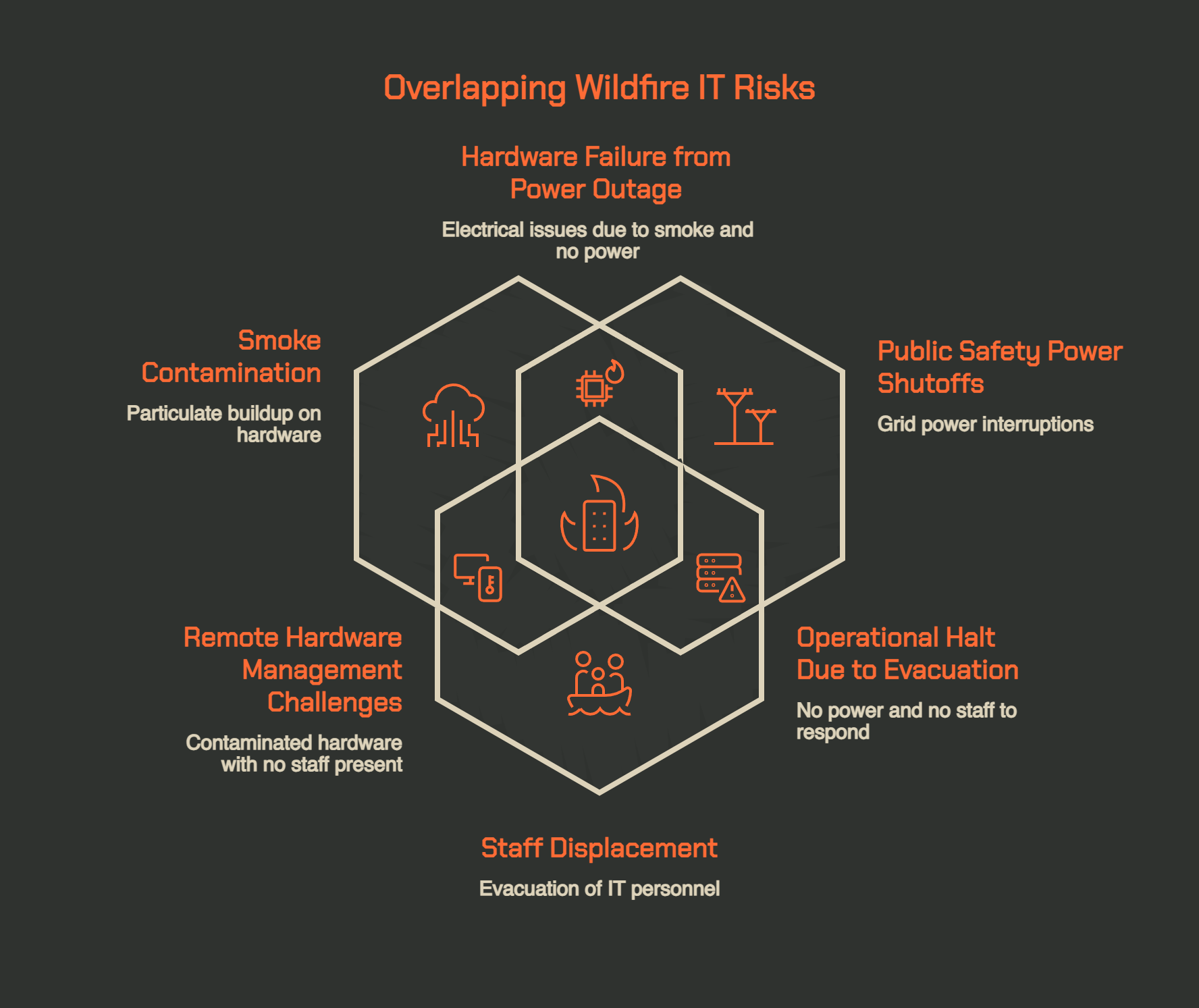
Wildfire events introduce three categories of operational exposure that are structurally different from cyber or hardware failure scenarios, and each of them warrants a dedicated section in any serious DR plan.
Smoke Contamination of On-Premises Hardware
Wildfire smoke travels far in advance of the fire front. It carries fine particulate matter, including PM2.5, that penetrates enclosed spaces and settles on electrical components.
A 2026 review published in Frontiers in Energy Research found that smoke and soot deposits onto insulators and electrical components degrade their insulating properties, increasing the probability of electrical failure in power infrastructure. The same physics apply at the server level.
On-premises hardware draws ambient air through cooling fans continuously. When that air carries wildfire particulates, those particles accumulate on circuit boards, heat sinks, and cooling fins. Hardware that survives a fire season can appear fully operational while quietly accumulating contamination that accelerates component failure over the following months.
Professional colocation data centres are structurally better positioned to manage this risk, operating in sealed, climate-controlled environments with multi-stage filtration rather than server rooms drawing in whatever regional air quality produces.
Public Safety Power Shutoffs and What They Mean for Your Operations
In wildfire-prone regions, electricity utilities proactively interrupt grid power during high-risk weather conditions to prevent their own infrastructure from sparking fires.
These are called Public Safety Power Shutoffs, and they are a deliberate operational decision, not a failure. The difference is important because a PSPS can be issued days before any fire is near a given facility and can remain in effect for several consecutive days.
The same Frontiers in Energy Research review mentioned above documented PSPS events during major North American wildfire seasons that affected millions of utility customers across service areas.
Canada is seeing similar proactive measures from grid operators in high-risk corridors. On-premises infrastructure that relies on grid power with limited UPS and generator backup can experience a full IT outage without any fire damage occurring. Most standard disaster recovery planning frameworks do not model a sustained power event that precedes any confirmed disaster.
Staff Displacement as an Operational Risk Factor
A mandatory evacuation does not affect only facilities. It affects the people who operate and respond to problems in those facilities.
Your on-call network engineers, database administrators, and security operations staff may be under the same evacuation order as the buildings they normally manage. A recovery plan that requires any specific individual to be in a specific location to function has a human single point of failure that no amount of infrastructure redundancy can compensate for.
Standard business continuity and disaster recovery frameworks account for system failure but rarely model a scenario in which the recovery team itself is displaced.
This can be significant when a wildfire season forces evacuations across large urban and industrial corridors in Alberta or British Columbia, which in recent seasons has meant tens of thousands of people displaced simultaneously.
The corrective architecture is documented runbooks that any qualified team member can execute remotely, combined with facilities that offer 24/7 managed remote hands so physical action at your infrastructure does not require your own staff to be present.
How Qu Data Centres Is Built for Wildfire Resilience
When a wildfire watch escalates to an evacuation order, your DR plan is only as strong as the infrastructure supporting it. The checklist matters, but so does where your data lives and who is managing it when your own team cannot reach it.
Our facilities across Calgary, Edmonton, Toronto, and Ottawa each carry N+1 generator infrastructure, onsite fuel for a minimum of 24 hours at full load, and clean agent fire suppression systems throughout.
TOR3 and OTT3 use Novec 1230 suppression with multi-zoned pre-action dry-pipe backup. Our Alberta facilities use FM-200 and dry-pipe pre-action systems with VESDA early warning detection that identifies smoke before a fire develops. Every facility is carrier-neutral with physically isolated interconnect rooms and diverse carrier paths, so no single regional network disruption takes down connectivity.
Our managed services team and 24/7 remote hands capability mean that even when your engineers are under an evacuation order, your infrastructure can still be acted on.
Whether you need to evaluate your current DR posture, architect a cross-regional failover environment, or assess disaster recovery as a service, we can help. Book a tour to learn more today.
Frequently Asked Questions About Wildfire Disaster Recovery
What Is a Wildfire Disaster Recovery Plan?
A wildfire disaster recovery plan is a phase-structured document guiding IT operations through each stage of a wildfire event, from pre-season preparation through post-containment restoration. Unlike a standard DR plan, it treats fire watches, evacuation orders, and utility power shutoffs as distinct triggers with distinct responses rather than a single activation point. The goal is operational continuity across an extended, evolving crisis rather than a binary on/off recovery event.
How Is Wildfire DR Different from a Standard IT DR Plan?
Standard DR plans are built around single-event triggers such as ransomware, hardware failure, or flooding. Wildfire events unfold in stages across days or weeks, and the primary IT risks such as proactive power shutoffs, smoke contamination, physical access loss, and staff displacement can all occur without any direct fire damage to infrastructure. A wildfire DR plan requires staged response protocols and phase-specific action triggers rather than a single activation decision.
What Is a Public Safety Power Shutoff and How Does It Affect IT Infrastructure?
A Public Safety Power Shutoff is a planned grid interruption by a utility operator to reduce wildfire ignition risk during extreme weather conditions. PSPS events can affect areas that never face any direct fire threat, cutting power for several consecutive days. On-premises infrastructure without sufficient generator autonomy can experience a full outage as a result. PSPS is a major wildfire-adjacent DR trigger that most standard planning frameworks do not model separately from fire damage scenarios.
How Does Colocation Help with Wildfire Disaster Recovery?
A professional colocation facility offers independent power redundancy, clean agent fire suppression, sealed and filtered cooling environments, and carrier-neutral connectivity, all of which reduce the operational impact of regional wildfire conditions. When the colocation provider operates facilities across multiple provinces, organisations can establish DR environments in a genuinely different risk zone from their primary site, addressing the regional correlation risk that in-province redundancy cannot resolve.
Yes. Wildfire smoke carries fine particulates that travel ahead of the fire front and enter on-premises server environments through cooling systems. These particles settle on circuit boards, cooling fins, and electrical components, causing accelerated corrosion and insulation degradation that leads to latent failures weeks or months after the fire season ends.
Sources Used for This Article
- Public Safety Canada: "Parliamentary Committee Notes: Canadian Wildfires" - publicsafety.gc.ca/cnt/trnsprnc/brfng-mtrls/prlmntry-bndrs/20250130/04-en.aspx
- Government of British Columbia: "B.C. hosting national wildfire symposium" - news.gov.bc.ca/releases/2025FOR0055-001162
- Frontiers in Energy Research: "Wildfire and smoke effects on power transmission and distribution systems safety: an analytical review" - frontiersin.org/journals/energy-research/articles/10.3389/fenrg.2026.1759856/full





Quick Answer: A wildfire disaster recovery checklist is a phase-based framework that guides IT teams through pre-season preparation, alert-stage readiness verification, active crisis response, and post-containment restoration. Unlike a cyberattack or hardware failure, wildfires unfold in stages over days or weeks, threatening power continuity, physical access, and regional connectivity at different points in time. An effective checklist treats each phase as a distinct operational scenario with its own triggers and actions.
Key Takeaways
According to Public Safety Canada, the 2023 wildfire season was the worst in Canadian history, burning over 15 million hectares, more than double the previous record. The 2024 season followed with 5,374 wildfires and 5.3 million hectares burned, with Alberta, British Columbia, Saskatchewan, and the Northwest Territories accounting for 70% of the total area. Then 2025 arrived as the second-worst wildfire season nationally on record, displacing more than 85,000 people across the country.
For businesses in Canada, the question is no longer whether wildfires represent a credible operational threat. It is whether your disaster recovery planning treats them like one. Most DR frameworks are designed around ransomware, hardware failure, and flooding. Each of those scenarios has a clear trigger: something fails, you activate a plan, and you begin recovery.
Wildfires do not work that way. Your building may never burn. Your facility may stay completely operational. And yet your team might be unreachable, your utility might cut power proactively, and your on-premises hardware might be quietly accumulating internal smoke damage that does not show up until months later. If your DR plan was not written with those scenarios in mind, it’s another disaster just waiting to happen.
Why Wildfires Are a Different Category of IT Disaster
Most DR frameworks treat disaster as a moment: the point at which something breaks. Wildfires are more accurately described as an extended condition, one that evolves across multiple phases, each with a different risk profile for IT infrastructure. Treating wildfire the same way you would treat a server failure or a ransomware event is commonly overlooked in wildfire preparedness.
The Phased Timeline No Standard DR Plan Accounts For
A wildfire crisis begins well before any structure is threatened. It starts with a fire watch, which escalates to an evacuation alert, then a potential evacuation order, then an active fire, and eventually a post-containment recovery period that can last weeks. At each phase, the IT risk is different.
During a fire watch, your team should be confirming replication currency and verifying remote access. During an evacuation order, you may need to activate failover before any damage has occurred at all. Post-containment, the concern shifts to latent hardware contamination and supply chain delays.
Standard disaster recovery planning is built around a single activation point, which makes sense for binary failure events. For wildfire, that model breaks down because the hazard shape keeps changing. A plan that activates once and then waits for resolution is not equipped for a crisis that shifts character every 48 to 72 hours over a period of weeks.
Regional Correlation Risk and Why Your DR Site's Province Matters
When IT teams talk about geographic redundancy, the conversation usually stops at physical distance between two buildings. What it rarely addresses is whether those two buildings sit in the same risk zone.
If your primary site is in Calgary and your disaster recovery site is in Edmonton, both facilities are in Alberta during a wildfire season that has twice now ranked among the worst in provincial history.
This is what is sometimes called regional correlation risk: the probability that a single large-scale event can affect both your primary and your recovery environment simultaneously.
For wildfires, that risk is not hypothetical.
Western Canada as a region accounted for 70% of the total area burned in 2024, which means in-province redundancy offered little meaningful protection for organisations that relied on it. Choosing a data centre in Canada with genuine geographic separation across provinces is not a premium consideration for high-risk regions. It is a functional requirement.
The Wildfire Disaster Recovery Checklist
This checklist is structured by crisis phase rather than by IT domain. That structure matters because the actions you need to take before a fire watch are categorically different from what you need during an evacuation, and both are different from what follows containment. Wildfire disaster recovery data centre best practices follow the event in sequence.
1. Before Fire Season Begins
Annual pre-season review is the only phase in which you have the time to identify and fix gaps before pressure removes that option. It is also the phase most organisations treat as administrative rather than operational. The actions below form the foundation of effective disaster recovery planning for fire-prone environments.
2. When a Fire Watch or Alert Is Issued
Most organisations do nothing at this phase. That is a costly error.
A fire watch is the interval during which you still have time to verify readiness, brief your team, and establish a communication baseline before conditions force reactive decision-making.
3. During Active Evacuation or Public Safety Power Shutoff
Waiting for fire damage to occur before activating your DR plan is one of the most common and expensive mistakes organisations make during wildfire events. An evacuation order makes facilities physically inaccessible regardless of whether the building is threatened. A Public Safety Power Shutoff can remove grid power from an entire corridor for days.
Neither scenario requires fire damage to constitute a full operational emergency.
4. After Containment and Before You Stand Down
Post-containment is where organisations rush to stand down prematurely, often before they have a complete picture of what the event actually did to their environment. Minimising business disruption following fire damage or smoke exposure requires methodical assessment before returning to primary operations.
Phase
Trigger
Priority Actions
Key Wildfire IT Risk
Pre-Season
Annual planning cycle
Audit RTO/RPO, verify DR site geography, test remote access
Undetected plan gaps before crisis conditions arrive
Fire Watch/Alert
Regional fire watch issued
Confirm backups, brief DR team, open provider communication
Delayed activation when conditions deteriorate quickly
Evacuation/PSPS
Evacuation order or utility power shutoff
Declare disaster status, activate failover, begin incident log
Physical access loss and power interruption before fire damage
Post-Containment
All-clear issued
Inspect hardware, engage vendors early, re-test before restoring
Smoke contamination and regional supply chain delays
Wildfire-Specific IT Risks and Why They Belong on Your DR Checklist
Wildfire events introduce three categories of operational exposure that are structurally different from cyber or hardware failure scenarios, and each of them warrants a dedicated section in any serious DR plan.
Smoke Contamination of On-Premises Hardware
Wildfire smoke travels far in advance of the fire front. It carries fine particulate matter, including PM2.5, that penetrates enclosed spaces and settles on electrical components.
A 2026 review published in Frontiers in Energy Research found that smoke and soot deposits onto insulators and electrical components degrade their insulating properties, increasing the probability of electrical failure in power infrastructure. The same physics apply at the server level.
On-premises hardware draws ambient air through cooling fans continuously. When that air carries wildfire particulates, those particles accumulate on circuit boards, heat sinks, and cooling fins. Hardware that survives a fire season can appear fully operational while quietly accumulating contamination that accelerates component failure over the following months.
Professional colocation data centres are structurally better positioned to manage this risk, operating in sealed, climate-controlled environments with multi-stage filtration rather than server rooms drawing in whatever regional air quality produces.
Public Safety Power Shutoffs and What They Mean for Your Operations
In wildfire-prone regions, electricity utilities proactively interrupt grid power during high-risk weather conditions to prevent their own infrastructure from sparking fires.
These are called Public Safety Power Shutoffs, and they are a deliberate operational decision, not a failure. The difference is important because a PSPS can be issued days before any fire is near a given facility and can remain in effect for several consecutive days.
The same Frontiers in Energy Research review mentioned above documented PSPS events during major North American wildfire seasons that affected millions of utility customers across service areas.
Canada is seeing similar proactive measures from grid operators in high-risk corridors. On-premises infrastructure that relies on grid power with limited UPS and generator backup can experience a full IT outage without any fire damage occurring. Most standard disaster recovery planning frameworks do not model a sustained power event that precedes any confirmed disaster.
Staff Displacement as an Operational Risk Factor
A mandatory evacuation does not affect only facilities. It affects the people who operate and respond to problems in those facilities.
Your on-call network engineers, database administrators, and security operations staff may be under the same evacuation order as the buildings they normally manage. A recovery plan that requires any specific individual to be in a specific location to function has a human single point of failure that no amount of infrastructure redundancy can compensate for.
Standard business continuity and disaster recovery frameworks account for system failure but rarely model a scenario in which the recovery team itself is displaced.
This can be significant when a wildfire season forces evacuations across large urban and industrial corridors in Alberta or British Columbia, which in recent seasons has meant tens of thousands of people displaced simultaneously.
The corrective architecture is documented runbooks that any qualified team member can execute remotely, combined with facilities that offer 24/7 managed remote hands so physical action at your infrastructure does not require your own staff to be present.
How Qu Data Centres Is Built for Wildfire Resilience
When a wildfire watch escalates to an evacuation order, your DR plan is only as strong as the infrastructure supporting it. The checklist matters, but so does where your data lives and who is managing it when your own team cannot reach it.
Our facilities across Calgary, Edmonton, Toronto, and Ottawa each carry N+1 generator infrastructure, onsite fuel for a minimum of 24 hours at full load, and clean agent fire suppression systems throughout.
TOR3 and OTT3 use Novec 1230 suppression with multi-zoned pre-action dry-pipe backup. Our Alberta facilities use FM-200 and dry-pipe pre-action systems with VESDA early warning detection that identifies smoke before a fire develops. Every facility is carrier-neutral with physically isolated interconnect rooms and diverse carrier paths, so no single regional network disruption takes down connectivity.
Our managed services team and 24/7 remote hands capability mean that even when your engineers are under an evacuation order, your infrastructure can still be acted on.
Whether you need to evaluate your current DR posture, architect a cross-regional failover environment, or assess disaster recovery as a service, we can help. Book a tour to learn more today.
Frequently Asked Questions About Wildfire Disaster Recovery
What Is a Wildfire Disaster Recovery Plan?
A wildfire disaster recovery plan is a phase-structured document guiding IT operations through each stage of a wildfire event, from pre-season preparation through post-containment restoration. Unlike a standard DR plan, it treats fire watches, evacuation orders, and utility power shutoffs as distinct triggers with distinct responses rather than a single activation point. The goal is operational continuity across an extended, evolving crisis rather than a binary on/off recovery event.
How Is Wildfire DR Different from a Standard IT DR Plan?
Standard DR plans are built around single-event triggers such as ransomware, hardware failure, or flooding. Wildfire events unfold in stages across days or weeks, and the primary IT risks such as proactive power shutoffs, smoke contamination, physical access loss, and staff displacement can all occur without any direct fire damage to infrastructure. A wildfire DR plan requires staged response protocols and phase-specific action triggers rather than a single activation decision.
What Is a Public Safety Power Shutoff and How Does It Affect IT Infrastructure?
A Public Safety Power Shutoff is a planned grid interruption by a utility operator to reduce wildfire ignition risk during extreme weather conditions. PSPS events can affect areas that never face any direct fire threat, cutting power for several consecutive days. On-premises infrastructure without sufficient generator autonomy can experience a full outage as a result. PSPS is a major wildfire-adjacent DR trigger that most standard planning frameworks do not model separately from fire damage scenarios.
How Does Colocation Help with Wildfire Disaster Recovery?
A professional colocation facility offers independent power redundancy, clean agent fire suppression, sealed and filtered cooling environments, and carrier-neutral connectivity, all of which reduce the operational impact of regional wildfire conditions. When the colocation provider operates facilities across multiple provinces, organisations can establish DR environments in a genuinely different risk zone from their primary site, addressing the regional correlation risk that in-province redundancy cannot resolve.
Can Wildfire Smoke Damage IT Hardware Without Direct Fire Contact?
Yes. Wildfire smoke carries fine particulates that travel ahead of the fire front and enter on-premises server environments through cooling systems. These particles settle on circuit boards, cooling fins, and electrical components, causing accelerated corrosion and insulation degradation that leads to latent failures weeks or months after the fire season ends.
Sources Used for This Article
Paul M
Paul Miedzik is Senior Manager of Marketing at Qu Data Centres, with extensive experience in enterprise cloud and digital infrastructure across the Canadian tech sector.